


Tesfaye Gebrewold: How a Hidden Stroke Led to a Fatal PE
Tesfaye Gebrewold, Assistant Professor of Forensic Medicine and Toxicology at Hawassa University, College of Medicine and Health Science, shared a post on LinkedIn:
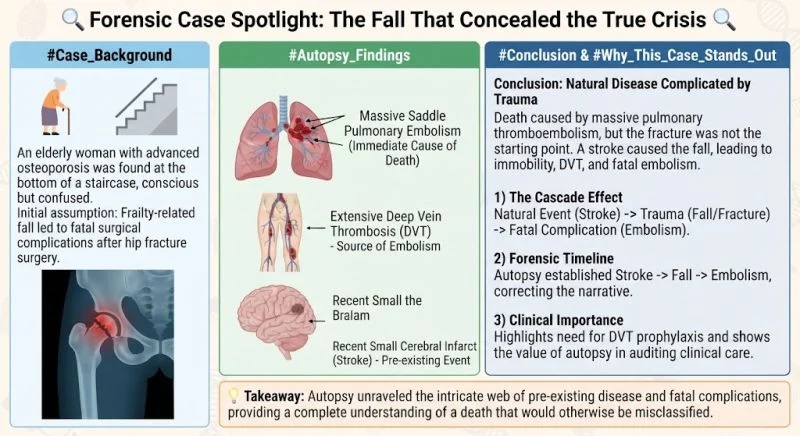
“Forensic Case Spotlight: The Fall That Concealed the True Crisis
Case background:
An elderly woman with advanced osteoporosis was found at the bottom of a staircase, conscious but confused and in pain.
X-rays confirmed a severe hip fracture. She underwent surgery but deteriorated rapidly, becoming hypotensive and febrile, and died 36 hours later.
The initial assumption was that a fall due to frailty led to fatal surgical complications.
Autopsy findings:
- External exam: Confirmed the recent surgical repair of a fractured femoral neck.
- Internal exam:
- Lungs: Both pulmonary arteries were massively obstructed by large, fresh blood clots (saddle pulmonary embolism). This was the immediate cause of death.
- Source: The deep veins of the pelvis and the leg opposite the fracture were riddled with extensive deep vein thrombosis (DVT).
- Brain: A small, recent infarct (area of dead tissue) was discovered in the right cerebral hemisphere. This was evidence of a stroke that had occurred prior to the fall.
Conclusion: Natural Disease Complicated by Trauma
Death was caused by a massive pulmonary thromboembolism, a natural complication of immobility from a hip fracture.
But the autopsy showed the fracture wasn’t the starting point.
A small stroke likely caused a sudden fall, and the resulting fracture triggered immobility and hypercoagulability, leading to fatal embolism.
Why This Case Stands Out?
- The Cascade Effect: A natural event (stroke) – trauma (fall or fracture) – fatal complication (embolism).
- Forensic Timeline: Autopsy established stroke first, fall second, embolism last changing the narrative from a simple fall to a complex medical sequence.
- Clinical Importance: Underscores the need for DVT prophylaxis in elderly, immobile patients and proves the value of autopsy in auditing clinical care.
Takeaway: A fall is often not just a simple accident.
Autopsy can unravel the intricate web of pre-existing disease, sentinel events, and fatal complications, providing a complete understanding of a death that would otherwise be misclassified.”
Stay updated with Hemostasis Today.
-
Oct 10, 2026, 17:58Archo Farzana Batool: Exploring Medical Writing Through an Article on Iron Deficiency Anemia
-
Oct 10, 2026, 17:53Assessing Frailty in Adults With Hemophilia – JTH
-
Oct 10, 2026, 17:52Fatma Sadeghi: Reducing Maternal Health Inequalities Through Nursing Advocacy
-
Oct 10, 2026, 17:50Grzegorz Hensler: How Apheresis Transformed Blood Cell Separation and Collection
-
Oct 10, 2026, 17:47Hemant K Sharma: Japan’s Universal Artificial Blood Research – A Potential Breakthrough in Transfusion Medicine
-
Oct 10, 2026, 17:40John Strouse: Learning About Bleeding Disorders and Sickle Cell Disease at FWGBD
-
Oct 10, 2026, 17:34Mae Caime: Speaking at the Annual Women’s Retreat for the Hemophilia Community in Florida
-
Oct 10, 2026, 17:30Chokri Ben Lamine: PNH beyond the Textbook Triad
-
Oct 10, 2026, 17:29Ruah Alyamany: Thrombosis and Anticoagulation in Hematological Malignancies at SOHO KSA 2026