

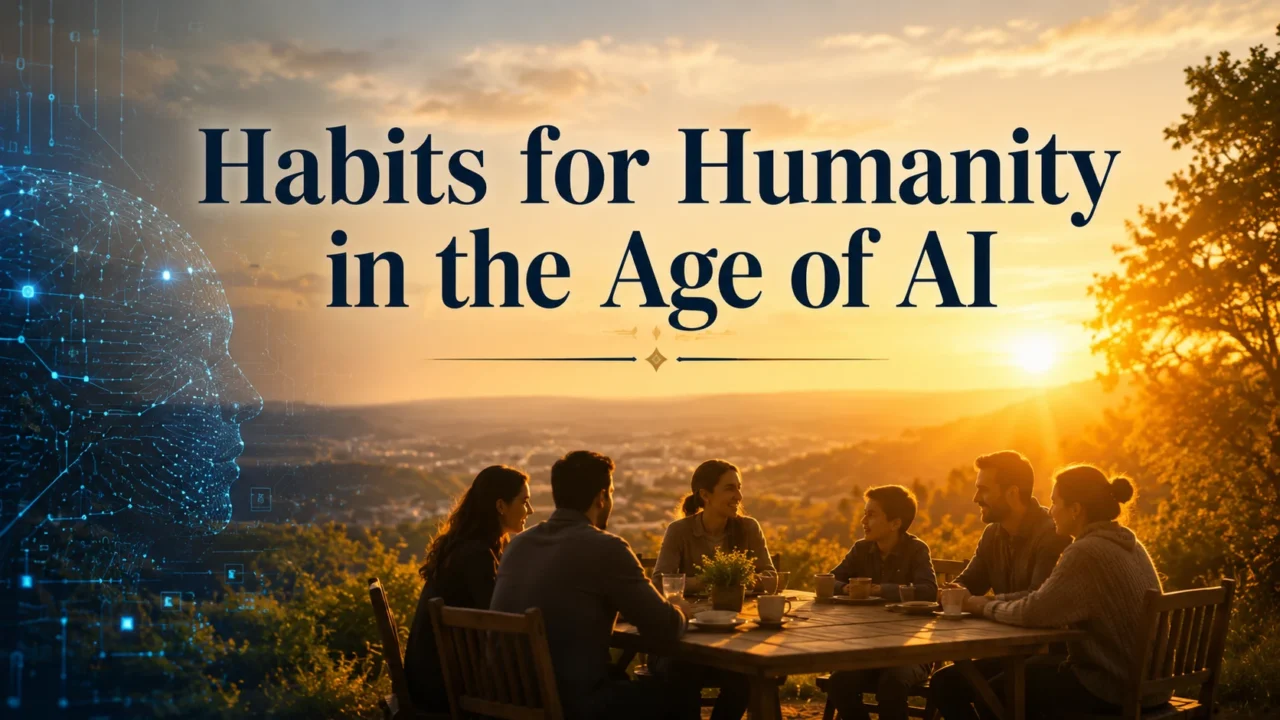
Thomas Rocco: Humanity in the Age of AI
Thomas Rocco, Clinical Professor Emeritus of Medicine at University of Rochester Medical Center, shared a post on LinkedIn:
” ‘We are in a civilization-warping crisis of institutional decline.
The consequences are all around us’
Ben Sasse’s commentary, ‘Habits for Humanity in the Age of AI,’ published in WSJ, explores the existential and societal challenges posed by the rapid advancement of artificial intelligence.
Drawing from his background in history, higher education and politics, as well as his recent personal health battles with pancreatic cancer,
Sasse argues that as AI begins to automate cognitive tasks and disrupt traditional labor markets, the most vital ‘habits’ for the future will be those that reinforce our distinct humanity.
He emphasizes several key themes
1. The Shift from Information to Wisdom:
Sasse posits that in an era where AI can synthesize data and generate content instantly, the mere accumulation of information is no longer a competitive or fulfilling pursuit.
Instead, he emphasizes the need for humans to cultivate deep literacy, critical thinking, and the ability to discern truth – habits that require active mental effort rather than passive consumption.
2. The Necessity of Physical Presence:
He warns against the ‘loneliness epidemic’ exacerbated by digital life. As AI-interfaces become more convincing, Sasse advocates for intentional habits of ‘incarnational’ living—prioritizing face-to-face community, shared physical labor, and local civic engagement that technology cannot replicate.
This is the practice of being fully ’embodied’ and physically present in the world.
An ‘attentive presence’ that includes
Face-to-face conversations over text or email.
Physical touch, eye contact, and shared silence.
The ‘messiness’ of being physically available to others in their time of need.
3. Redeeming Time:
Sasse reflects on the concept of ‘redeeming the time,’ a theme he has discussed in light of his stage 4 pancreatic cancer diagnosis.
He suggests that AI should be used to offload the ‘drudgery’ of life to free up time for what truly matters: family, faith, and service to neighbors.
4. Counter-Cultural Discipline:
He recommends personal disciplines to resist the ‘attention economy,’ such as setting strict boundaries on device usage (e.g., ‘no-tech’ dinners) and engaging in hobbies that provide a sense of agency and tangible accomplishment.
4. Agency vs. Fatalism:
While acknowledging that many feel paralyzed or reactive in the face of AI-driven layoffs and change, Sasse encourages a shift toward ‘realistic optimism.’
He argues that while we cannot control technological shifts, we can control our habits of heart and mind, which ultimately determine our resilience.
Ultimately, Sasse’s message is that the ‘Age of AI’ is not just a technological revolution, but a moral one.
We must ensure that as machines become more ‘intelligent,’ humans do not become more machine-like, but instead double down on the relationships and virtues that make life meaningful.”
Stay updated with Hemostasis Today.
-
Sep 28, 2026, 16:24Pankti Solanki: ISBT Recognized JAMA as the 49th Human Blood Group System
-
Sep 28, 2026, 15:52Kassa Tameru: Antithrombotic Management in GI Bleeding and Elective Endoscopy
-
Sep 28, 2026, 15:51Chengappa Kavadichanda: How Do aPLs Change Over Time in Early Lupus?
-
Sep 28, 2026, 15:18Linda Shore-Lesserson: Celebrating 25 Years of PBM at the SABM Meeting
-
Sep 28, 2026, 14:45Access Real-Time Bleeding Disorder Guidelines with the New WFH Resource Hub – WFH
-
Sep 28, 2026, 14:44Subham Banerjee: When Routine Blood Grouping Hid a Rare Diagnosis
-
Sep 28, 2026, 14:41Francois Roubille: Can Low-Dose Colchicine Prevent Atrial Fibrillation After CABG?
-
Sep 28, 2026, 14:39William Aird: Gulliver’s Atlas – Mapping the Evolution of the Vertebrate Red Cell
-
Sep 28, 2026, 14:30Rafael Zubiran: High Lp(a) Drives 1 in 15 Cases of Aortic Stenosis