


Tijjani Balas: Why Early Detection of DVT Matters
Tijjani Balas, Medical Doctor at Doma Hospital and Gombe State University, shared a post on LinkedIn:
“A blood clot in the leg can become a life threatening emergency in seconds.
And many people don’t know they have one.
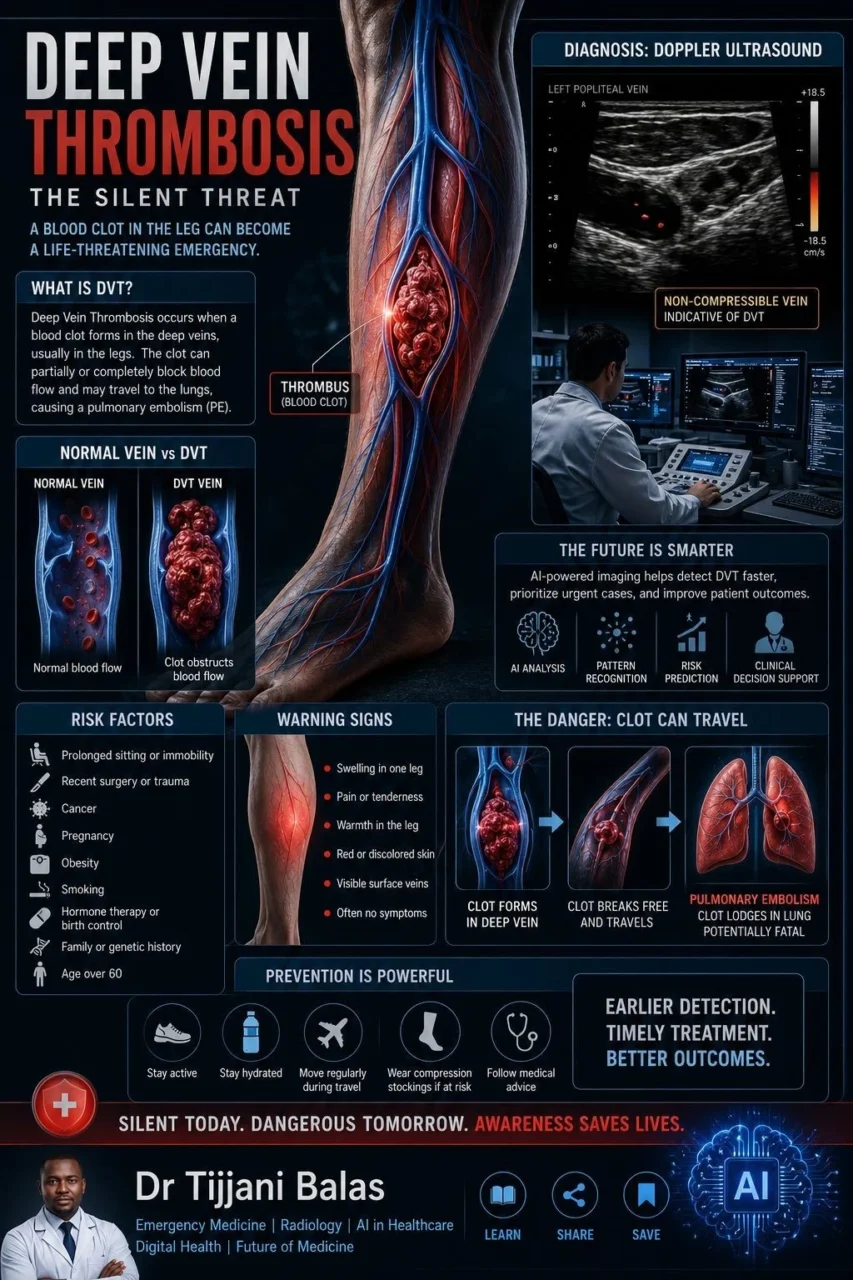
This is Deep Vein Thrombosis (DVT).
A condition where a blood clot forms in the deep veins, most commonly in the legs.
At first, it may seem harmless.
A swollen calf.
Mild pain.
A feeling of warmth.
Some patients have no symptoms at all.
But the real danger begins when part of the clot breaks free.
It can travel through the bloodstream and lodge in the lungs.
This is called a Pulmonary Embolism.
And it can be fatal.
What makes DVT particularly important is that many risk factors are part of modern life:
- Prolonged sitting
- Long distance travel
- Recent surgery
- Hospitalization
- Cancer
- Pregnancy
- Smoking
- Certain genetic conditions
In emergency medicine, one of the most important lessons is this:
Not every dangerous condition looks dramatic.
Sometimes the greatest threat is the one we cannot see.
This is where medical imaging becomes critical.
Ultrasound remains the frontline tool for diagnosing DVT.
Fast.
Non invasive.
Life saving.
The future is becoming even more interesting.
Artificial intelligence is increasingly being integrated into vascular imaging workflows, helping clinicians identify abnormalities faster, prioritize urgent cases, and improve diagnostic efficiency.
Technology is advancing.
But awareness remains our first line of defense.
Know the warning signs.
Recognize the risks.
Act early.
Because preventing a clot from reaching the lungs is far easier than treating the consequences after it arrives.
Save this post.
Share with colleagues, healthcare professionals, and anyone who spends long hours sitting at work or while traveling.
What do you think will have the biggest impact on reducing DVT related deaths over the next decade?
Earlier diagnosis, better public awareness, or AI assisted healthcare?
The most dangerous clots are often the ones patients never knew existed.”
Stay updated with Hemostasis Today.
-
Sep 23, 2026, 16:04Monia Ezzalfani: Advancing Patient-Centered Care in Hemophilia A and B
-
Sep 23, 2026, 15:49Bilge Başak: How Activated PRP Modulates Osteoarthritic Chondrocyte Function
-
Sep 23, 2026, 14:50Mbonjo Bitsie Dora: Strengthening Sickle Cell Care Through Education, Awareness and Innovation
-
Sep 23, 2026, 13:58The New B12 Diagnostic Algorithm: From Serum Cobalamin to Functional Deficiency
-
Sep 23, 2026, 13:56Noha Soror: Preparing for Hematology and Medical Oncology Board Certification
-
Sep 23, 2026, 13:46Ugochi Ogu: What Can Platelet Proteomics Reveal about Pain and Neurocognitive Vulnerability in Sickle Cell Disease?
-
Sep 23, 2026, 13:42Melissa Hollo: Connecting Obesity and Anemia for Earlier Maternal Risk Intervention
-
Sep 23, 2026, 13:16Beverley Hunt: Advances in Haemostatic Management of Postpartum Haemorrhage
-
Sep 23, 2026, 13:13Ioanna Mela: Recruiting a Research Associate on DNA nanotechnology