


Waleed Zia: The Balance Between Bleeding and Thrombosis
Waleed Zia, Anesthesia Specialist at The Indus Hospital, shared a post on LinkedIn:
“Coagulation Pathway – A Visual Guide to Hemostasis
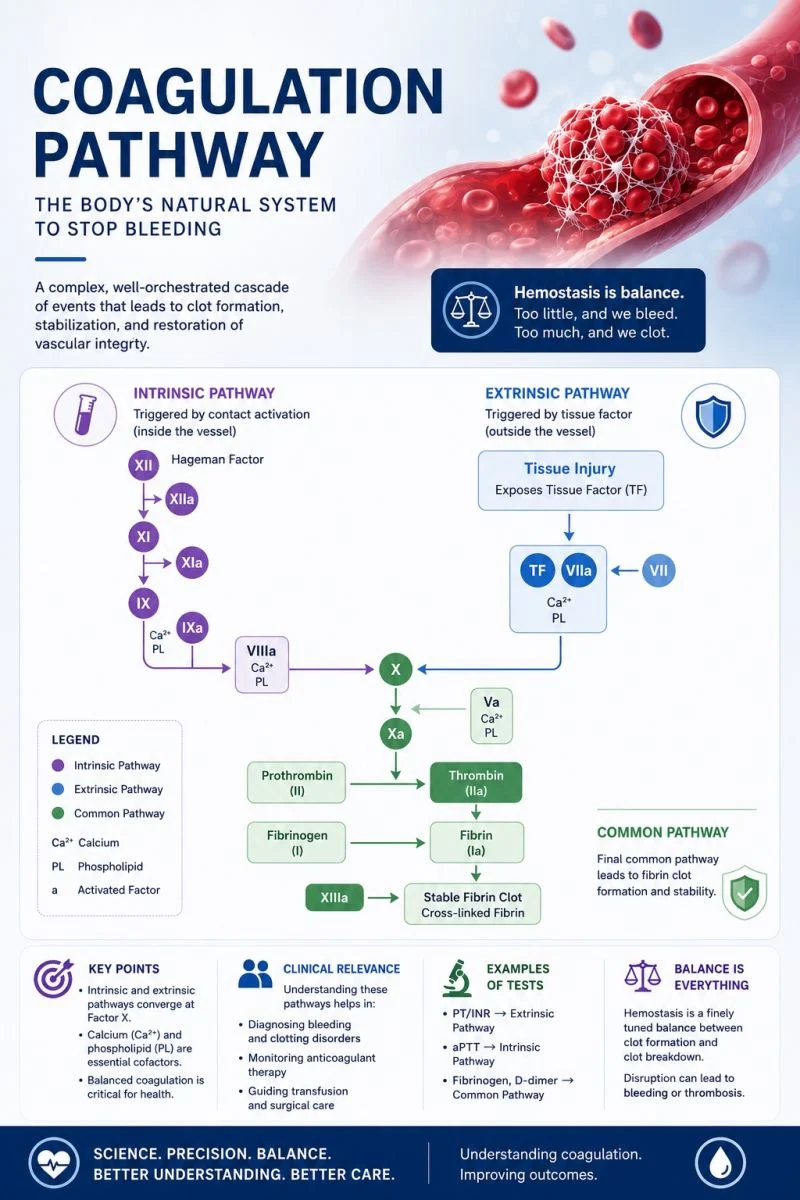
This infographic provides a clear and structured overview of the blood coagulation cascade, illustrating how the body prevents excessive bleeding through a highly regulated and coordinated process known as hemostasis.
The poster is divided into three main sections:
1. Intrinsic Pathway
- Activated by contact with negatively charged surfaces inside the blood vessel.
- Involves coagulation factors XII, XI, IX, and VIII.
- Leads to activation of Factor X.
- Commonly assessed by aPTT (activated partial thromboplastin time).
2. Extrinsic Pathway
- Triggered by tissue injury outside the vessel.
- Initiated by Tissue Factor (Factor III).
- Involves Factor VII.
- Rapid pathway that also activates Factor X.
- Commonly assessed by PT/INR (prothrombin time/international normalized ratio).
3. Common Pathway
- Begins at Factor X activation.
- Factor Xa converts Prothrombin (Factor II) into Thrombin (Factor IIa).
- Thrombin converts Fibrinogen (Factor I) into Fibrin.
- Factor XIII stabilizes the fibrin clot through cross-linking.
- Results in a stable fibrin clot that stops bleeding.
Key Components Highlighted in the Diagram
- Role of Calcium (Ca²⁺) as an essential cofactor.
- Importance of phospholipid (PL) surfaces.
- Activated factors are clearly labeled with ‘a’.
- Color coding to differentiate intrinsic, extrinsic, and common pathways.
Clinical Relevance
The poster also emphasizes practical medical applications:
- Helps in understanding bleeding disorders (e.g., hemophilia).
- Useful in monitoring anticoagulation therapy (e.g., warfarin, heparin).
- Essential for interpreting coagulation laboratory tests.
- Guides decision-making in surgery and transfusion medicine.
Core Message
Hemostasis is a delicate balance:
- Too little clotting – bleeding
- Too much clotting – thrombosis
The infographic reinforces the concept that proper regulation of the coagulation cascade is vital for maintaining vascular integrity and overall patient safety.”
Stay updated with Hemostasis Today.
-
Sep 21, 2026, 04:06Allison Lewin: How Gender Shapes the Way We Receive Medical Care
-
Sep 21, 2026, 03:49Jessica Lee: Walking Together for a Stronger Bleeding Disorders Community
-
Sep 21, 2026, 03:36Syed Asif Ali Shah: From Pakistan to Australia – A Clinical Haematology Milestone
-
Sep 21, 2026, 03:22Katie Baca-Motes: Estradiol Fluctuations May Help Explain Menstrual Migraine
-
Sep 21, 2026, 03:00Family History Can Reveal Hidden Risk of Aortic Dissection – The Marfan Foundation
-
Sep 21, 2026, 02:47Transitioning from Paediatric to Adult Haemophilia Care – Haemophilia Foundation Australia
-
Sep 21, 2026, 02:29Diana Castro Paupério: A New Era for Patient Blood Management
-
Sep 21, 2026, 00:29Iheanyichukwu Ike: Childhood Anaemia in Nigeria Through an Analysis of the 2018 NDHS
-
Sep 21, 2026, 00:27Nicole De Vita: The Global Burden of Iron Deficiency and Anemia in Women at SABM