

Zafer Tandogdu: Can TXA Redefine Bleeding Management in Urology
Zafer Tandogdu, Consultant Urologist, Member of Uro-oncology Robotic Surgery Team at University College London Hospitals NHS Foundation Trust, Senior Researcher and co-founder of UTISOLVE Research Group, shared Daniel Jiménez Peralta’s post on LinkedIn:
“Shout it from the rooftops: tranexamic acid reduces surgical bleeding, transfusion need, and major bleeding — without an observed increase in thromboembolic events.
Use it thoughtfully, but don’t fear it reflexively.”
Daniel Jiménez Peralta, Digital Health Office Collaborator at Spanish Association of Urology, Urologist at the La Rioja Health Service, shared a post on LinkedIn:
“Everything we assumed about tranexamic acid in urology had never really been proven.
Until now.
Kari Tikkinen — thank you for bringing this question to the table.
For years, young urologists like me saw tranexamic acid being used by other specialties during high risk of bleeding while we looked the other way.
The EAU and AUA guidelines did not clearly recommend it.
The prior evidence was inconsistent.
And the fear of thrombotic events outweighed the perceived benefit.
Until the urology subgroup analysis of POISE-3 arrived.
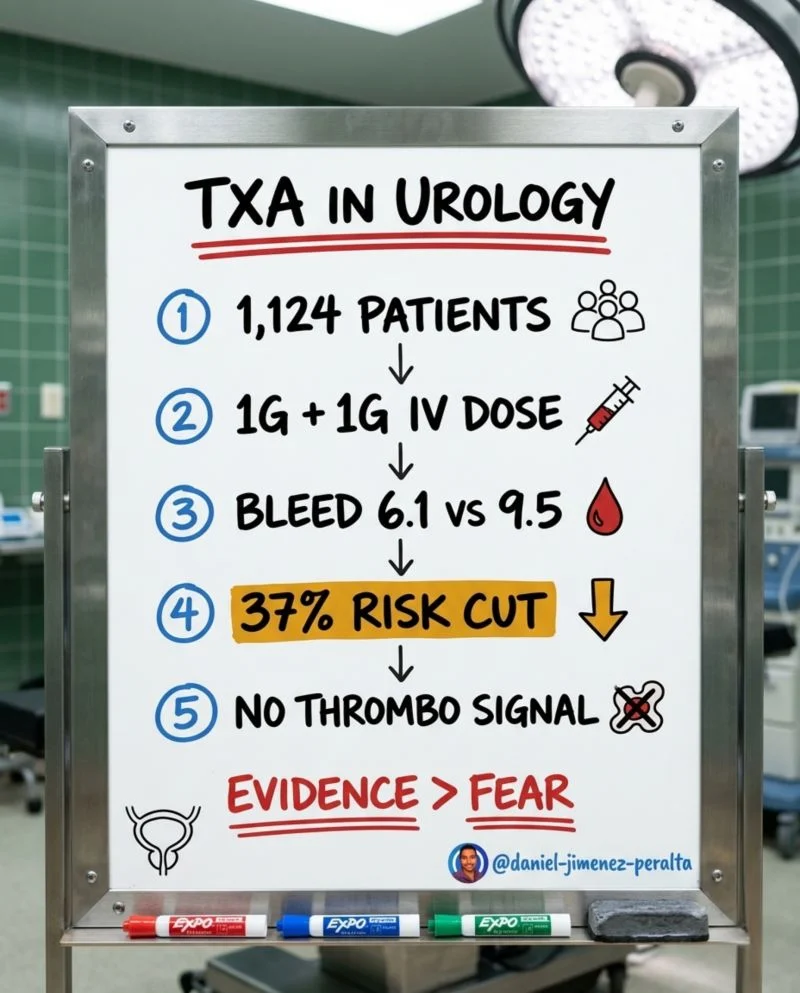
- 1,124 patients.
- High cardiovascular-risk urologic surgery.
- 1 g of TXA at induction plus 1 g at closure.
The results:
- Major bleeding: 6.1 percent versus 9.5 percent (HR 0.63)
- 37 percent relative risk reduction
- No clear signal of increased thrombotic events
What does this mean in practice?
For every 1,000 patients operated on, 34 major bleeds avoided.
In cystectomies. In open nephrectomies. In older patients with cardiovascular risk and on antithrombotic therapy.
TXA is inexpensive. It’s accessible. And now it has robust evidence.
Are you already using it in your department?
What has your experience been?”
Stay updated with Hemostasis Today.
-
Oct 11, 2026, 21:22Shayan Roshan: Happy to Share Two Research Milestones in Trauma Care and Pancreatic Cancer
-
Oct 11, 2026, 21:16Chokri Ben Lamine: Anemia in Myelofibrosis – Multiple Mechanisms, Limited Responses
-
Oct 11, 2026, 21:03Carmela Walker: Supporting Warriors Living With SCD Through Dental Care and Advocacy
-
Oct 11, 2026, 21:00Rishdha Roshad: Intraoperative Cell Salvage – Turning Blood Loss into an Opportunity for Recovery
-
Oct 11, 2026, 20:59Anthony R. Sloan: Honored to Share Our Work at the 20th Midwest Platelet Conference
-
Oct 11, 2026, 20:55Vipin M. Vashishtha: Mild COVID-19 and Malaria Leave Measurable Fingerprints on the Clotting System
-
Oct 11, 2026, 16:57Shiny K. Kajal: Japan Advances Artificial Blood via Haemoglobin Vesicles Trials
-
Oct 11, 2026, 16:45Luca Scarcia: Rescue Stenting Superior When Posterior Circulation Thrombectomy Fails
-
Oct 11, 2026, 16:27Giuseppe Bellelli: Reevaluating Anticoagulation Net Benefit in Frail Older Adults