

Estrogen-Associated VTE: From Real-World Evidence to the Biology of Persistent Thrombosis
Two presentations at the ISTH 2026 Congress provided complementary insights into one of the most important challenges in women’s vascular health – estrogen-associated venous thromboembolism (VTE).
One translated decades of clinical experience into practical guidance through data from the international RIETE Registry, while the other explored the biological mechanisms that may sustain thrombosis through extracellular vesicles (EVs).
Together, these studies highlight a major shift in thrombosis research.
The field is moving beyond identifying risk factors for VTE toward understanding the biological processes that determine why thrombotic risk persists in some patients long after the initial event.
By integrating large-scale real-world evidence with advances in vascular biology, researchers are laying the foundation for a more individualized approach to thrombosis prevention and treatment.
Estrogen and Venous Thromboembolism: More Than a Transient Risk Factor
Venous thromboembolism remains one of the leading cardiovascular complications affecting women of reproductive age.
Combined hormonal contraceptives, menopausal hormone therapy, and other estrogen-containing treatments are well-recognized risk factors, promoting thrombosis through enhanced thrombin generation, acquired resistance to activated protein C and disruption of the body’s natural anticoagulant pathways.
Although estrogen exposure is often discontinued after a thrombotic event, several important clinical questions remain. Which women remain at risk of recurrence?
How long should anticoagulation continue? And can biological markers improve risk stratification beyond conventional clinical assessment?
These questions formed the basis of two complementary presentations at ISTH 2026.
Real-World Evidence From the RIETE Registry
Investigators presented data from the RIETE (Registro Informatizado de Enfermedad TromboEmbólica) Registry, one of the world’s largest prospective registries of patients with venous thromboembolism.
Unlike randomized clinical trials, which enroll carefully selected patient populations, RIETE reflects routine clinical practice across multiple countries and healthcare settings.
Its strength lies in capturing the diversity and complexity of patients encountered in everyday medicine, providing valuable information on treatment strategies, recurrence, bleeding complications, and long-term outcomes.
The presentation reinforced the growing importance of real-world evidence in refining clinical decision-making, particularly for patient populations that are often underrepresented in randomized studies.
Toward Individualized Anticoagulation
One of the strongest messages from the session was that estrogen-associated VTE should not be considered a uniform clinical entity.
Treatment decisions increasingly depend on multiple factors, including the indication for estrogen therapy, whether hormonal exposure has been discontinued, inherited thrombophilia, obesity, reproductive plans, previous thrombotic events, bleeding risk and patient preferences.
Rather than applying a standard duration of anticoagulation to every patient, clinicians are moving toward individualized treatment strategies that balance recurrent thrombosis against bleeding risk.
This personalized approach reflects a broader evolution in thrombosis care, where management is guided by overall risk rather than by a single provoking factor.
Why Does Thrombotic Risk Persist?
While removal of estrogen exposure eliminates an important trigger for thrombosis, recurrence still occurs in a proportion of women.
Conventional laboratory tests do not fully explain this ongoing risk, suggesting that persistent biological changes may continue after the acute event has resolved.
This question was explored in a second presentation examining the role of extracellular vesicles, an emerging area of vascular biology that is attracting increasing attention within thrombosis research.
Extracellular Vesicles: Small Particles, Big Implications
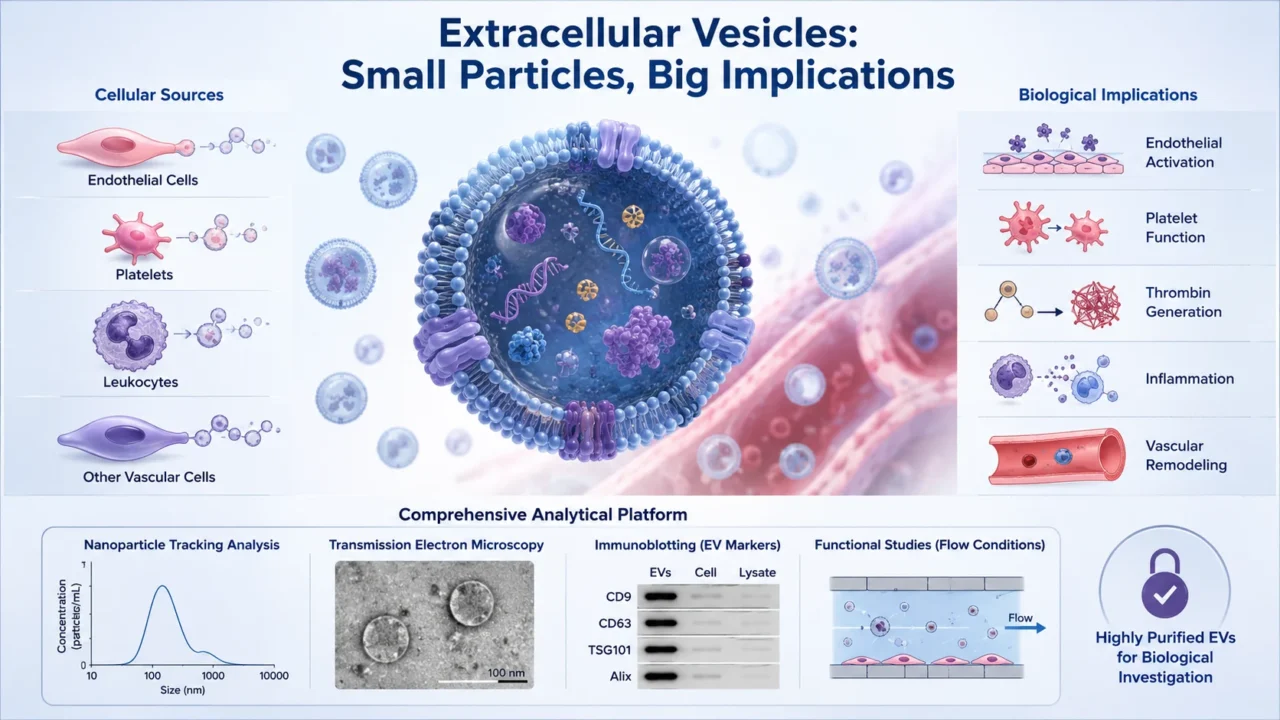
Extracellular vesicles are tiny membrane-bound particles released by endothelial cells, platelets, leukocytes, and other vascular cells. Once regarded simply as cellular debris, they are now recognized as important mediators of intercellular communication, transporting proteins, nucleic acids, lipids, and inflammatory signals throughout the circulation.
Because extracellular vesicles influence endothelial activation, platelet function, thrombin generation, inflammation, and vascular remodeling, they have emerged as promising contributors to both thrombosis and thromboinflammation.
To characterize these particles, investigators employed a comprehensive analytical platform combining nanoparticle tracking analysis, transmission electron microscopy, immunoblotting for canonical extracellular vesicle markers, and functional studies under flow conditions. This rigorous methodology confirmed successful isolation of highly purified extracellular vesicles suitable for biological investigation.
Evidence of Persistent Vascular Activation
The study demonstrated significantly increased concentrations of circulating small extracellular vesicles during active thrombotic disease.
Importantly, some abnormalities persisted even during clinical remission, suggesting that endothelial activation may continue beyond apparent recovery.
These findings support the concept that thrombotic disease may leave behind a prolonged state of vascular dysfunction that is not captured by conventional coagulation testing. Such persistent biological activity could help explain why some patients remain vulnerable to recurrent thrombosis despite appropriate treatment and removal of the original provoking factor.
Implications for Women’s Vascular Health
Although the extracellular vesicle study was not limited to women, its implications for estrogen-associated thrombosis are substantial. Estrogen affects endothelial biology, platelet activation, inflammatory pathways, and coagulation, making extracellular vesicles a plausible biological link between hormonal exposure and persistent vascular dysfunction.
Future research will determine whether extracellular vesicle profiling can identify women who remain at increased thrombotic risk after discontinuation of estrogen therapy and completion of anticoagulation. If validated, these biomarkers could complement traditional clinical assessment and improve individualized decision-making.
From Clinical Evidence to Precision Medicine
Current risk assessment relies primarily on clinical history, provoking factors, inherited thrombophilia, D-dimer testing and conventional coagulation assays.
However, these tools may not fully capture the biological processes that determine long-term vascular risk.
The integration of novel biomarkers such as extracellular vesicles represents an important step toward precision medicine in thrombosis. Beyond predicting recurrent VTE, these biomarkers may eventually help monitor endothelial recovery, assess treatment response, and personalize the duration of anticoagulation according to each patient’s underlying biology rather than clinical history alone. 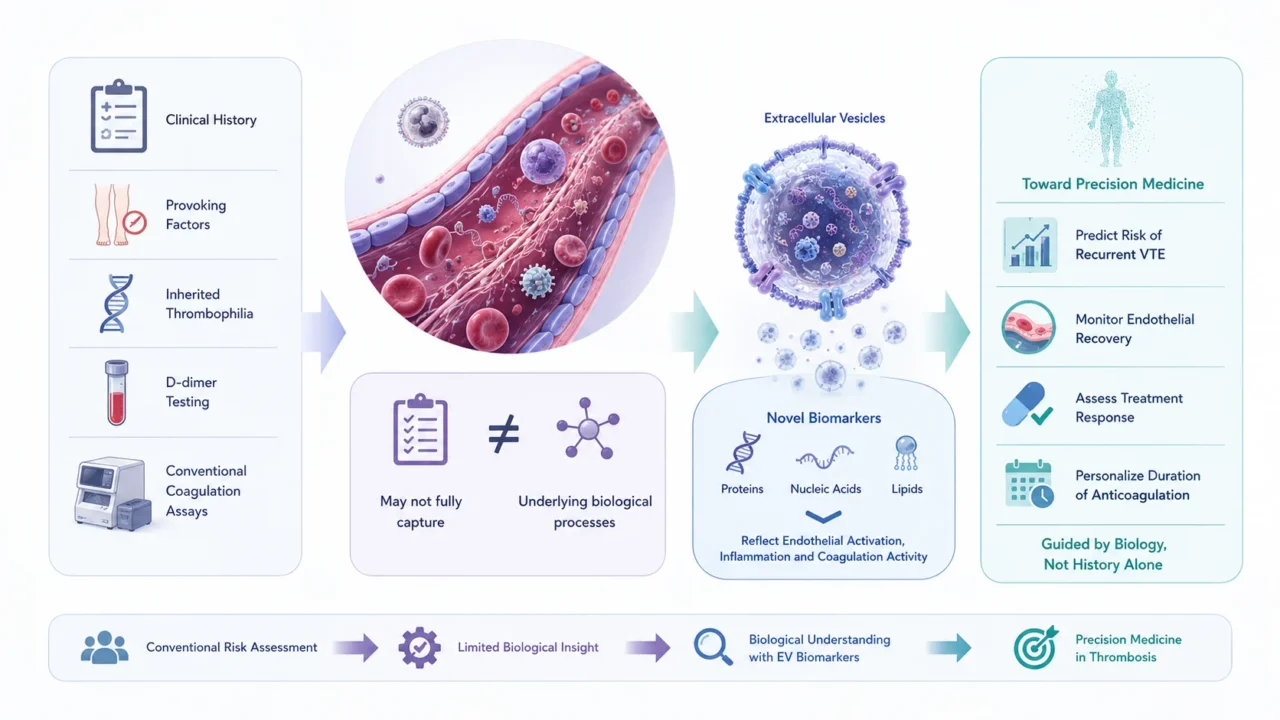
Advancing Precision Medicine in Women’s Vascular Health
The presentations at ISTH 2026 highlighted the evolution of thrombosis research from real-world clinical evidence to the biological mechanisms underlying disease.
The RIETE Registry reinforces the importance of individualized management of estrogen-associated VTE, while emerging research on extracellular vesicles suggests new opportunities to better understand persistent thrombotic risk.
As clinical evidence and translational science continue to converge, future strategies for managing estrogen-associated VTE may combine traditional risk assessment with novel biomarkers, supporting more precise prediction of recurrence and increasingly personalized care for women.
Written by Heghine Khachatryan, MD, PhD, Editor-in-Chief at Hemostasis Today.
Stay Updated with the Latest ISTH 2026 Updates on Hemostasis Today.
-
Oct 16, 2026, 13:59Aya Akmal Amin: Antiphospholipid Syndrome Management and Risk Stratification
-
Oct 16, 2026, 13:10Emanuel Sueldo: CAHT 2026 Celebrates Scientific Progress and Team Achievements
-
Oct 16, 2026, 13:05Maha Othman: Queen’s Health Sciences Advances CAT Risk Models and Pediatric ISTH-BAT Cut-Offs
-
Oct 16, 2026, 13:03Thrombosis Awareness Must Lead to Timely Action – Roche
-
Oct 16, 2026, 12:49Wolfgang Miesbach: 5-Year CBDR Data Confirms Emicizumab Safety and Efficacy in Hemophilia A
-
Oct 16, 2026, 12:40Edward Lee Carter: How Factor XI Inhibition Could Transform Anticoagulation Therapy
-
Oct 16, 2026, 12:40Marc Carrier: Looking Ahead to ISTH 2027 in Vancouver
-
Oct 16, 2026, 12:30Bob Lempke: How One Blood Donation Can Save Up to Three Lives
-
Oct 16, 2026, 12:30Why VWF Therapies Belong on the EU Critical Medicines List – EHC