


Shahram Paydar: TXA in Elderly Trauma: A Game-Changer for Endothelial Protection?
Shahram Paydar, Professor of Surgery and Trauma Surgeon, Consultant at Gulf Specialized Hospital, shared on LinkedIn:
“TXA in Elderly Trauma: A Game-Changer for Endothelial Protection? New Evidence Says Yes!
Trauma doesn’t discriminate by age, but outcomes do—especially for our older adults, who make up nearly 25% of admissions yet face steeper morbidity and mortality. Enter tranexamic acid (TXA): We know it’s a staple for bleeding control in TBI and hemorrhage, but a fresh 2025 analysis in J Trauma Acute Care Surg spotlights its extra punch in the ≥55 crowd.
Key findings from this secondary dive into the prehospital TXA-in-TBI database (n=436):
Despite similar injury severity (ISS ~20, head AIS ~3), older patients (mean 66y) showed sky-high admission endothelial biomarkers—thrombomodulin (↑17%), VCAM-1 (↑19%), angiotensin-2 (↑23%)—signaling pre-injury vulnerability.
The kicker?
2g prehospital TXA dampened these markers more dramatically in elders vs. younger folks (e.g., thrombomodulin p<0.00001, VCAM-1 p<0.0002 vs. placebo).
Younger subsets?
Less impact.
Why does this matter?
Endothelial dysfunction fuels the post-trauma inflammatory storm, and elders start from a weaker baseline. TXA’s amplified endothelial “shield” here could blunt hypercoagulability, reduce secondary hits, and—potentially—tip the scales on survival and recovery.
No direct mortality links yet (Level IV evidence), but it’s a clarion call: Standard TXA protocols might pack bigger benefits for our aging trauma wave.
As populations gray, this underscores TXA’s role beyond hemostasis—it’s endothelial insurance for the vulnerable.
Time to tweak protocols? Or wait for RCTs?
What’s your take—ramping up TXA emphasis in elder polytrauma? Share protocols or cases below!”
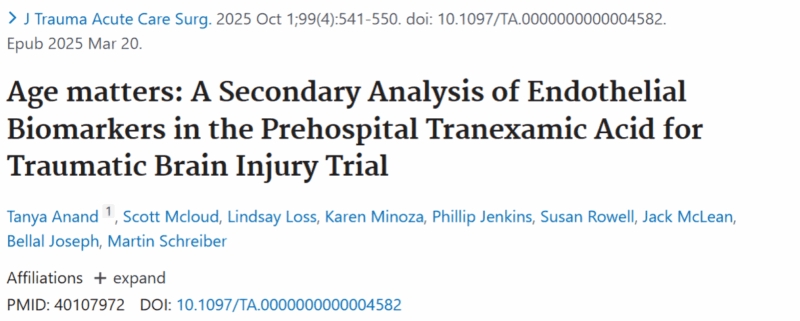
Title: Age matters: A Secondary Analysis of Endothelial Biomarkers in the Prehospital Tranexamic Acid for Traumatic Brain Injury Trial
Authors: Tanya Anand, Scott McLoud, Lindsay Loss, Karen Minoza, Phillip Jenkins, Susan Rowell, Jack McLean, Bellal Joseph, Martin Schreiber
Read the full article here.
Stay updated with Hemostasis Today.
-
Oct 15, 2026, 14:34Marium Khan: New Systematic Review Examines Asundexian Safety and Efficacy in Cardiovascular Disease
-
Oct 15, 2026, 14:03JTH Research Recap Explores Occult Malignancy Screening in DVT
-
Oct 15, 2026, 13:52Thierry Peyrard: A Heartfelt Thank You Ahead of Blood 2026
-
Oct 15, 2026, 12:40Todd Keitz: DVT and PE Explained in Five Minutes
-
Oct 15, 2026, 12:35Bartosz Hudzik: Balancing Ischemic and Bleeding Risk After ACS and PCI
-
Oct 15, 2026, 12:25Violeta Jardin: Understanding Fibrinolytic Shutdown Beyond Conventional TEG
-
Oct 15, 2026, 11:28Iliana Chatzifragkou: How Does Haemophilia Affect Early Motor Development?
-
Oct 15, 2026, 11:14Sunil Bajaj: DVT Pumps Explained – Uses, Types, and Key Features
-
Oct 15, 2026, 10:57Surya Sundaravel: A New Review Explores the Diagnosis and Management of DVT