


Arun V J on The “Whole Blood” Nostalgia Trap
Arun V J, Consultant in the Department of Transfusion Medicine at Malabar Medical College, shared on LinkedIn:
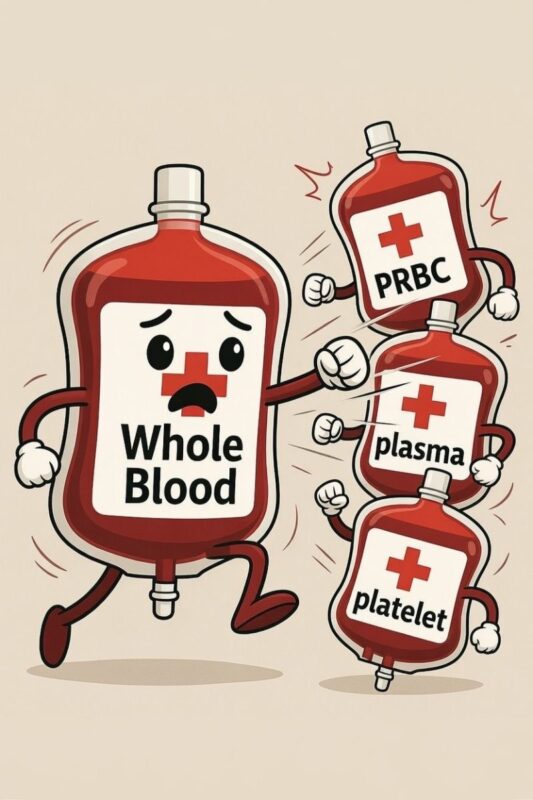
”The “Whole Blood” Nostalgia Trap: Why Modern Medicine Rips Your Donation Apart
Stop asking for Whole Blood for routine patients.
It sounds intuitive, right? “I lost blood, give me blood.” But in Transfusion Medicine, intuition is often wrong.
If you treat a non-trauma patient with Whole Blood in 2025, you aren’t practicing holistic medicine. You are practicing logistical negligence.
Here is why Component Therapy isn’t just a preference—it is the biological Gold Standard.
1. The “Storage Lesion” Reality (The Fridge War)
Blood cells are not good roommates. They hate each other’s preferred environments.
Red Cells need the fridge 2-6 degree Celsius to survive.
Platelets die in the fridge. They need room temperature 20-24 Degree Celsius.
Plasma factors degrade unless frozen solid -18 Degree Celsius.
If you keep blood “Whole” in a fridge, you are prioritizing the Red Cells and actively killing the Platelets. You are transfusing a compromised product.
2. The Sniper vs. The Shotgun
Most patients don’t need the “soup.”
Thalassemia patients need Red Cells, not Plasma volume.
Dengue patients need Platelets, not Red Cells.
Burn victims need Plasma, not Iron.
Giving Whole Blood to these patients is like using a shotgun to kill a mosquito.
It’s messy, it causes Volume Overload (TACO), and it increases reaction risks. Component therapy is the sniper shot—precise, potent, and safe.
3. The Efficiency Equation
In a world of scarcity, waste is a sin.
Whole Blood: 1 Donation = 1 Patient.
Component Therapy: 1 Donation = 3 Patients (1 Anemia + 1 Dengue + 1 Bleeding Disorder).
The Verdict:
We don’t separate blood to make it complicated. We separate it because human physiology demands it.
Unless you are dealing with a massive trauma hemorrhage, “splitting the bag” is the only responsible way to honor the donor’s gift.
Be precise. Be scientific. Choose Components.
Thoughts on this?
Are you Team Whole Blood or Team Components?
Read more.”
Stay updated with Hemostasis Today.
-
Sep 8, 2026, 09:42Vineet Sankhla: Rethinking Potent P2Y12 Inhibition in AF Patients Undergoing PCI
-
Sep 8, 2026, 09:23Mehdi Mirsaeidi: Platelets and Thromboinflammation in COPD
-
Sep 8, 2026, 09:03Michel Cabrera Ortega: LAAC vs OAC – Which Risk Are We Trading?
-
Sep 8, 2026, 08:58Zehraan Ibni Akbar: Peripheral Blood Smear – A Window into Hematological Diagnosis
-
Sep 8, 2026, 08:50Dirk Sibbing: Potent P2Y12 Inhibition in Patients With Atrial Fibrillation and Acute Coronary Syndrome
-
Sep 8, 2026, 08:39ASH-a-Palooza – Exploring What’s Next in Hematology
-
Sep 8, 2026, 08:23Khaled Musallam: A Masterclass on Thalassemia Care in the MENA Region
-
Sep 8, 2026, 08:23Atoosa Salimi: The Role of Platelet-Derived Serotonin in Severe COVID-19
-
Sep 8, 2026, 07:59Mohammedsefa Arusi Dari: Exploring the Link Between Iron Deficiency Anemia and Sleep Apnea