

VKAs and DOACs with Pall T Onundarson: The Never-Ending Comparison
Pall T Onundarson, Professor Emeritus at Landspitali University Hospital, shared a thoughtful paragraph on LinkedIn:
”’You will be assassinated by industry’ a prominent professor in England in the field of coagulation told me after I presented the Fiix test and the results of the Fiix-trial in 2014.
I thought he was being funny at the time but he wasn´t. I don´t laugh anymore.
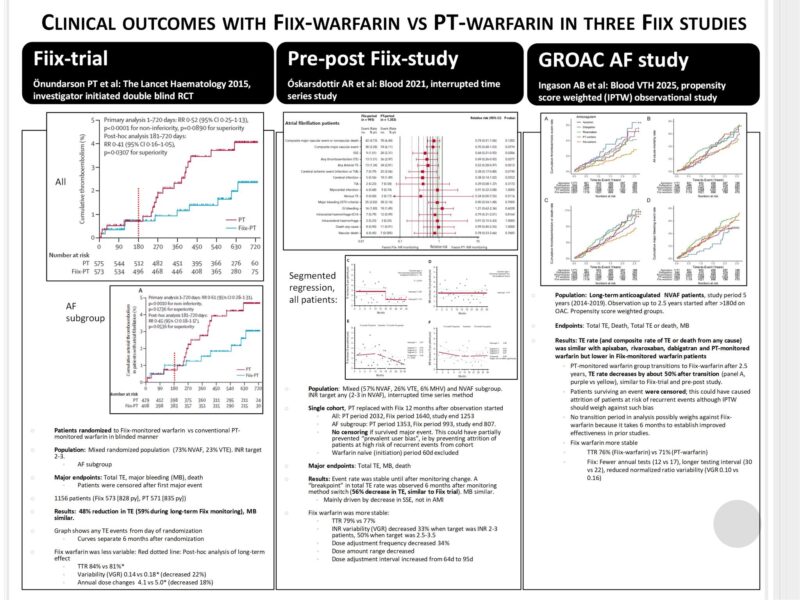
Our group has published three clinical studies (Onundarson PT et al, The Lancet Haematology 2015; Oskarsdottir AR et al, Blood 2021; Ingason AB et al., Blood VTH 2025) that all demonstrate more improvement in oral anticoagulation (OAC) outcomes by far (about 50% reduction in thromboembolism without increase in bleeding) with Fiix-monitored warfarin than has been observed with any other OAC compared to well managed conventional PT-INR monitored warfarin. Off note, also more effective than DOAC drugs with similar major bleeding incidence.
Short conclusion: Warfarin should not be monitored with the PT-INR and we have used the Fiix normalized ratio since 2016.
For sure I remain alive 11 years later – but these studies are hardly ever mentioned in anticoagulation discussions. In psychology it is called “cognitive dissonance” ( or “Don´t confuse me with facts, I´ve made up my mind”).
The publications are hardly ever cited by scientists studying anticoagulants, talkin at conventions and writing clinical guidelines.
Guidelines that are supposed to assure patients and society that patients receive the best possible care. As if the studies don´t exist. And we all know now that many patients still need warfarin and VKAs. Don´t we at least owe it to them to improve their anticoagulation outcomes if possible?
Was the renowned professor in England correct? It seems like the “assassination” is not literal but presents as purposeful “silencing” or “cancellation” by my medical collegues in the field.
Does industry come into play as the professor suggested? I don´t know but is it possible that the drug industry influences the medical profession and in particular key opinion leaders through payments of all kinds to such a degree that prestigious leaders in the field are willing to ignore a new method?
A new method that possibly could save more lives and prevent more disability than all the current recommended treatments – and save an enormous amount of money at the same time? Is there bias?
I can understand that some scepticism would exist – but wouldn´t the appropriate path be to independently test whether the theory has merits and if the published results can be independently confirmed?
The figure compares the results of the three clinical studies mentioned above. Click on it to enlarge.
P.s.: The dilute Fiix test can be used to measure DOAC drugs as well as warfarin (Letertre LR et al, J Thromb Haemostasis 2016).”
The Never-Ending Comparison of effectiveness of use of VKAs or DOACs and mnitoring of those drugs is discussed for some time now.
Read Pall T Onundarson sharing his views on the perspectives!
Stay informed on the emerging in the field of coagulation disorders with Hemostasis Today.
-
Oct 11, 2026, 14:09Joseph Sci Borg: The Haemoglobin Switch as a Programmable Biological Transition
-
Oct 11, 2026, 14:07Robert Sidonio։ Bleeding Care for Women and Girls With Hemophilia
-
Oct 11, 2026, 13:58Jose M. Adrover: Postdoctoral Fellowship on Neutrophils and Cancer-Associated Thrombosis
-
Oct 11, 2026, 13:42Natalie Arnold։ Uncovering Hidden Cardiovascular Risk in Apparently Low-Risk Individuals
-
Oct 11, 2026, 12:11Carmine Siniscalchi: Could LDL Cholesterol Help Us Better Predict Bleeding Risk in Patients with VTE?
-
Oct 11, 2026, 12:03What is ITP? Raising Awareness for Immune Thrombocytopenia – ITP Australia and New Zealand
-
Oct 11, 2026, 11:55Gauri Jayasinghe: Privileged to Serve as Resource Person for the Blood Transfusion Essentials Programme
-
Oct 11, 2026, 11:49Toby Richards: New Definitions for Iron Deficiency Delighted to Be in the USA with the New ASH Guidelines
-
Oct 11, 2026, 11:44Lesley Van Wyk: ASCP High-Yield Review – Essential Thalassemia Concepts and Differential Diagnosis