


Dr Abdul Mannan: The Molecular “Switch” That Saves Lives – Pathophysiological Review of the Protein C System
Dr Abdul Mannan, Consultant Haematologist at Betsi Cadwaladr University Health Board, shared a post on LinkedIn:
“The Molecular “Switch” That Saves Lives: A Pathophysiological Review of the Protein C System
In the world of clinical haematology, balance is a survival mechanism. Today, we are analyzing the Systemic Dysregulation of the Protein C System—a catastrophic failure that leads to the medical emergency of Purpura Fulminans (PF).
Part 1: The Physiological Masterpiece (The Normal State)
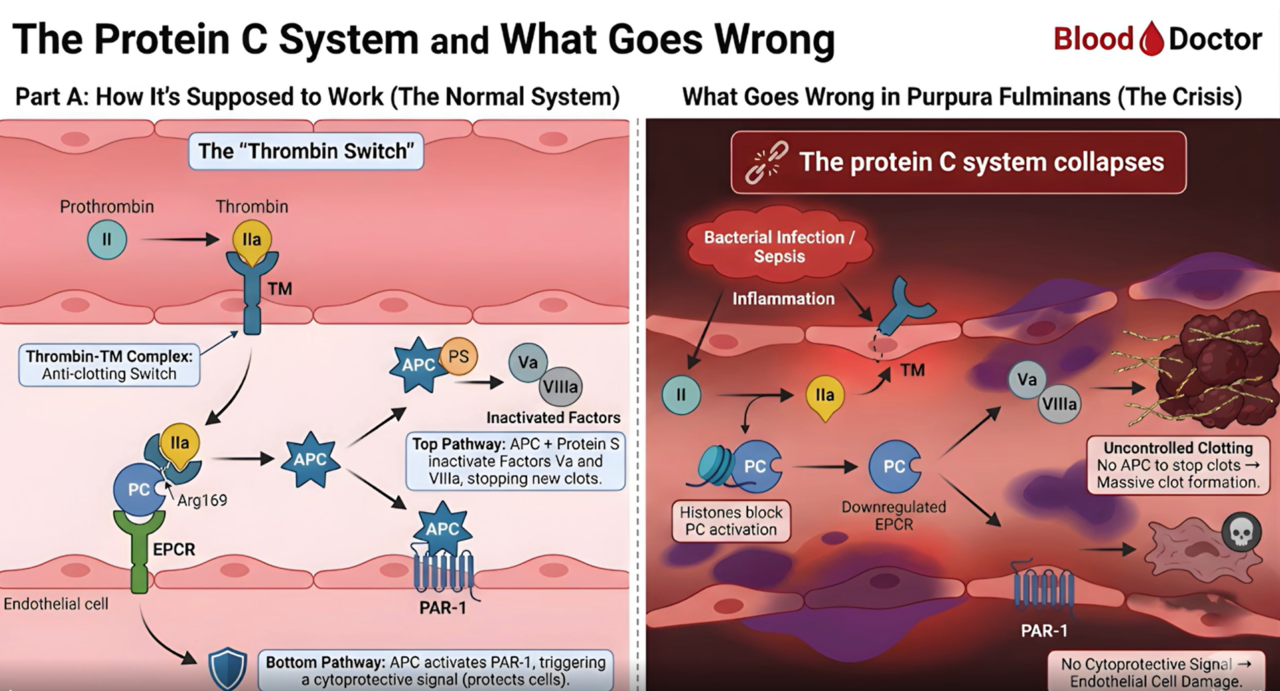
Normally, the endothelium is a pro-survival, antithrombotic surface. The “Thrombin Switch” is the central mechanism:
The Mechanism: Thrombin (IIa) binds to Thrombomodulin (TM) on the endothelial surface.
The Switch: This complex shifts thrombin’s substrate specificity away from fibrinogen and toward Protein C (PC).
The Result: PC is converted to Activated Protein C (APC). Along with its cofactor Protein S, it proteolytically inactivates Factors Va and VIIIa, halting the coagulation cascade.
Cytoprotection: APC also signals through PAR-1 and EPCR to activate anti-inflammatory and anti-apoptotic pathways.
Part 2: The Molecular Collapse (Pathophysiology of PF)
In severe sepsis—often triggered by Neisseria meningitidis—this elegant system suffers a total Pathophysiological Failure:
Receptor Shedding: Massive cytokine release triggers the proteolytic shedding of TM and EPCR from the endothelial surface. Without these anchors, PC cannot be activated.
Nuclear Interference: Neutrophil Extracellular Traps (NETs) release histones that directly inhibit the activation of the PC zymogen.
Consumption Coagulopathy: Unchecked thrombin generation consumes existing Protein C faster than hepatic synthesis can replenish it.
The Clinical Consequence: Maladaptive thromboinflammation. The resulting microvascular thrombosis leads to the characteristic purpuric skin necrosis and multi-organ failure.
Part 3: The Clinical Rescue (The “Blood Doctor” Protocol)
Management of this Molecular Collapse requires immediate, evidence-based intervention:
The Diagnostic Threshold: A PC activity level <40% in the context of rapidly progressing purpura is a critical diagnostic marker.
Precision Replacement: Administer Protein C Concentrate (100 units/kg). Our goal is a therapeutic target of >80% activity to restore the antithrombotic rheology.
The Anticoagulation Paradox: While the patient may appear to have a bleeding diathesis, we must address the underlying “thrombin storm” with Heparin (monitored via anti-Xa) to salvage the microcirculation.
Summary for the Haematology Community
Purpura Fulminans represents the ultimate “tipping point” where the cross-talk between coagulation and innate immunity becomes lethal. Recognizing the Systemic Dysregulation of Protein C early is the difference between limb salvage and mortality.
To my fellow Haematologists: In your practice, do you prioritize PC concentrate or FFP as the primary replacement bridge in the first 6 hours?”
Find more posts featuring Abdul Mannan on Hemostasis Today.
-
Oct 7, 2026, 13:23Nisheeth Patel: The Clinical Balance Between Clot Prevention and Bleeding
-
Oct 7, 2026, 13:08Maria Carvajal Perea: Prothrombin Complex Concentrate vs Plasma – Optimizing Hemostasis After Cardiac Surgery
-
Oct 7, 2026, 12:41PACT Memorandum of Understanding as a New Step for People with Bleeding Disorders – WFH
-
Oct 7, 2026, 12:38Behnood Bikdeli: Cancer Therapies and Thrombosis – Navigating the Complexities of Cancer-Associated Thrombosis
-
Oct 7, 2026, 12:22Cameron Borg: Could Taking Vitamin D Negatively Impact Circadian Network?
-
Oct 7, 2026, 12:13Francisco Chacón-Lozsán: Superior Vena Cava Syndrome – Understanding the Physiology, Diagnosis and Management
-
Oct 7, 2026, 11:44Megan Curtis: Raising Awareness of Pernicious Anaemia
-
Oct 7, 2026, 10:42Nasir K.: The Global Healthcare Community Comes Together for IPAW 2026
-
Oct 7, 2026, 09:20Maurizio Bertaina: Optimizing Anticoagulation in Temporary Mechanical Circulatory Support