


Dr Abdul Mannan Comments Raheel Moazzam’s Thesis: Why are Left-Sided DVTs More Common Than Right?
Dr Abdul Mannan, Consultant Haematologist at Betsi Cadwaladr University Health Board, shared a post on LinkedIn:
“Why are left-sided DVTs more common than right?
We’ve known this pattern for decades. But the reason wasn’t clear.
Until now.
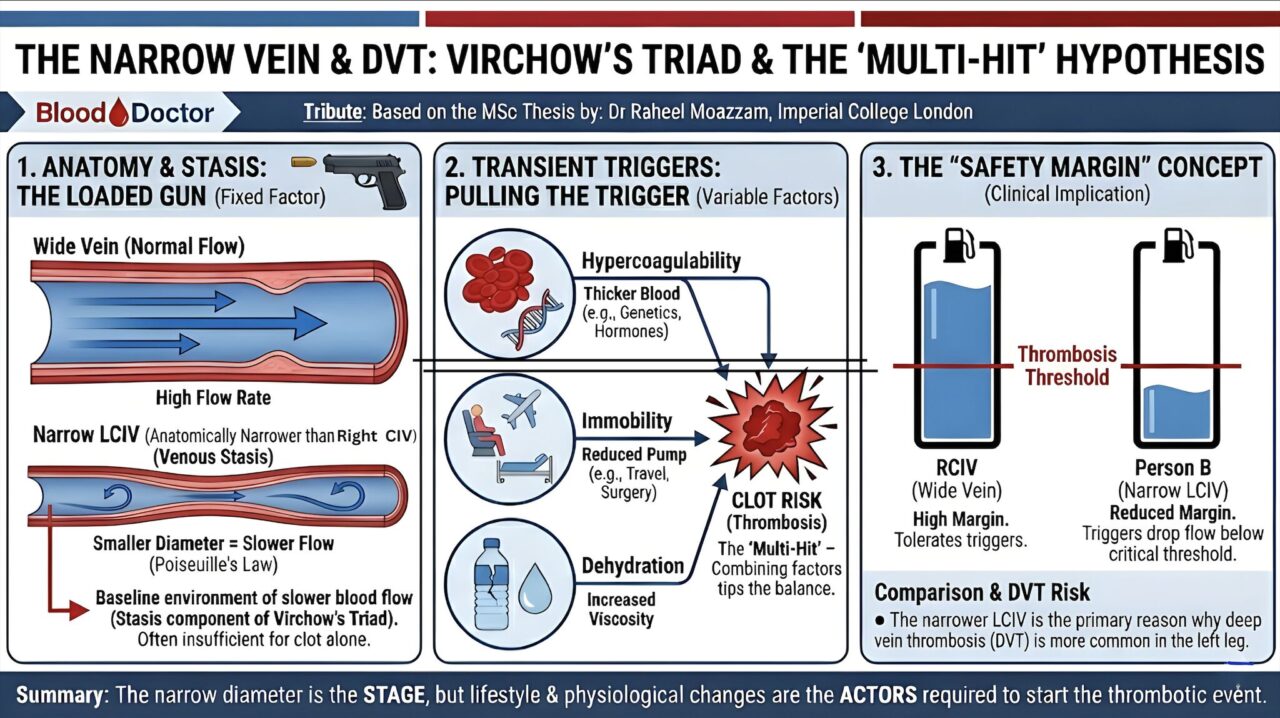
Dr Raheel Moazzam ‘s thesis at Imperial College London answers this question. Her work discovered something we didn’t know before: the left common iliac vein (LCIV) is anatomically narrower than the right. Not because of compression. Not because of disease. Just normal human anatomy.
This is a genuine anatomical finding.
Here’s why it matters:
- Narrower vein = slower blood flow (Poiseuille’s Law)
- Slower flow = baseline venous stasis
- Stasis is one leg of Virchow’s Triad
- The LCIV sits in a state of “primed risk.” Like a loaded gun.
But stasis alone doesn’t cause clots. You need triggers:
- Hypercoagulability (genetics, hormones)
- Immobility (flights, surgery, bed rest)
- Dehydration (increased blood viscosity)
When these hit someone with a narrow LCIV, they cross the thrombosis threshold. That’s the multi-hit hypothesis.
Someone with a wide vein tolerates these triggers. Someone with a narrow vein doesn’t.
This explains the left-right difference we see in clinical practice.
I’ve created a visual to summarise this concept for teaching. Credit goes to Dr Moazzam for this elegant piece of work connecting anatomy to clinical reality.
What do you think? Does this change how you explain DVT risk to patients?”
Explore more posts for deeper insights into hemostasis with Hemostasis Today.
-
Oct 20, 2026, 06:45Grant Garcia: Why Does a Blood Clot Diagnosis Immediately End an Athlete’s Season?
-
Oct 20, 2026, 06:35Parag Tamhankar: Landmark Study Reveals Genetic Spectrum and Targeted Therapies for ALPS in the Indian Population
-
Oct 20, 2026, 06:26Nina Houben: Neonatal Blood Transfusion Symposium and PhD Defense
-
Oct 20, 2026, 05:46Jan T. Kielstein: DNP Poisoning and Hemoadsorption The Limits of Rescue Therapy
-
Oct 20, 2026, 05:33Giulia Di Paolo: Connecting Plasma Donation to the Patients Who Depend on It
-
Oct 20, 2026, 05:20James Knowles: Exploring Plasma Manufacturing and Strengthening Industry Collaboration
-
Oct 20, 2026, 05:11Giuseppe Lippi։ Understanding Liver Test Abnormalities After AAV Gene Therapy
-
Oct 20, 2026, 05:02Sanam Loghavi: Test Your Hematology Knowledge at ASH 2026!
-
Oct 20, 2026, 04:13Ifeanyichukwu Ifechidere: DOACs Are Not the Answer to Every Anticoagulation Question