


Ahmed Koriesh: MeVO Thrombectomy – How The Evidence Evolved
Ahmed Koriesh, Director of Hospital Neurology Service at Cleveland Clinic Florida, shared on LinkedIn:
”MeVO Thrombectomy – How The Evidence Evolved
A few years ago, we asked:
‘If thrombectomy works for LVO, why not distal occlusions?’
Then the randomized era began.
PLATO (2023) — PCA Occlusion
- Inclusion: Isolated PCA (≤24h)
- Imaging: Standard CT
- NIHSS: No strict cutoff
Result:
- Better vision recovery
- No improvement in overall mRS (not a good marker for vision though)
- Higher sICH and mortality
Functional endpoint neutral. Improved vision but increased sICH.
DISCOUNT (2024)
- Inclusion: Distal M2/M3/A2/P2, NIHSS >5 or disabling
- Imaging: CT if ≤6h or DWI-FLAIR 6-24h
Result:
- mRS 0–2 worse with EVT (60% vs 77%)
- Higher ICH and serious adverse events
- Trial stopped early
First major harm signal.
DUSK (2024)
- Inclusion: M3/M4/A2/A3/P1/P2 ≤24h
- Imaging: Standard CT
Result:
- No difference in mRS shift
- Possible signal in NIHSS ≥8
- Safety comparable
Equipoise. Severity may matter.
ESCAPE-MeVO (2025)
- Inclusion: M2/M3/A2/A3/P2/P3 ≤12h
- NIHSS: >5 (or 3–5 disabling)
- Imaging: ASPECTS ≥6 (perfusion optional)
Result:
- No benefit in mRS 0–1 or 0–2
- Mortality higher (13.3% vs 8.4%)
- sICH numerically higher
Possible contributors:
- Long onset-to-recanalization times (median 359 minutes)
- Moderate reperfusion rates (~75%)
- 15% spontaneous recanalization
Still no overall benefit.
At this point, enthusiasm cooled.
Then came a different signal.
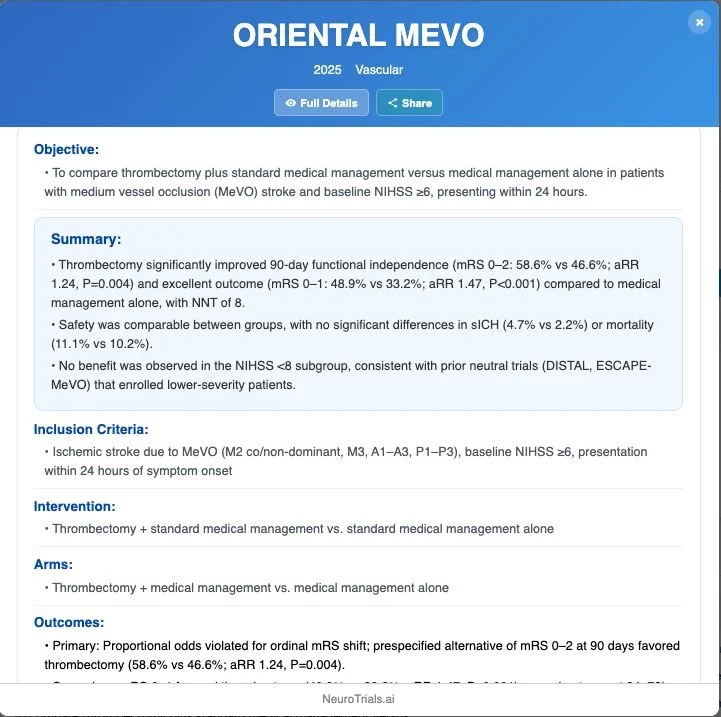
ORIENTAL MEVO (2026 – Interim results)
- Inclusion: MeVO, NIHSS ≥6 (not just disabling stroke)
- Imaging: ≤24h
- Severity threshold enforced
Result:
- mRS 0–2 improved (58.6% vs 46.6%)
- mRS 0–1 improved
- Mild increase in sICH
- Benefits were seen most if NIHSS ≥ 8
Benefit appears in more severe MeVO.
DISTALS (2026 – still going)
- Inclusion: MeVO/DVO ineligible for IVT
- Imaging: Tissue-based reperfusion endpoint
- Device: New device, very small profile, manually expandable, low radial force for smaller arteries.
Result:
- 86% reperfusion vs 28% medical
- 0% sICH so far
- Clinical outcomes pending
Device refinement may matter.
The Evolution
We moved from:
Treating all distal occlusions
- To recognizing harm in mild/moderate cases
- To identifying severity (NIHSS ≥8) as a key selector
- To refining device strategy and imaging
The MeVO door is not closed – it’s being refined.
Mild distal stroke – likely no benefit
Moderate-severe MeVO – possible benefit, pending final results of Oriental-MeVO/DISTALS
Dominant proximal M2 – strongest evidence”
Stay updated with Hemostasis Today.
-
Oct 16, 2026, 15:18Carmine Liberatore: Limited Accuracy of VTE Risk Scores in Multiple Myeloma
-
Oct 16, 2026, 14:55Alex Borstein and the Bleeding Phenotype of Hemophilia A Carriers
-
Oct 16, 2026, 13:59Aya Akmal Amin: Antiphospholipid Syndrome Management and Risk Stratification
-
Oct 16, 2026, 13:10Emanuel Sueldo: CAHT 2026 Celebrates Scientific Progress and Team Achievements
-
Oct 16, 2026, 13:05Maha Othman: Queen’s Health Sciences Advances CAT Risk Models and Pediatric ISTH-BAT Cut-Offs
-
Oct 16, 2026, 13:03Thrombosis Awareness Must Lead to Timely Action – Roche
-
Oct 16, 2026, 12:49Wolfgang Miesbach: 5-Year CBDR Data Confirms Emicizumab Safety and Efficacy in Hemophilia A
-
Oct 16, 2026, 12:40Edward Lee Carter: How Factor XI Inhibition Could Transform Anticoagulation Therapy
-
Oct 16, 2026, 12:40Marc Carrier: Looking Ahead to ISTH 2027 in Vancouver