


Ahmed Alotaibi: How Many Lives Could Nationwide Prehospital Blood Access Potentially Save?
Ahmed Alotaibi, Senior specialist (Blood bank and blood transfusion) at Afif General Hospital – Riyadh Third Health Cluster (Ministry of Health), shared a post on LinkedIn about a recent article by Daniel T. Lammers et al., published in Transfusion, adding:
“How many lives could nationwide prehospital blood access potentially save?
One U.S. study estimated more than 21,000 over four years.
A 2025 study in Transfusion tried to estimate what nationwide access to prehospital blood could mean for trauma survival in the United States.
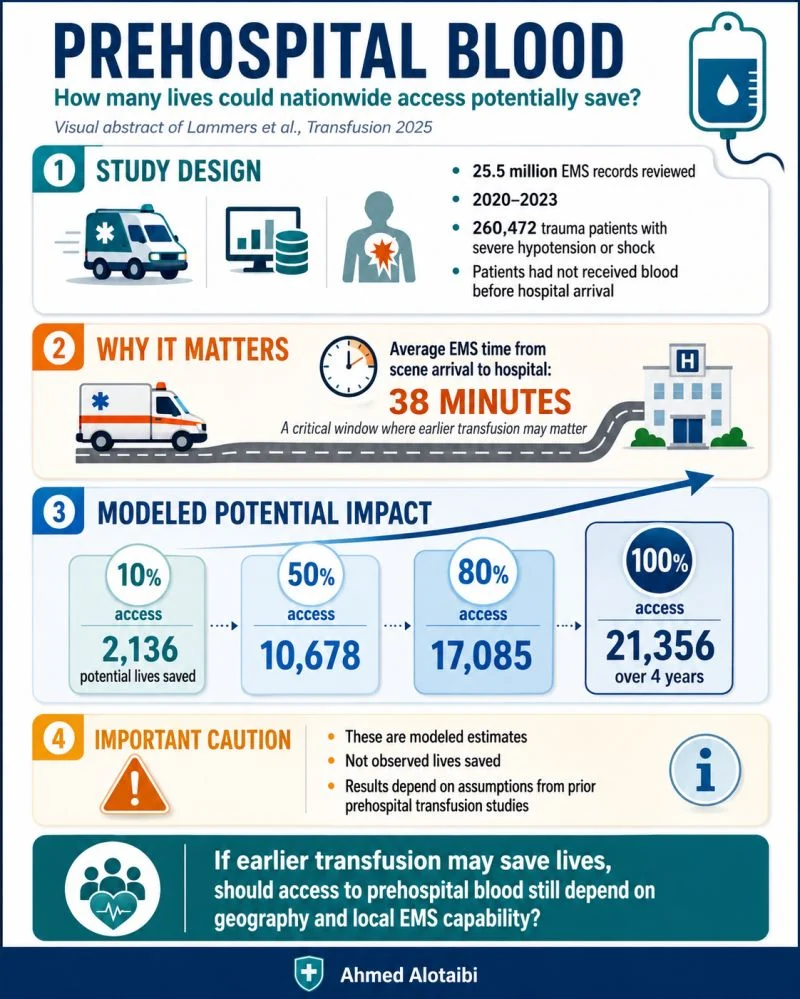
The investigators analysed 25.5 million EMS records from 2020 to 2023 and identified 260,472 trauma patients with severe hypotension or shock who had not received blood before hospital arrival.
They then modelled the potential effect of making prehospital blood products available.
The estimated impact was striking:
- 10% access: about 2,136 potential lives saved
- 50% access: about 10,678
- 80% access: about 17,085
- 100% access: about 21,356 potential lives saved over four years
The average EMS time from arrival on scene to hospital destination was around 38 minutes, which highlights how much critical resuscitation time may be lost before a patient ever reaches a trauma centre.
But the key limitation matters:
These were modelled estimates, not observed lives saved.
The authors applied mortality effects from previous prehospital transfusion studies to a large national EMS population, so the final numbers depend on those assumptions.
Still, the study raises a very important question for trauma systems and blood banks:
If earlier transfusion may save lives, should access to blood depend so heavily on geography and local EMS capability?
For transfusion services, wider prehospital blood use also means thinking about donor supply, product choice, storage, rotation, wastage, and how blood centres support EMS systems.
Should prehospital blood become a standard part of major trauma systems, or should it remain targeted to selected regions and high-risk patients?
Reference:
Lammers DT, Betzold R, Henry R, et al. Nationwide estimates of potential lives saved with prehospital blood transfusions. Transfusion. 2025;65(Suppl 1):S14-S22. doi:10.1111/trf.18174.”
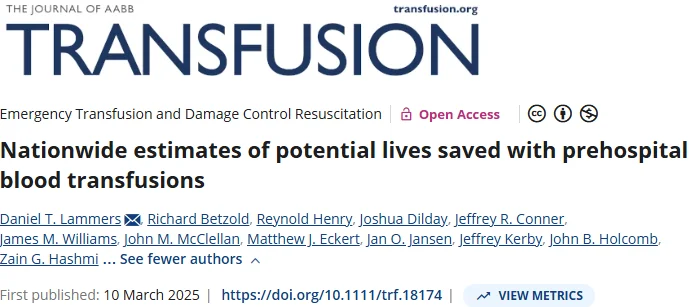
Title: Nationwide estimates of potential lives saved with prehospital blood transfusions
Article: Daniel T. Lammers, Richard Betzold, Reynold Henry, Joshua Dilday, Jeffrey R. Conner, James M. Williams, John M. McClellan, Matthew J. Eckert, Jan O. Jansen, Jeffrey Kerby, John B. Holcomb, Zain G. Hashmi
Stay updated with Hemostasis Today.
-
Sep 20, 2026, 01:18Sebastian Mafeld: Has 2026 Changed How We Treat Pulmonary Embolism?
-
Sep 20, 2026, 01:16Pall T. Onundarson: DOACs – Monitoring, Tailoring Dose and Identifying Problems
-
Sep 20, 2026, 01:15Thierry Fumeaux: From Efficacy to Effectiveness – The Value of Real-World Evidence
-
Sep 20, 2026, 01:14Said El Shamieh: VEGFA Genetic Variants and Bleeding Risk During Warfarin Therapy
-
Sep 20, 2026, 01:04Omar Danoun: Levetiracetam May Increase Thromboembolic Risk With DOACs
-
Sep 20, 2026, 01:02Mohamed Abo-Aly: Which Antiseizure Medication is Safest for Patients on DOACs?
-
Sep 20, 2026, 00:58Hamza Rafiq: How Does a Deep Vein Thrombosis Become a PE?
-
Sep 20, 2026, 00:50A Shared Platelet Factor 4–Targeted Immune Mechanism in Adenovirus Infection – NEJM
-
Sep 20, 2026, 00:46Julia R. Coleman: Platelet Biology and Sex Differences in the Plasma Milieu at AAST 2026