


Aleksandra Pikula: Why Midlife Is The Critical and Underutilized Window for Women’s Stroke and Dementia Prevention
Aleksandra Pikula, Jay and Sari Sonshine Chair in Stroke Prevention and Cerebrovascular Brain Health at University Health Network, shared on LinkedIn about a recent article she and her colleagues co-authored, adding:
”Newly published preprint.
Thank you, American Heart Association, for the invitation to present this topic review – as a priority for womens brain health and stroke prevention
Midlife is not the middle of a woman’s story but a hinge point of her brain’s future.
We know the risks, now we need the actions.
Preeclampsia at 32. Cognitivefog at 47 – dismissed as ‘just menopause.’
At 53, she presents with a TIA and a brain that has been accumulating silent vascular burden for two decades.
Why was each episode treated in isolation?
In this paper, we synthesize a decade of transformative evidence (2015–25) and guidelines on why midlife is the critical and underutilized window for women’s stroke and dementia prevention.
- Adverse pregnancy outcomes like preeclampsia are not transient – neuroimaging reveals greater cerebral small vessel disease 20–30 yrs later, all major APOs independently predict stroke risk decades out
- Menopause transition registers in the brain before it registers in the clinic-imaging studies show changes that are not to be dismissed
- MHT picture has been clarified. Oral MHT carry an increased ischemic stroke risk regardless of initiation timing.
Transdermal estradiol shows a favourable cerebrovascular safety but has not yet demonstrated sustained cognitive benefits, making individualized decisions based on VMS burden, timing, route, and baseline vascular risk essential
- Midlife biomarkers predict stroke 30 yrs out – not only basic panel, but elevated hsCRP, LDL, and Lp(a) together conferred a 2.4-fold increased stroke risk — yet Lp(a) testing remains <20% even in specialty practice
- Late perimenopause is a transient cognitive vulnerability window – making it a critical therapeutic target
- Physicalactivity (multimodal) provides optimal benefits during the menopausal transition – should be a standard prescription
So, midlife is not just a risk period but an intervention period.
Coordinated, lifelong care with one shared question at every appointment: ‘What is her brain health trajectory – and who is watching it?’
- OBGYN – flags preeclampsia as a permanent cerebrovascular marker
- Menopause Specialist- evaluates hormone timing with vascular risk in mind
- Primary Care- adds cognitive baseline at 45, intensifies vascular surveillance at menopause
- Neurology and Stroke -sees high-risk midlife women proactively, not post-event
- Patients receive one unified braincare plan, not five disconnected
The goal is a system where a woman at 35 with a history of preeclampsia already has a brain health plan – not one that begins when she presents with a TIA at 53.
We need a shared belief across specialties that women’s brain health is an overdue obligation.”
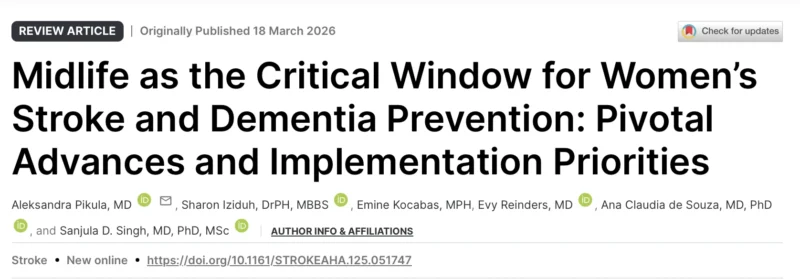
Title: Midlife as the Critical Window for Women’s Stroke and Dementia Prevention: Pivotal Advances and Implementation Priorities
Authors: Aleksandra Pikula, Sharon Iziduh, Emine Kocabas, Evy Reinders, Ana Claudia de Souza, Sanjula D. Singh
Read the Full Article on Stroke
Stay updated on all scientific advances with Hemostasis Today.
-
Sep 30, 2026, 01:52Javed Anees: DADA2 – When a Young Stroke Is More Than a Stroke
-
Sep 30, 2026, 01:51How a Venous Thrombus Becomes Revascularized – ISTH
-
Sep 29, 2026, 22:45Victor Agunyego: Paracetamol – The Most Common Drug We Underestimate
-
Sep 29, 2026, 22:42Nova Sinclair: Advancing the Future of Hematology – Meet Our 2027 Organizing Committee
-
Sep 29, 2026, 22:41Lorenz Räber: Intracoronary Imaging in PCI – Why, When, How, and Which Modality?
-
Sep 29, 2026, 22:31Selma Turkovic: Pleased to Deliver the Opening Presentation at Kingston Hospital
-
Sep 29, 2026, 22:31Miguel Teran: Ultrasound and Simulation in Arterial Blood Sampling
-
Sep 29, 2026, 22:28Mohammad Refaei: Navigating Your Career in Hematology From Training to Practice
-
Sep 29, 2026, 22:27Matteo Foschi: 10 Clinical Pearls for Antithrombotic Therapy in Secondary Stroke Prevention