


Allen Seylani: Impact of a Treat-to-Target Urate-Lowering Strategy on Cardiovascular Events
Allen Seylani, Scientific Reviewer at Oxford University Press, Resident Physician at Cleveland Clinic, shared a post on LinkedIn about a recent article by Pascal Richette et al. published in JAMA Internal Medicine:
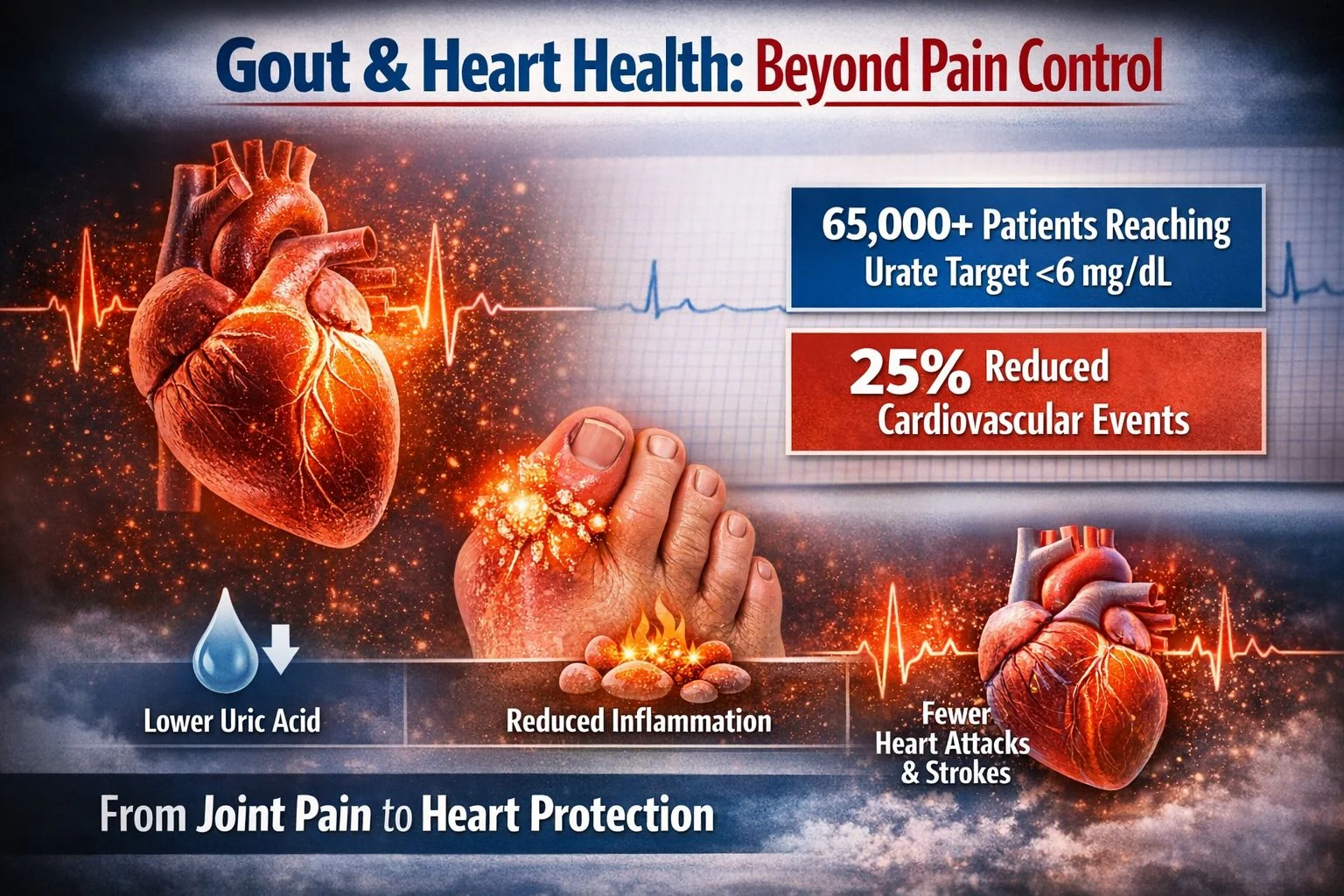
“A new study in JAMA Internal Medicine followed over 100,000 patients with gout and asked a simple but powerful question.
Does treating to a serum urate target below 6 mg/dL actually change cardiovascular outcomes.
The answer appears to be yes.
Patients who achieved target urate levels had a significantly lower risk of major cardiovascular events within 5 years compared with those who did not.
Fewer flares were expected. Fewer heart attacks and strokes were not.
This matters because it reframes gout from a nuisance disease to a systemic inflammatory condition with real cardiovascular consequences. It also challenges us as clinicians and researchers to stop thinking of urate lowering as a checkbox and start thinking of it as disease modification.
The most striking part to me is not just the association, but the implication. Inflammation, not urate alone, may be the missing link connecting gout to cardiovascular risk. Treating to target likely works because it quiets chronic inflammation, reduces flare related inflammatory surges, and stabilizes the system as a whole.
And yet, fewer than one third of patients actually reached target urate levels within a year.
That gap between evidence and practice is where leadership lives.
This is where better care models, tighter follow up, patient education, and accountability can change outcomes at scale. It is also where translational thinking matters, connecting population data, molecular inflammation, and bedside decisions.
Gout is no longer just about pain control. It is about prevention, longevity, and systems level thinking.
Curious how others are integrating treat to target strategies into real world practice, and how we can do better for patients who are still being left behind.”
Title: Urate Lowering and Cardiovascular Risk—Extending the Benefits of a Treat-to-Target Strategy in Gout
Authors: Pascal Richette, Augustin Latourte, Hang-Korng Ea
Read the Full Article on JAMA Internal Medicine

Stay updated with Hemostasis Today.
-
Sep 30, 2026, 14:13Ashok Choudhury: Portal Vein Thrombosis and Outcomes in Cirrhosis
-
Sep 30, 2026, 13:57Leslye Conde Bazán: When Conventional Imaging Is Not Enough – The Role of IVUS
-
Sep 30, 2026, 13:41Huda Salah Eldin: The Challenge of Balancing Antithrombotic Therapy After PCI
-
Sep 30, 2026, 13:29Abdus Salam: What Can CT Venography Reveal About the Veins?
-
Sep 30, 2026, 13:03Amira Mohy: Diagnostic Flow Cytometry Panels for Hematological Malignancies
-
Sep 30, 2026, 12:52Paul Watton: Could Repetitive Head Impacts Leave a Molecular Memory?
-
Sep 30, 2026, 12:41The Journey to ISTH 2027 Starts in Vancouver
-
Sep 30, 2026, 11:36Basit Ali: A Closer Look at CT Venography
-
Sep 30, 2026, 11:16Christina Pohlman: Could aPL Levels Help Predict Stroke Recurrence?