


Allen Seylani: A Small RNA With a Big Grip on Cholesterol and Heart Disease
Allen Seylani, Scientific Reviewer at Oxford University Press, Resident Physician at Cleveland Clinic, shared a post on LinkedIn about a recent article by Xiuchun Li et al. published in Nature Communications:
“A Small RNA With a Big Grip on Cholesterol and Heart Disease
Huge credit to Changcheng Zhou professor of medicine and biomedical sciences at University of California, Riverside University of California, Riverside Internal Medicine department and his team.
Using an advanced sequencing approach that reveals RNA species we have been missing, the authors identify a liver enriched tRNA derived small RNA called tsRNA Glu CTC as the most abundant small RNA in the liver.
This molecule is cholesterol responsive, moves into the nucleus, binds SREBP2, and amplifies transcription of the very pathway that governs cholesterol synthesis. When tsRNA Glu CTC is increased, mice develop hypercholesterolemia, hepatic steatosis, fibrosis, and accelerated atherosclerosis.
When it is silenced with antisense therapy, LDL levels fall, liver fat improves, and atherosclerotic plaque burden shrinks. Even more striking, the naturally modified version of this RNA is far more potent than synthetic RNA, highlighting how RNA chemistry itself shapes disease biology.
This is not just a new pathway. It is a new layer of regulation that sits above the classic statin and PCSK9 paradigm and directly tunes SREBP2 activity. It reframes noncoding RNA as an active transcriptional regulator in cardiometabolic disease and opens the door to RNA targeted therapies that act upstream of cholesterol synthesis itself.
For anyone interested in cardiology, metabolism, RNA biology, or therapeutic innovation, this is worth a close read. It is a reminder that some of the most powerful regulators in biology are the ones we could not see until now.
This discovery opens the door for places like Cleveland Clinic, a leader in cardiovascular medicine, to lead the field in translating tsRNA based biomarkers and antisense therapies into precision tools that target cholesterol biology at its transcriptional core rather than its downstream consequences.”
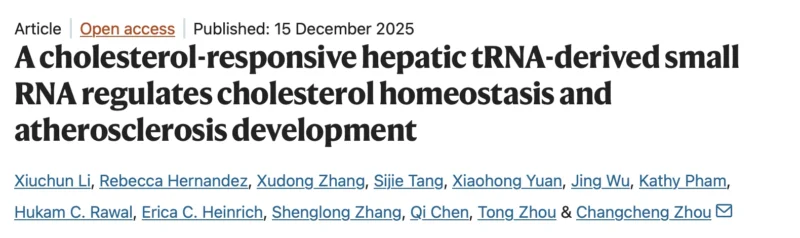
Title: A cholesterol-responsive hepatic tRNA-derived small RNA regulates cholesterol homeostasis and atherosclerosis development
Authors: Xiuchun Li, Rebecca Hernandez, Xudong Zhang, Sijie Tang, Xiaohong Yuan, Jing Wu, Kathy Pham, Hukam C. Rawal, Erica C. Heinrich, Shenglong Zhang, Qi Chen, Tong Zhou, Changcheng Zhou
Read the Full Article on Nature Communications
Explore more posts for deeper insights into hemostasis with Hemostasis Today.
-
Sep 30, 2026, 14:13Ashok Choudhury: Portal Vein Thrombosis and Outcomes in Cirrhosis
-
Sep 30, 2026, 13:57Leslye Conde Bazán: When Conventional Imaging Is Not Enough – The Role of IVUS
-
Sep 30, 2026, 13:41Huda Salah Eldin: The Challenge of Balancing Antithrombotic Therapy After PCI
-
Sep 30, 2026, 13:29Abdus Salam: What Can CT Venography Reveal About the Veins?
-
Sep 30, 2026, 13:03Amira Mohy: Diagnostic Flow Cytometry Panels for Hematological Malignancies
-
Sep 30, 2026, 12:52Paul Watton: Could Repetitive Head Impacts Leave a Molecular Memory?
-
Sep 30, 2026, 12:41The Journey to ISTH 2027 Starts in Vancouver
-
Sep 30, 2026, 11:36Basit Ali: A Closer Look at CT Venography
-
Sep 30, 2026, 11:16Christina Pohlman: Could aPL Levels Help Predict Stroke Recurrence?