


Brecca Gaffney: The Role of Hemophilia Severity on Movement Patterns
Brecca Gaffney, Assistant Professor at University of Colorado Denver Anschutz Medical Campus, reposted from RPTH Journal on LinkedIn:
”New pub alert
Strong work led by postdoc Danielle Siegel, PhD demonstrating the role of hemophilia severity on movement patterns.
Fun collaboration and exciting to see biomechanics being applied in yet another novel clinical population to help inform different types of rehab aimed at preserving long-term joint health.
More to come!!”
Quoting RPTH Journal‘s post:
”Hemophilia and joint health: when does arthropathy start limiting movement?
Recurrent joint bleeds are a hallmark of hemophilia, leading over time to hemophilic arthropathy, chronic joint damage that affects mobility and quality of life.
But how well do standard clinical scores capture real-world functional limitations?
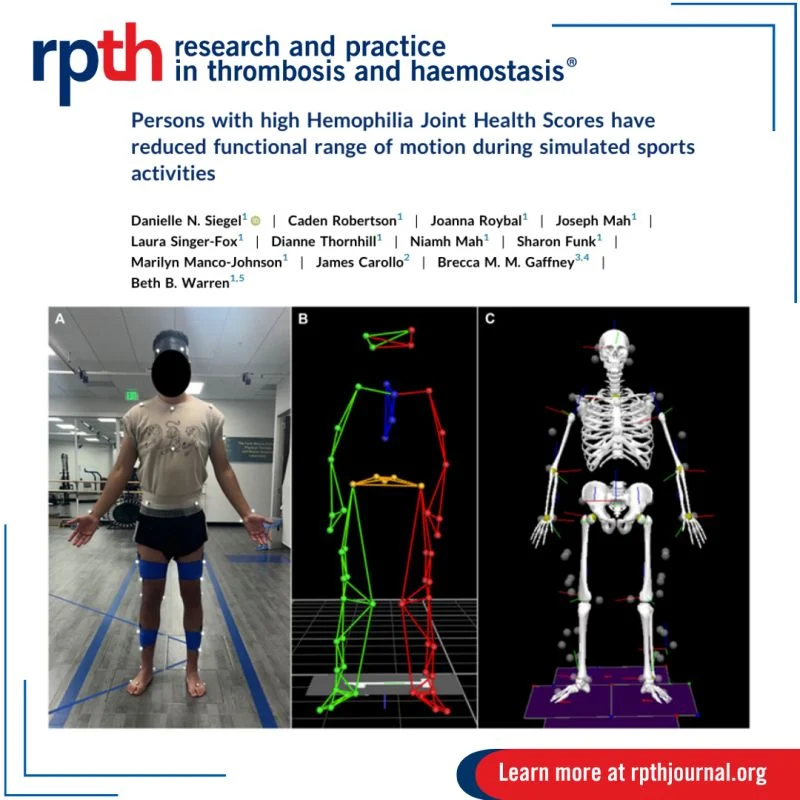
A new study used motion capture analysis to assess functional range of motion (ROM) during simulated sports activities in 86 persons with hemophilia A or B, compared to 33 healthy controls.
Key findings:
- Persons with a 6-joint Hemophilia Joint Health Score (HJHS) ≥25 showed significantly reduced ROM, particularly at the ankle, with reductions in 8 out of 10 activities
- Those with HJHS <25 had functional ROM comparable to healthy controls
- A HJHS threshold of 25 may represent a tipping point for clinically meaningful mobility loss
Findings make a strong case for early prophylaxis and targeted rehabilitation to preserve joint function before that threshold is reached.”
Title: Persons with high Hemophilia Joint Health Scores have reduced functional range of motion during simulated sports activities
Authors: Danielle N. Siegel, Caden Robertson, Joanna Roybal, Joseph Mah, Laura Singer-Fox, Dianne Thornhill, Niamh Mah, Sharon Funk, Marilyn Manco-Johnson, James Carollo, Brecca M.M. Gaffney, Beth B. Warren
Read the Full Article on RPTH Journal
Stay updated on all scientific advances with Hemostasis Today.
-
Sep 30, 2026, 01:52Javed Anees: DADA2 – When a Young Stroke Is More Than a Stroke
-
Sep 30, 2026, 01:51How a Venous Thrombus Becomes Revascularized – ISTH
-
Sep 29, 2026, 22:45Victor Agunyego: Paracetamol – The Most Common Drug We Underestimate
-
Sep 29, 2026, 22:42Nova Sinclair: Advancing the Future of Hematology – Meet Our 2027 Organizing Committee
-
Sep 29, 2026, 22:41Lorenz Räber: Intracoronary Imaging in PCI – Why, When, How, and Which Modality?
-
Sep 29, 2026, 22:31Selma Turkovic: Pleased to Deliver the Opening Presentation at Kingston Hospital
-
Sep 29, 2026, 22:31Miguel Teran: Ultrasound and Simulation in Arterial Blood Sampling
-
Sep 29, 2026, 22:28Mohammad Refaei: Navigating Your Career in Hematology From Training to Practice
-
Sep 29, 2026, 22:27Matteo Foschi: 10 Clinical Pearls for Antithrombotic Therapy in Secondary Stroke Prevention