

Rivaroxaban versus Aspirin after Atrial Fibrillation Ablation – Cardiology Insights and Heart Health
Cardiology Insights and Heart Health shared a post on LinkedIn about a recent article by Atul Verma et al, adding:
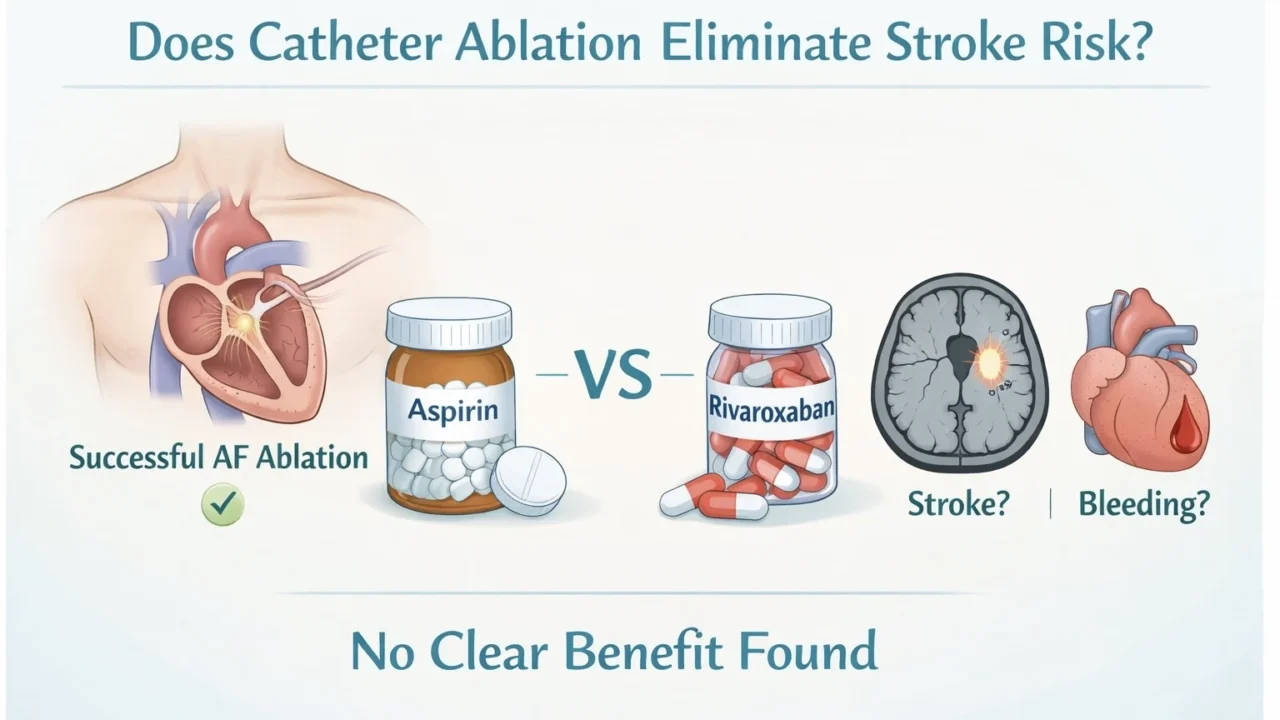
“Catheter ablation can eliminate atrial fibrillation (AF), but does it eliminate the associated stroke risk?
Current clinical guidelines advise indefinite anticoagulation after atrial fibrillation ablation based on a patient’s stroke risk score, regardless of the procedure’s success.
This recent international RCT aimed to assess if long-term oral anticoagulant therapy remains necessary in cases with successful catheter ablation, potentially eliminating this medication for some patients.
The study included 1284 patients with:
- ≥1-year post-successful AF ablation
- Moderate stroke risk (CHA2DS2-VASc score ≥1, or ≥2 for women and patients with vascular disease)
- No recurrent atrial tachyarrhythmia
Patients were randomized to:
- Control: 70-120 mg aspirin
- Anticoagulant: 15 mg rivaroxaban
Composite primary outcome: stroke, systemic embolism, or new covert embolic stroke (≥15 mm infarct on MRI) at 3-year follow-up
- 5 events (rivaroxaban) versus 9 events (aspirin)
- RR 0.56 (95 percent CI 0.19-1.65), P=0.28
Secondary outcome: stroke/systemic embolism alone
- RR = 0.72 (95 percent CI 0.23-2.25)
The 95 percent confidence intervals for the risk ratios of both the primary and secondary efficacy measures crossed 1, indicating no statistically significant benefit.
Safety outcomes:
- No significant difference in fatal/major bleeding – HR 2.51 (95 percent CI 0.79-7.95)
- Higher minor and clinically relevant nonmajor bleeding incidence with rivaroxaban
Researchers noted that the incidences of primary and secondary outcomes were much lower than anticipated, with previous studies involving patients of similar stroke risk having higher rates.
They attributed this to catheter ablation being effective at reducing stroke risk or to selection bias of participants chosen for the study.
Strengths:
- Randomized and international design
- 3-year follow-up
- MRI detection of subclinical cerebral infarcts
Limitations:
- Underpowered results due to unexpectedly low event rates
- Predominantly older, male population
- Limited applicability to patients with very high stroke risk
Future trials
- Investigate higher stroke risk populations
- Compare discontinuation to placebo rather than aspirin
- Have greater power for clinical stroke outcomes
- Incorporate continuous remote rhythm monitoring to better assess AF burden post-ablation
In patients with moderate stroke risk and a successful AF ablation, rivaroxaban did not significantly reduce stroke risk compared with aspirin, but did have higher non-major bleeding risk.
While these findings do not support routine discontinuation of anticoagulation with aspirin, they suggest that stroke risk after a successful ablation may be lower than previously assumed and prompt further investigation into individualized anticoagulation strategies.”
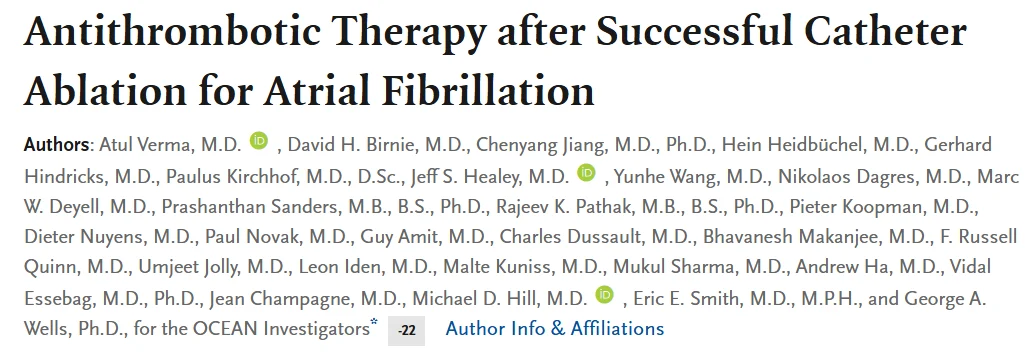
Title: Antithrombotic Therapy after Successful Catheter Ablation for Atrial Fibrillation
Authors: Atul Verma, David H. Birnie, Chenyang Jiang, Hein Heidbüchel, Gerhard Hindricks, Paulus Kirchhof, Jeff S. Healey, Yunhe Wang, Nikolaos Dagres, Marc W. Deyell, Prashanthan Sanders, Rajeev K. Pathak, Pieter Koopman, Dieter Nuyens, Paul Novak, Guy Amit, Charles Dussault, Bhavanesh Makanjee, Russell Quinn, Umjeet Jolly, Leon Iden, Malte Kuniss, Mukul Sharma, Andrew Ha, Vidal Essebag, Jean Champagne, Michael D. Hill, Eric E. Smith, George A. Wells
Stay updated on all scientific advances with Hemostasis Today.
-
Oct 16, 2026, 12:49Wolfgang Miesbach: 5-Year CBDR Data Confirms Emicizumab Safety and Efficacy in Hemophilia A
-
Oct 16, 2026, 12:40Edward Lee Carter: How Factor XI Inhibition Could Transform Anticoagulation Therapy
-
Oct 16, 2026, 12:40Marc Carrier: Looking Ahead to ISTH 2027 in Vancouver
-
Oct 16, 2026, 12:30Bob Lempke: How One Blood Donation Can Save Up to Three Lives
-
Oct 16, 2026, 12:30Why VWF Therapies Belong on the EU Critical Medicines List – EHC
-
Oct 16, 2026, 12:17Exploring Endothelial Cells, Genetic Fate Mapping, and Revascularization – ISTH
-
Oct 16, 2026, 10:07Habib Bennaceur: Building a Stronger Care Pathway for Sickle Cell Disease in India
-
Oct 16, 2026, 09:59Tareq Abadl: A Simple Guide to Blood Collection Tubes
-
Oct 16, 2026, 09:50Mona Alfaraj: Distinguishing HCL from SMZL in Bone Marrow