


Danny Hsu: The Reversal Dilemma – Rethinking our approach to DOAC-associated ICH
Danny Hsu, President of THANZ, Director of Therapeutic Apheresis, Immune and Obstetric Haematology at South Western Sydney Local Health District, shared RPTH Journal’s post on LinkedIn, adding:
“The Reversal Dilemma: Rethinking our approach to DOAC-associated ICH
Managing DOAC-associated intracerebral hemorrhage (ICH) remains one of the most high-stakes challenges we face in thrombosis and stroke care. We constantly have to balance the urgent need for rapid anticoagulation reversal against the dreaded prothrombotic risk.
While we initially had high hopes for targeted reversal, the unexpected and rather disappointing thrombotic complication rates seen with andexanet alfa in the ANNEXA-I trial (~10.3%) have left many of us questioning our real-world algorithms.
This brings us to a highly relevant new study in RPTH Journal evaluating 4-factor prothrombin complex concentrate (4F-PCC) for FXa inhibitor-associated ICH (mostly apixaban).
The results make a very compelling case for 4F-PCC:
Efficacy:
- Hemostatic efficacy achieved in 75% of patients.
- Excellent hemostatic control (less than 20% hematoma expansion) in 67.3%.
- Stable neurological status at 48 hours in 71.2%.
Safety (The critical signal):
- Only a 1.9% thromboembolic event rate (compared to the ~10.3% seen with andexanet alfa).
- Zero arterial thrombotic events.
- The single thrombotic event was a delayed DVT on day 22, making direct causality with 4F-PCC highly uncertain.
Importantly, despite these drastically different thrombotic profiles, 30-day mortality remains comparable (23.1%).
The Takeaway:
4F-PCC is not just a backup option; it represents a highly practical, relatively safe, and effective real-world alternative—especially given the ongoing availability, cost, and thrombosis concerns surrounding targeted reversal agents.
What is the current go-to reversal strategy for DOAC-associated ICH in your centre?”
RPTH Journal shared a post on LinkedIn about a recent article by Mohammad Shamiea et al., published in RPTH Journal, adding:
“Can 4-factor prothrombin complex concentrate (4F-PCC) safely reverse factor Xa inhibitor–associated intracerebral hemorrhage?
Managing DOAC-associated ICH remains one of the most urgent challenges in thrombosis and stroke care. While andexanet alfa provides targeted reversal, concerns around thrombosis, cost, and availability continue to shape real-world practice.
A new RPTH study evaluated outcomes in 52 patients with FXa inhibitor–associated intracerebral hemorrhage treated with 4F-PCC.
Here’s the key signal:
- Hemostatic efficacy achieved in 75% of patients
- Stable neurological status at 48 hours in 71.2%
- Only 1 thromboembolic event occurred (1.9%)
- No arterial thrombotic events were observed
What’s changing under the hood?
- Most patients were receiving apixaban (86.6%) for atrial fibrillation
- Median baseline hematoma volume was relatively small (5.45 mL)
- Nearly all patients avoided rescue therapy within 12 hours
- Excellent hemostatic control (<20% hematoma expansion) occurred in 67.3%
The most interesting comparison comes from ANNEXA-I.
In this cohort:
Thrombotic complications: 1.9%
Compared with ANNEXA-I andexanet data:
Thrombotic complications: approxiamately 10.3%
Importantly, mortality remained similar:
30-day mortality: 23.1%
This highlights a key clinical tradeoff. Balancing rapid anticoagulation reversal against prothrombotic risk.
One particularly important point from this study:
The single thrombotic event was a delayed DVT occurring on day 22, making direct causality with 4F-PCC uncertain.
Translation:
4F-PCC may represent a practical and relatively safe real-world alternative for FXa inhibitor reversal in ICH, especially in healthcare settings where andexanet alfa is unavailable or cost-prohibitive.”
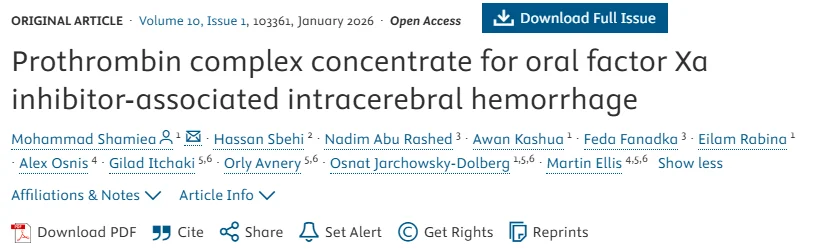
Title: Prothrombin complex concentrate for oral factor Xa inhibitor-associated intracerebral hemorrhage
Authors: Mohammad Shamiea, Hassan Sbehi, Nadim Abu Rashed, Awan Kashua, Feda Fanadka, Eilam Rabina, Alex Osnis, Gilad Itchaki, Orly Avnery, Osnat Jarchowsky-Dolberg, Martin Ellis
Other posts featuring Danny Hsu and RPTH Journal on Hemostasis Today.
-
Oct 6, 2026, 16:43Beth Shirley: Xylitol Consumption Increases Platelet Reactivity and Cardiovascular Risk
-
Oct 6, 2026, 16:37Jared Rice: What Sets the Transfusion Threshold in Anemia of Prematurity?
-
Oct 6, 2026, 16:30Thirunavukkarasu Angappan: Immunoglobulin Decides How Much Plasma Gets Collected
-
Oct 6, 2026, 16:18Gemma Davies: New CMML Research Selected for Presentation at the 68th ASH Annual Meeting
-
Oct 6, 2026, 16:03Professor Csongor Kiss Receives the Kálmán Laki Prize – Hungarian Society of Thrombosis and Haemostasis
-
Oct 6, 2026, 15:52Mark Kheifets: A Massive Stent Thrombosis Requiring Aspiration Thrombectomy
-
Oct 6, 2026, 15:40Joseph Aslan։ Targeting Mitochondrial Permeability Transition To Reduce Platelet Thrombogenicity
-
Oct 6, 2026, 15:36Nominations Open for ISTH Outstanding Mentor Awards – ISTH
-
Oct 6, 2026, 15:17Walaa Obaid: How Warfarin Went From Poison To Medicine