


Deepak Yadav: Practice-Changing Stroke Trial Alert
Deepak Yadav, Consultant and Assistant Professor of Neurology at Amrita Hospital, shared on LinkedIn about a recent article by Yao Lu et al, published in The Lancet:
”Practice-Changing Stroke Trial Alert | The Lancet (2026)
For decades, neuroprotection in acute ischaemic stroke has been the graveyard of failed trials.
Hundreds of agents showed promise in animals… and disappeared in humans.
Until now.
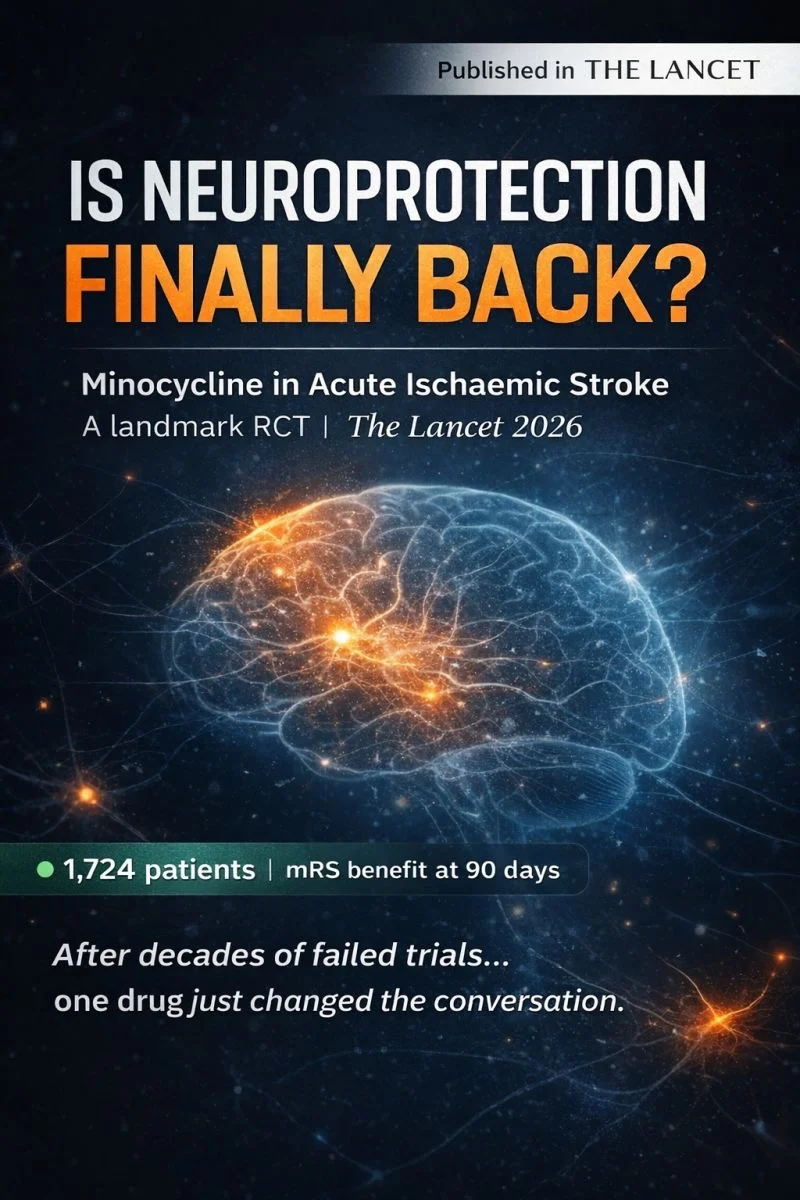
The EMPHASIS trial, a large multicentre, double-blind RCT published in The Lancet, reports that oral minocycline started within 72 hours of acute ischaemic stroke improves 90-day functional outcomes — safely.
What did EMPHASIS show?
- 1,724 patients, NIHSS 4–25
- Minocycline vs placebo (added to standard care)
- mRS 0–1 at 90 days:
52.6% vs 47.4%
Adjusted RR 1.11 (p = 0.006)
- Ordinal mRS shift also significant
- No increase in symptomatic ICH or serious adverse events
This is not a surrogate marker. This is functional recovery.
Why is this IMPORTANT?
Because this trial succeeds where others failed:
- NA-1 (ESCAPE-NA1) – benefit lost after adjustment
- Magnesium (FAST-MAG) – biologically elegant, clinically neutral
- Citicoline (ICTUS) – large trial, no benefit
- NXY-059 (SAINT I and II) – early hope, ultimate disappointment
EMPHASIS is different:
Large sample
Pragmatic design
Clinically meaningful endpoint
Cheap, widely available drug
Oral, easy to implement — even in resource-limited settings
Why might minocycline work?
Because stroke injury is not just vascular — it’s inflammatory.
Minocycline targets:
- Microglial activation
- Matrix metalloproteinases
- BBB disruption
- Secondary neuroinflammation
In short: it addresses the biology of delayed injury, not just reperfusion.
Should we change practice today? Not blindly.
But this trial re-opens the neuroprotection conversation with real data.
Questions that now matter:
Benefit in minor vs severe strokes?
Interaction with thrombolysis / thrombectomy?
Optimal dose and duration?
External validation outside China?
Bottom line:
After years of negative trials, EMPHASIS gives neuroprotection its strongest clinical signal yet.
This is one of those papers we’ll be citing for years.
Do you think minocycline should enter routine post-stroke protocols — or do we wait for replication?
Let’s discuss.”
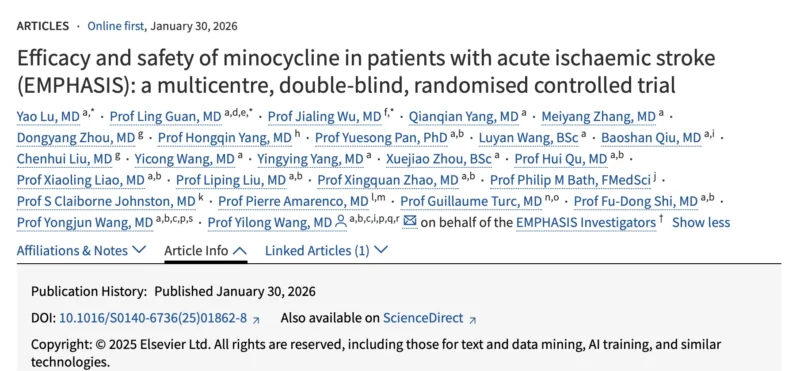
Title: Efficacy and safety of minocycline in patients with acute ischaemic stroke (EMPHASIS): a multicentre, double-blind, randomised controlled trial
Authors: Yao Lu, Ling Guan, Jialing Wu, Qianqian Yang, Meiyang Zhang, Dongyang Zhou, Hongqin Yang, Yuesong Pan, Luyan Wang, Baoshan Qiu, Chenhui Liu, Yicong Wang, Yingying Yang, Xuejiao Zhou, Hui Qu, Xiaoling Liao, Liping Liu, Xingquan Zhao, Philip M Bath, S Claiborne Johnston, Pierre Amarenco, Guillaume Turc, Fu-Dong Shi, Yongjun Wang, Yilong Wang on behalf of the EMPHASIS Investigators
Read the Full Article on The Lancet
Stay updated on all scientific advances with Hemostasis Today.
-
Oct 4, 2026, 11:02Stimuli-Induced Remodeling of the Platelet Lipidome in Pulmonary Embolism – ESC
-
Oct 4, 2026, 10:45Join the Bleeding Disorders Advocacy Network! – HFA
-
Oct 4, 2026, 06:12David McIntosh: 900 Plasma Donations One Patient One Lifeline
-
Oct 4, 2026, 06:00Aadil Sheikh: Menopausal Hormone Therapy and Thrombosis Rethinking Route Dose and Risk
-
Oct 4, 2026, 05:39Alicja Urbaniak: Targeting CD148 for Novel Antithrombotic Therapy
-
Oct 4, 2026, 05:27Nirali Thakkar: Influenza and Myocardial Infarction An Unexpected Cardiovascular Connection
-
Oct 4, 2026, 05:03Hisham Fahmi: Thromboprophylaxis in Children With ALL A Risk Adapted Approach
-
Oct 4, 2026, 05:00Mary Cushman: Erin Michos Highlights Rising Heart Disease Mortality Among Younger Women in the US
-
Oct 4, 2026, 04:48Liv Tybjærg Nordestgaard: Is Fasting Necessary Before Blood Sampling?