


Edward Lee Carter: 61% of Patients on Reduced-Dose Apixaban Did Not Meet Label Criteria
Edward Lee Carter, Clinical Pharmacist Practitioner at U.S. Department of Veterans Affairs, shared a post on LinkedIn about a recent article by Pishoy Gouda etv al., published in JACC: Advances, adding:
“Apixaban 2.5 mg BID isn’t simply the ‘safer dose.’
It’s the correct dose for a specific patient population.
A new JACC: Advances analysis of real-world apixaban prescribing caught my attention:
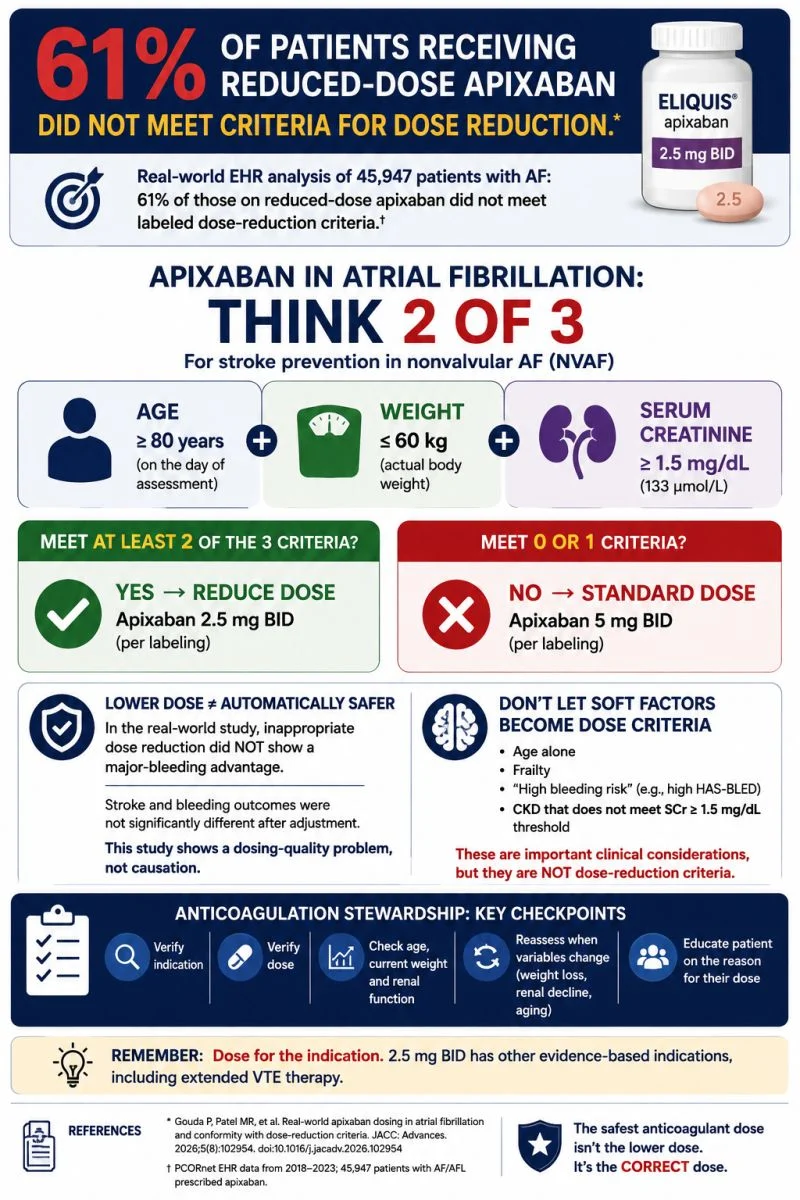
61% of patients receiving reduced-dose apixaban did not meet the labeled criteria for dose reduction.
For stroke prevention in nonvalvular atrial fibrillation, the rule is worth remembering:
Think 2 of 3
- Age 80 years or older
- Weight 60 kg or less
- Serum creatinine 1.5 mg/dL or higher
Meet at least 2 of 3, use apixaban 2.5 mg BID
Meet 0 or 1, use generally 5 mg BID, per labeling.
Why does inappropriate dose reduction happen?
The reasoning is often understandable:
- ‘They’re elderly.’
- ‘They’re frail.’
- ‘Their kidneys aren’t great.’
- ‘I’m worried about bleeding.’
Those factors absolutely deserve clinical consideration.
But they don’t independently rewrite the dose-reduction criteria.
And importantly, this study did not show that inappropriate dose reduction provided a major-bleeding advantage.
It also did not prove that every off-label dose reduction causes stroke – this was observational evidence, and that distinction matters.
What it does reveal is a persistent medication-safety opportunity.
This is anticoagulation stewardship at its most practical:
- Verify the indication.
- Verify the dose.
- Check current weight and renal function.
- Reassess as patients age and clinical circumstances change.
And perhaps most importantly:
Don’t confuse dose reduction with risk reduction.
Sometimes the safest anticoagulant dose isn’t the lower dose.
It’s the correct dose.
Important: these criteria apply to NVAF dosing. Apixaban 2.5 mg BID has other evidence-based indications, including extended VTE therapy.”
Title: Clinical Patterns and Appropriateness of Apixaban Dosing in Patients With Atrial Fibrillation
Authors: Pishoy Gouda, Josephine Harrington, Kelly Arps, Gretchen Sanders, Anqi Chen, Karen Chiswell, Paul Hofmann, Keith Marsolo, Kirubel Asfaw, Rosa Coppolecchia, John H. Alexander, Jonathan Piccini, Christopher B. Granger, Heidi T. May, Elizabeth Chrischilles, Benjamin A. Steinberg, Alanna M. Chamberlain, Jeffrey VanWormer, W. Schuyler Jones, Manesh R. Patel
Other posts featuring Edward Lee Carter on Hemostasis Today.
-
Sep 20, 2026, 03:22The Voices of People Living With Bleeding Disorders – EHC
-
Sep 20, 2026, 01:18Sebastian Mafeld: Has 2026 Changed How We Treat Pulmonary Embolism?
-
Sep 20, 2026, 01:16Pall T. Onundarson: DOACs – Monitoring, Tailoring Dose and Identifying Problems
-
Sep 20, 2026, 01:15Thierry Fumeaux: From Efficacy to Effectiveness – The Value of Real-World Evidence
-
Sep 20, 2026, 01:14Said El Shamieh: VEGFA Genetic Variants and Bleeding Risk During Warfarin Therapy
-
Sep 20, 2026, 01:04Omar Danoun: Levetiracetam May Increase Thromboembolic Risk With DOACs
-
Sep 20, 2026, 01:02Mohamed Abo-Aly: Which Antiseizure Medication is Safest for Patients on DOACs?
-
Sep 20, 2026, 00:58Hamza Rafiq: How Does a Deep Vein Thrombosis Become a PE?
-
Sep 20, 2026, 00:50A Shared Platelet Factor 4–Targeted Immune Mechanism in Adenovirus Infection – NEJM