


Platelet-Derived Extracellular Vesicles for Hemostasis and Bleeding Reduction in TBI – Every Labs
Every Labs shared a post on LinkedIn about a recent article by Alpa Trivedi et al., pubished in Journal of Translational Medicine, adding:
“Freeze-dried platelet vesicles cut bleeding in the injured brain, no cold chain needed.
New in the Journal of Translational Medicine (July 20, 2026), a UCSF-led team tested freeze-dried platelet-derived extracellular vesicles (LPEVs) in traumatic brain injury. Mice received one dose 40 minutes after controlled cortical impact.
Why this matters
- Hemorrhage is the leading cause of preventable death worldwide; intracranial bleeding drives early deaths after TBI.
- TBI is the top cause of death and disability in people aged 1 to 44 globally.
- Freeze-dried vesicles need no cold chain, so they could ride in an ambulance or field kit.
Key takeaways
- One LPEV dose 40 minutes post-injury significantly reduced intracranial hemorrhage in a mouse cortical impact model.
- LPEVs generated thrombin and sped clot formation in blood from healthy donors, trauma patients, and dysfunctional platelets.
- Effects ran through GPIIb/IIIa-dependent platelet aggregation; blood-brain barrier permeability and neuroinflammation were unchanged.
Reality check
The authors note LPEVs kept platelets’ hemostatic cargo but lost vasculoprotective factors, decoupling bleeding control from barrier protection. Human trials and dosing studies come next.
Bottom line
A shelf-stable vesicle product may stop brain bleeding early after trauma, though barrier repair will need something more.
Institutions
- University of California, San Francisco
- Cellphire Therapeutics, Inc.
- Vitalant Research Institute
- Uniformed Services University
Citation
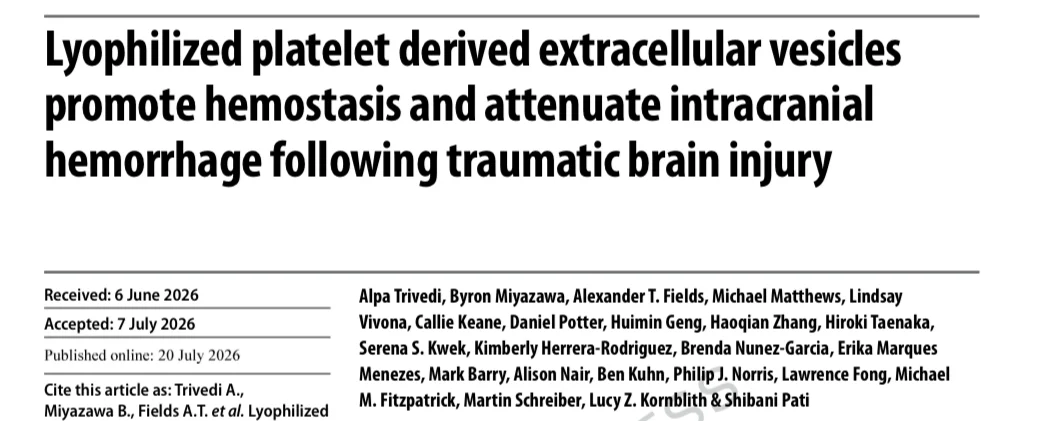
Lyophilized platelet derived extracellular vesicles promote hemostasis and attenuate intracranial hemorrhage following traumatic brain injury Trivedi et al., Journal of Translational Medicine (2026). Volume and article number not yet indexed at time of writing.”
Title: Lyophilized platelet derived extracellular vesicles promote hemostasis and attenuate intracranial hemorrhage following traumatic brain injury
Authors: Alpa Trivedi, Byron Miyazawa, Alexander T. Fields, Michael Matthews, Lindsay Vivona, Callie Keane, Daniel Potter, Huimin Geng, Haoqian Zhang, Hiroki Taenaka, Serena S. Kwek, Kimberly Herrera-Rodriguez, Brenda Nunez-Garcia, Erika Marques de Menezes, Mark Barry, Alison Nair, Ben Kuhn, Philip J. Norris, Lawrence Fong, Michael M. Fitzpatrick, Martin Schreiber, Lucy Z. Kornblith and Shibani Pati
Stay updated on all scientific advances with Hemostasis Today.

-
Sep 18, 2026, 15:54Swapnil Pawar: Why Aren’t We Using Cryopreserved Platelets Everywhere Yet?
-
Sep 18, 2026, 15:37Abdul Mannan: Evaluating Longitudinal Platelet Trends Beyond Standard Reference Intervals
-
Sep 18, 2026, 15:30Peter A. Everts։ Platelet Phenotype May Hold the Key to More Consistent PRP Therapy
-
Sep 18, 2026, 15:25Brandon Temple: Turning Personal Experience Into Advocacy for wAIHA Research
-
Sep 18, 2026, 15:01A. M. Thirugnanam: Antiplatelet Discontinuation and the Risk of Stent Thrombosis
-
Sep 18, 2026, 14:52Abdul Muqtadir Abbasi: How Do Hematologists Know Which Coagulation Factor Is the Problem?
-
Sep 18, 2026, 14:48Kato Ramaekers: Redefining Integrin αIIbβ3 in Platelet Formation
-
Sep 18, 2026, 14:33Heghine Khachatryan: The discussion of Thrombophilia, APS and Coagulation Testing
-
Sep 18, 2026, 14:27Maria Cherska: Are We Overlooking the Spleen in Cardiometabolic Research?