


Francisco Chacón-Lozsán: Does Tranexamic Acid Still Have a Role in Gastrointestinal Bleeding?
Francisco Chacón-Lozsán, Fellow at World Extreme Medicine, Member of European Society of Intensive Care Medicine (ESICM) and American College of Cardiology, shared a post on LinkedIn about a recent article by Ernesto Calderon Martinez et al, published in Indian Journal of Gastroenterology, adding:
“Tranexamic acid in gastrointestinal bleeding: Are we finally ready to change practice?
Tranexamic acid (TXA) has transformed the management of traumatic bleeding, postpartum hemorrhage, and perioperative blood loss.
Yet its role in acute gastrointestinal (GI) bleeding has remained controversial, largely because the landmark HALT-IT trial failed to demonstrate an overall mortality benefit and raised concerns about thromboembolic complications.
Many clinicians consequently abandoned TXA for GI bleeding altogether.
This systematic review and meta-analysis, including 23 studies and more than 2 million patients, offers a more nuanced perspective. Rather than asking whether TXA simply ‘works’ or ‘doesn’t work,’ it identifies the clinical settings where benefit may exist and those where caution is warranted.
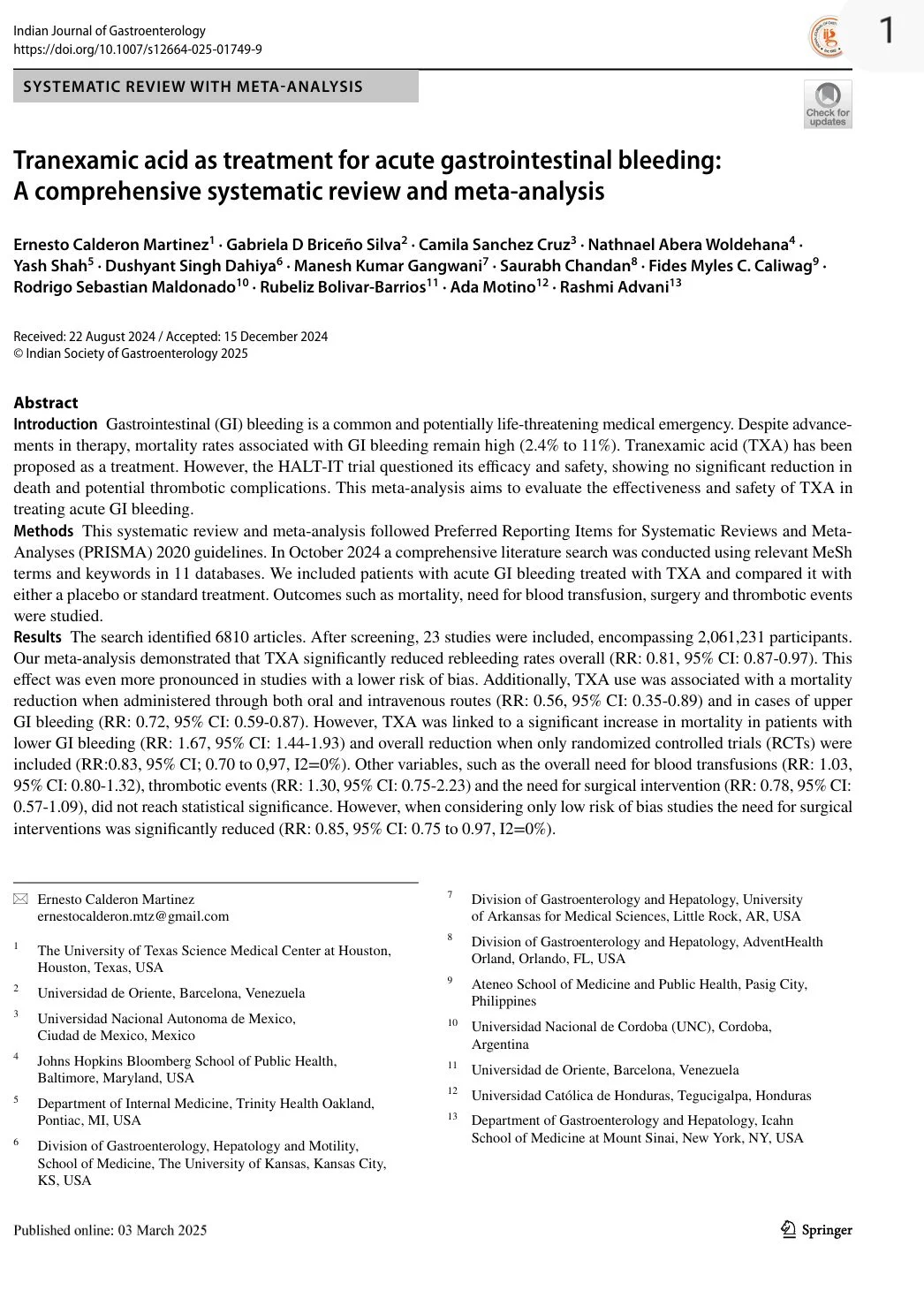
The strongest finding is a 19% reduction in rebleeding (RR 0.81, 95% CI 0.68–0.97), suggesting that inhibition of fibrinolysis can improve clot stability after the initial hemorrhage. Importantly, this benefit was most consistent in upper gastrointestinal bleeding (UGIB).
The mortality analysis is even more interesting.
Although the overall pooled mortality reduction did not reach statistical significance, predefined subgroup analyses demonstrated a significant mortality benefit in patients with UGIB (RR 0.72), when multiple routes of administration were used, and when only randomized controlled trials were analyzed.
In contrast, the available evidence suggested a potential increase in mortality among patients with lower GI bleeding, emphasizing that gastrointestinal bleeding should not be treated as a single disease entity.
Equally important is what TXA did not improve.
The meta-analysis found no convincing reduction in overall transfusion requirements, hospital length of stay, endoscopic intervention, or surgery in the primary analyses.
Likewise, no statistically significant increase in thromboembolic events was demonstrated across the pooled data, although heterogeneity remained substantial and careful patient selection remains essential.
The clinical message is therefore more balanced than previous interpretations of HALT-IT. TXA should probably not be administered routinely to every patient with GI bleeding.
However, dismissing the drug entirely may also be an oversimplification. Patients with severe upper GI bleeding, particularly those with evidence of hyperfibrinolysis or persistent rebleeding despite standard therapy, may represent the subgroup most likely to benefit.
Conversely, current evidence does not support its routine use in lower GI bleeding.
As always, physiology should guide therapy.”
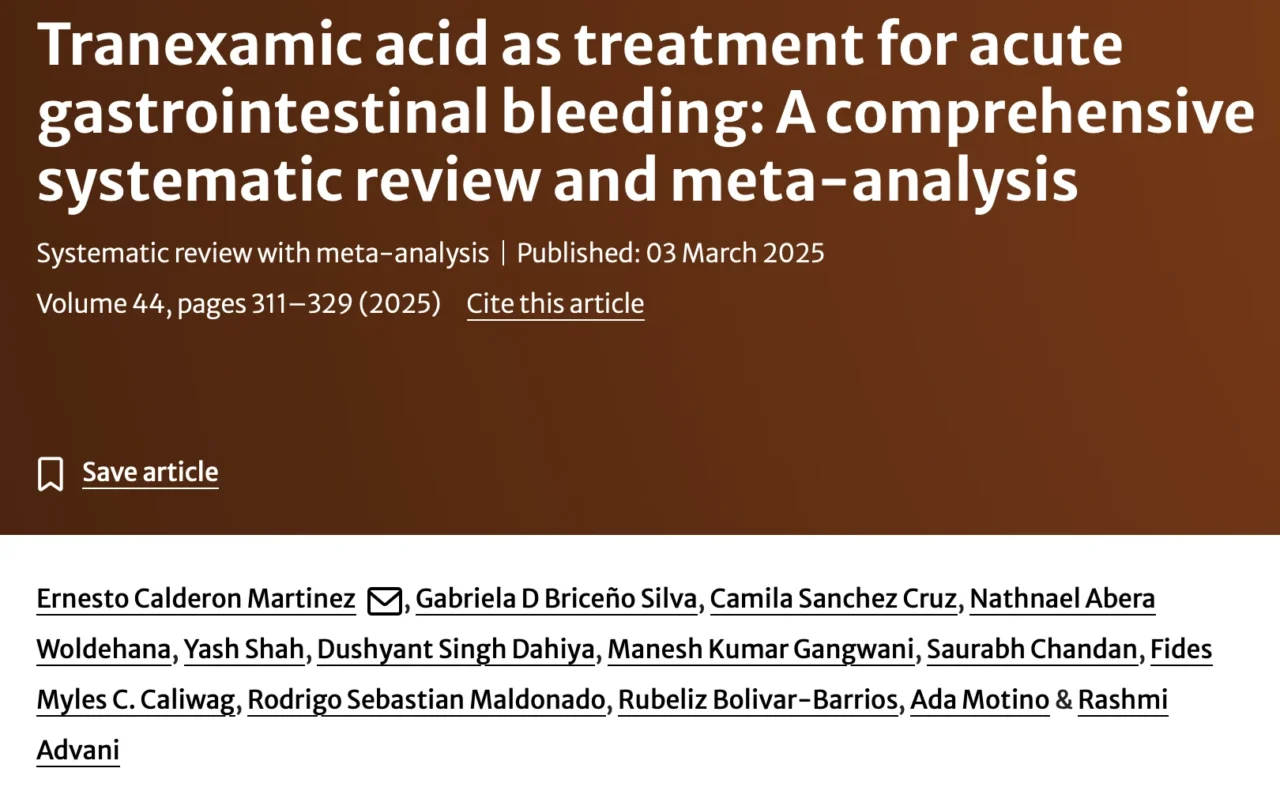
Title: Tranexamic acid as treatment for acute gastrointestinal bleeding: A comprehensive systematic review and meta-analysis
Authors: Ernesto Calderon Martinez, Gabriela D. Briceño Silva, Camila Sanchez Cruz, Nathnael Abera Woldehana, Yash Shah, Dushyant Singh Dahiya, Manesh Kumar Gangwani, Saurabh Chandan, Fides Myles C. Caliwag, Rodrigo Sebastian Maldonado, Rubeliz Bolivar-Barrios, Ada Motino, Rashmi Advani
Stay updated on all scientific advances with Hemostasis Today.
-
Sep 22, 2026, 04:43Michael Cahillane: Highlights From BBTS2026 in Glasgow
-
Sep 22, 2026, 04:15Wolfgang Miesbach: First AAV Gene Therapy Data in Adolescents With Haemophilia B
-
Sep 22, 2026, 04:03Emmanuel J Favaloro: 100 Years of VWD – A Special Virtual Issue
-
Sep 22, 2026, 03:31Mostafa Elshazly: How Is Humidification Used During Non Invasive Ventilation?
-
Sep 22, 2026, 03:05Sumyea Kabir: Jehovah’s Witnesses Update Their Position on Blood Components
-
Sep 22, 2026, 02:33Gerardo Moscatelli: The Spike Protein Cascade – From Endothelial Binding to Vascular Collapse
-
Sep 21, 2026, 20:56George Touma: ApoB Should Be Central to All Lipid Guidlines
-
Sep 21, 2026, 20:55Christopher Robinson: Obstetric Risks Are Seen at the Extremes of Birthweight
-
Sep 21, 2026, 20:54Emicizumab for Refractory GI Bleeding in Myeloma-Associated Acquired VWD – JTH