


Heghine Khachatryan: Less Frequent INR Monitoring – Does It Necessarily Mean Poorer Anticoagulation Control?
Heghine Khachatryan, Editor-in-Chief of Hemostasis Today, Head of Hemophilia and Thrombosis Center at Yeolyan Hematology and Oncology Center, shared Thrombosis Update’s post on LinkedIn:
“Less frequent INR monitoring — does it necessarily mean poorer anticoagulation control?
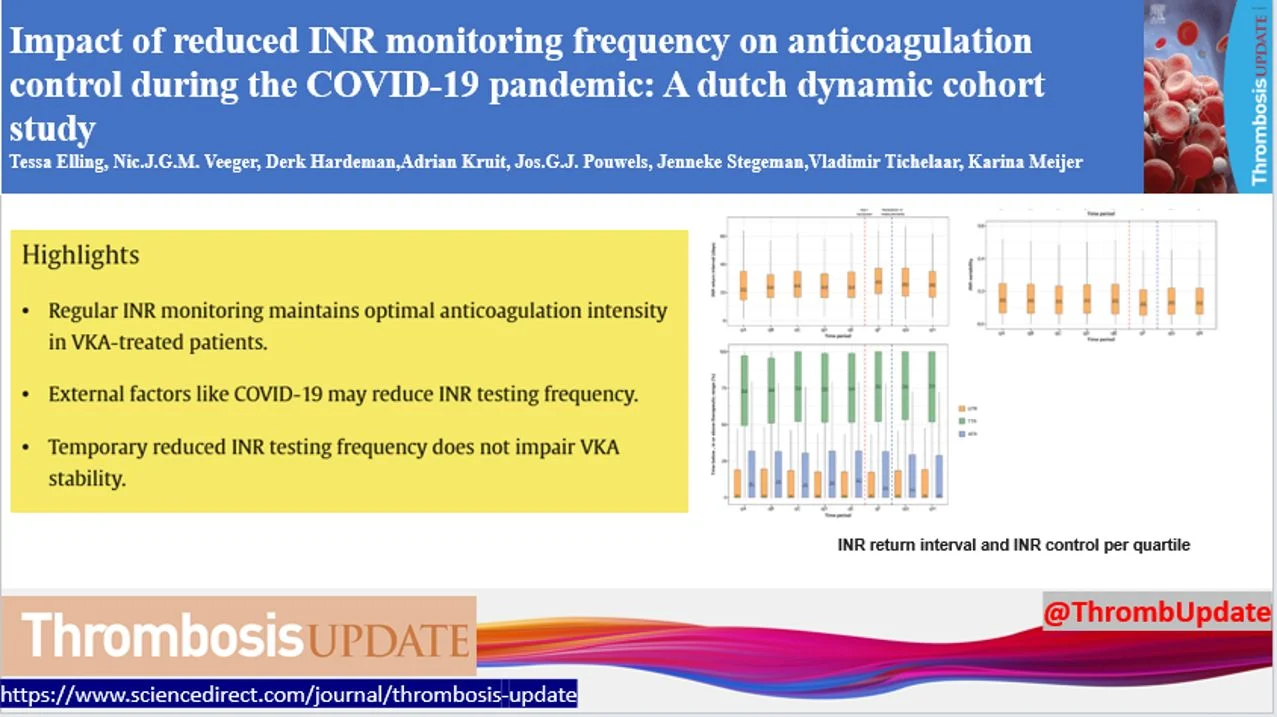
An important real-world observation from a Dutch dynamic cohort study published in Thrombosis Update challenges an assumption deeply embedded in VKA management: that reducing INR testing frequency will inevitably compromise anticoagulation stability.
During the COVID-19 pandemic, INR monitoring became less frequent compared with the pre-pandemic period. Yet, importantly, this temporary reduction did not appear to impair VKA stability.
The message is nuanced.
Regular INR monitoring remains a cornerstone of safe and effective vitamin K antagonist therapy. However, in appropriately selected, clinically stable patients, the optimal monitoring strategy may be more individualized than a rigid testing schedule suggests.
For me, the broader lesson extends beyond the pandemic:
Good anticoagulation management is not simply about how often we measure INR—it is about identifying when monitoring adds meaningful clinical value and adapting follow-up to the stability and risk profile of the individual patient.
This raises an interesting question for contemporary anticoagulation practice:
Can we move from fixed INR-monitoring intervals toward more personalized, risk-adapted monitoring strategies in stable VKA-treated patients?”
Thrombosis Update shared a post on LinkedIn about a recent article by Tessa Elling et al., adding:
“This dutch dynamic cohort study in Thrombosis Update reported decreased INR testing frequency during the COVID19 compared with the pre-pandemic period.
Here is the link of the the associated editorial commentary.”
Title: Impact of reduced INR monitoring frequency on anticoagulation control during the COVID-19 pandemic: A dutch dynamic cohort study
Authors: Tessa Elling, Nic J.G.M. Veeger, Derk Hardeman, Adrian Kruit, Jos G.J. Pouwels, Jenneke Stegeman, Vladimir Tichelaar, Karina Meijer
Stay updated on all scientific advances with Hemostasis Today.
-
Sep 22, 2026, 19:02Blocking Histone-Induced Platelet-Erythrocyte Interactions With Polyanions – Platelets Journal
-
Sep 22, 2026, 18:49Abdul Rahman Hamad: Early Action for Better Outcomes in Deep Vein Thrombosis
-
Sep 22, 2026, 18:37Carmine Siniscalchi: Age-Adjusted D-Dimer Cutoffs in DVT Diagnosis
-
Sep 22, 2026, 18:37Stefano Romeo: The Cardiovascular Patient Journey is Still Full of Gaps
-
Sep 22, 2026, 18:11Bharath Kumar V.։ Advancing Safer Anticoagulation for Cancer-Associated Thrombosis
-
Sep 22, 2026, 18:10Fatima Zahra: ASH Released New Guidelines on the Diagnosis of Iron Deficiency
-
Sep 22, 2026, 17:49Nirav Dhanesha: Targeting FXI for Safer Anticoagulation
-
Sep 22, 2026, 17:17Eric Lambert: Intravascular Imaging and the Future of Precision PCI
-
Sep 22, 2026, 16:45Claudiu Stoicescu: Are We Starting Cardiovascular Risk Assessment Too Late?