


Heghine Khachatryan: When Cancer Is Not Enough to Predict VTE Risk
Heghine Khachatryan, Editor-in-Chief of Hemostasis Today, Head of Hemophilia and Thrombosis Center at Yeolyan Hematology and Oncology Center, shared Journal of Thrombosis and Haemostasis’ post on LinkedIn, adding:
“When ‘Cancer’ Is Not Enough: Rethinking VTE Risk in Hospitalized Patients
Cancer-associated thrombosis remains one of the most challenging intersections of oncology and hemostasis.
Yet an important clinical question persists:
Can we identify which hospitalized patients with cancer are truly at greatest risk of venous thromboembolism—and target prevention more precisely?
A compelling new study by Karlyn A. Martin and colleagues, published in the Journal of Thrombosis and Haemostasis (JTH), takes an important step toward answering this question.
The investigators developed and externally validated a risk assessment model specifically for hospital-acquired VTE in medical inpatients with active cancer, using data from six academic health systems.
The model achieved an AUC of 0.68 in the development cohort and 0.64 in external validation and performed better than a non–cancer-specific model. JTH article
Why does this matter?
Because ‘cancer’ should not be treated as a single, uniform thrombotic risk category.
The hospitalized patient with cancer represents a particularly complex hemostatic environment: malignancy-related hypercoagulability intersects with acute illness, treatment, immobility, comorbidities – and, critically, bleeding risk.
The real clinical objective is therefore not simply to prescribe thromboprophylaxis more broadly.
It is to identify the right patient, at the right moment, with an individualized assessment of both thrombosis and bleeding risk.
This work moves us closer to precision thromboprophylaxis: from recognizing cancer as a risk factor to understanding risk within cancer.
Perhaps the most important message is simple:
Risk assessment should not end with the diagnosis of cancer. That is where it should begin.
An important contribution to the evolving field of cancer-associated thrombosis and a valuable reminder that better prediction can ultimately support better prevention.”
Journal of Thrombosis and Haemostasis (JTH) shared a post on LinkedIn, about a recent article by Karlyn A. Martin et al., adding:
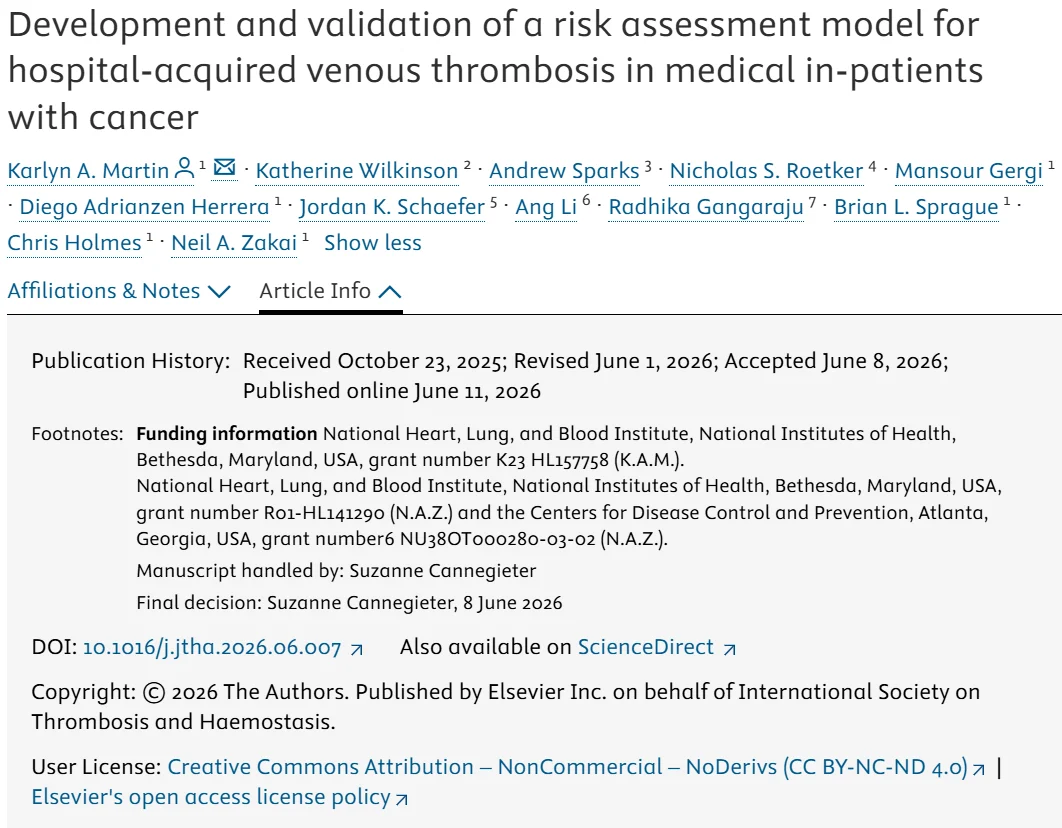
“Development and validation of a risk assessment model for hospital-acquired venous thrombosis in medical inpatients with cancer
General clot-risk tools underperform in hospitalized cancer patients. This study built and validated a risk assessment model for hospital-acquired venous thrombosis specific to medical inpatients with cancer, and it outperformed a non-cancer model.
The tool is meant to support individualized decisions about thromboprophylaxis in a group whose bleeding and clotting risks are both elevated.”
Title: Development and validation of a risk assessment model for hospital-acquired venous thrombosis in medical inpatients with cancer
Authors: Karlyn A. Martin, Katherine Wilkinson, Andrew Sparks, Nicholas S. Roetker, Mansour Gergi, Diego Adrianzen Herrera, Jordan K. Schaefer, Ang Li, Radhika Gangaraju, Brian L. Sprague, Chris Holmes, Neil A. Zakai
Other posts featuring Heghine Khachatryan and Journal of Thrombosis and Haemostasis on Hemostasis Today.
-
Sep 24, 2026, 08:55Andres Gudino: Clot Characterization Through Hounsfield Units in Ischemic Stroke
-
Sep 24, 2026, 06:52Gina Sado: Screening-Detected Atrial Fibrillation Carries High Risk of Heart Failure
-
Sep 24, 2026, 06:33Benjamin Vipler: Optimal Oral Anticoagulation Choice in Atrial Fibrillation and Advanced CKD
-
Sep 24, 2026, 06:08Christopher Salerno: AI-Powered At-Home Anemia Screening Advances Telehealth Access
-
Sep 24, 2026, 05:38Aya Qattan: When a Normal CBC Does Not Mean Normal Iron Status
-
Sep 24, 2026, 05:11Mastering Warm Autoimmune Hemolytic Anemia Diagnosis and Practice – ASH Education
-
Sep 23, 2026, 16:04Monia Ezzalfani: Advancing Patient-Centered Care in Hemophilia A and B
-
Sep 23, 2026, 15:49Bilge Başak: How Activated PRP Modulates Osteoarthritic Chondrocyte Function
-
Sep 23, 2026, 14:50Mbonjo Bitsie Dora: Strengthening Sickle Cell Care Through Education, Awareness and Innovation