


Ifeanyichukwu Ifechidere: The Biggest DOAC Myth in Coagulation – ‘No Monitoring Required’
Ifeanyichukwu Ifechidere, Specialist Biomedical Scientist at Sheffield Teaching Hospitals NHS Foundation Trust, shared a post on LinkedIn:
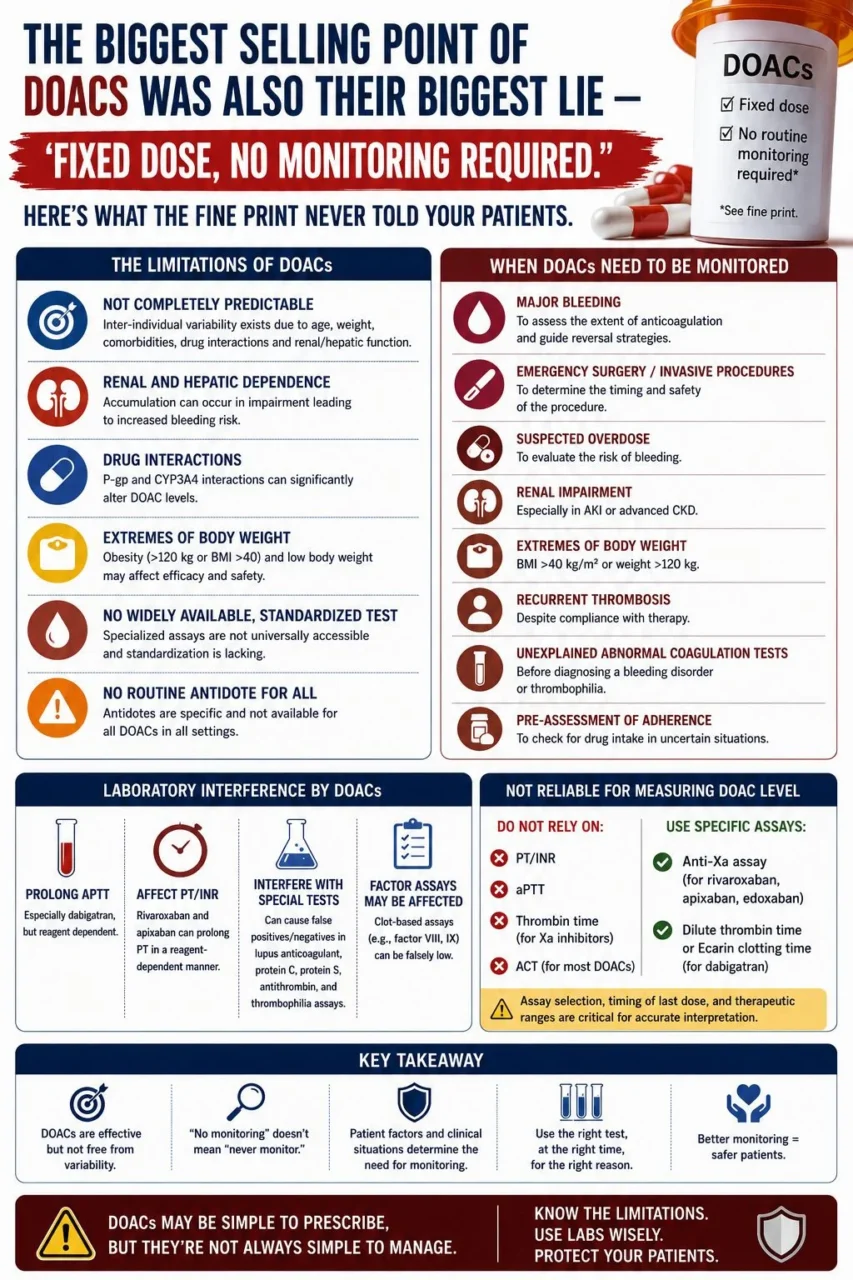
“The biggest selling point of DOACs was also their biggest lie — ‘fixed dose, no monitoring required.’ Here’s what the fine print never told your patients.
That’s one of the most repeated statements in coagulation.
It’s also one of the most misunderstood.
Because while Direct Oral Anticoagulants (DOACs) were designed for predictable anticoagulation…
predictable does Not mean problem-free.
And this is where many laboratory professionals — and even clinicians — get caught off guard.
Let’s be clear:
DOACs usually do not require routine therapeutic monitoring like warfarin.
But ‘no routine monitoring’ is very different from: ‘Never monitor them’
‘Ignore the laboratory impact’
‘Assume every patient responds predictably’
Because real-life patients are not textbook patients.
I’ve seen situations where DOAC measurement became critical:
- Major bleeding
- Emergency surgery
- Suspected overdose
- Renal impairment
- Extreme body weight
- Recurrent thrombosis despite therapy
- Unexplained abnormal coagulation results
And here’s the dangerous part
Many people still rely on PT/APTT to estimate DOAC effect.
But depending on:
- the drug
- the reagent
- the analyser
…the result may be:
- highly sensitive
- minimally sensitive
- completely misleading.
A ‘normal’ PT/APTT does Not reliably exclude clinically significant DOAC levels.
Read that again.
This is why understanding assay limitations matters.
Because DOACs can:
- Falsely prolong lupus anticoagulant testing
- Distort clot-based factor assays
- Interfere with thrombophilia investigations and
- Create confusing coagulation profiles
And unless you actively think about DOAC interference…you may end up interpreting the wrong disease instead of the drug effect.
That’s why specialised assays matter:
- Use of Anti-Xa assays for rivaroxaban/apixaban/edoxaban
- Dilute thrombin time or ecarin-based assays for dabigatran
Not because we monitor every patient routinely —but because certain clinical situations demand accurate assessment.
As biomedical scientists, our role is evolving.
We are no longer just producing coagulation numbers.
We are identifying interferences, Understanding assay behaviour, and helping clinicians interpret anticoagulation safely
Because sometimes the most dangerous coagulation result…is the one everyone assumes they already understand.”
Find more posts featuring Ifeanyichukwu Ifechidere on Hemostasis Today.
-
Oct 16, 2026, 18:12Adil Nawaz: Extended Dual Antiplatelet Therapy After Coronary Stenting
-
Oct 16, 2026, 17:50Elad Asher։ STORM-PE Shows Functional Benefits of Thrombectomy
-
Oct 16, 2026, 17:32Shruthi Narayan: STORM-PE and STRIKE-PE Studies Advance Understanding of Recovery After Pulmonary Embolism
-
Oct 16, 2026, 17:22Wolfgang Miesbach։ What a Near-Perfect FISH Score Fails to See
-
Oct 16, 2026, 17:06Troels Wienecke: Connecting Myeloproliferative Disease and Ischemic Stroke
-
Oct 16, 2026, 17:03Only 5 Days Left to Submit Your Research for EAHAD 2027
-
Oct 16, 2026, 16:48Abdul Rahman: Reticulocyte Count and Bone Marrow Activity
-
Oct 16, 2026, 16:44DOAC Adherence in Stroke Patients With Atrial Fibrillation – International Journal of Stroke
-
Oct 16, 2026, 16:22Shannon Farmer: Driving Patient Blood Management Forward in Australia and New Zealand