


Marcel Miron-Celis: The Largest Cohort Ever Studied on Perioperative Management of Thrombotic APS
Marcel Miron-Celis, Data Scientist at MDClone, shared Joseph R. Shaw‘s post on LinkedIn, adding:
“If you are a physician interested in the perioperative management of patients with thrombotic antiphospholipid syndrome, then you should read this awesome research paper that I worked on with my previous colleagues at The Ottawa Hospital.
Largest cohort ever studied on this topic, with very interesting findings!”
Joseph R. Shaw, Director of Research and Program at Ottawa Department of Medicine, EHJ-CVP Associate Editor of European Heart Journal, shared a post on LinkedIn about a recent article he and his colleagues co-authored, published in Blood Advances, adding:
”I’m pleased to share that our paper, ‘Perioperative management of antithrombotic therapy in patients with thrombotic antiphospholipid syndrome,’ has been published in Blood Advances.
This project grew out of a practical and difficult question we face often in thrombosis care: how should we manage anticoagulation interruption in patients with thrombotic APS who need surgery or an invasive procedure?
Data to guide these decisions is limited.
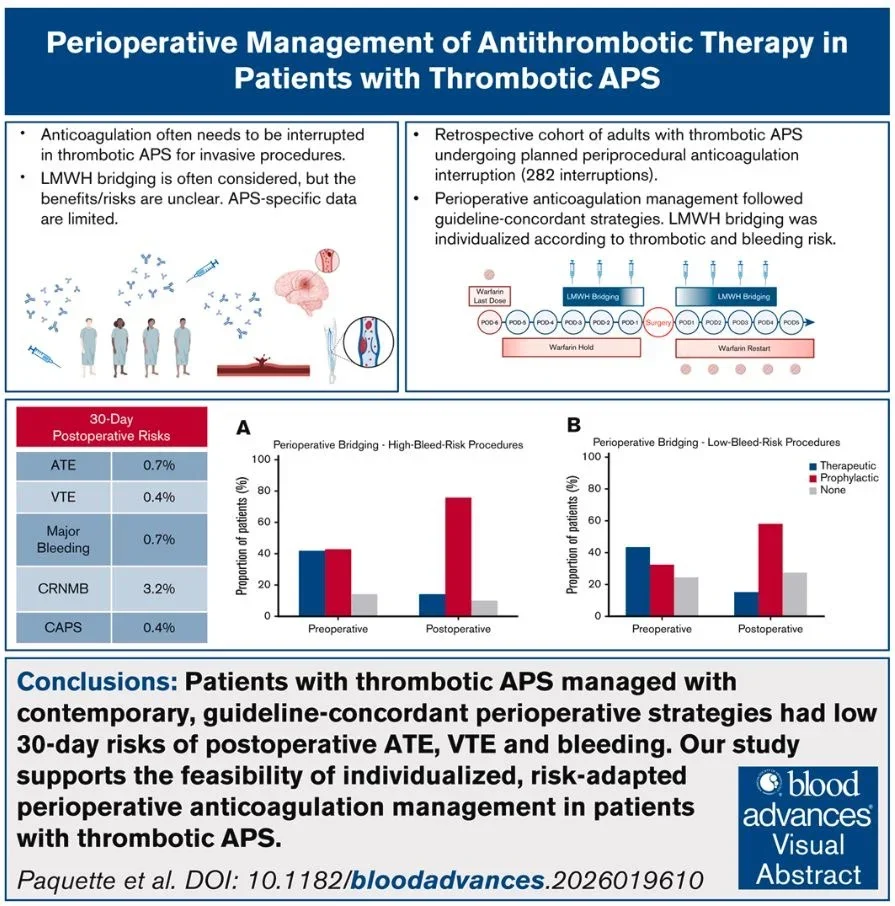
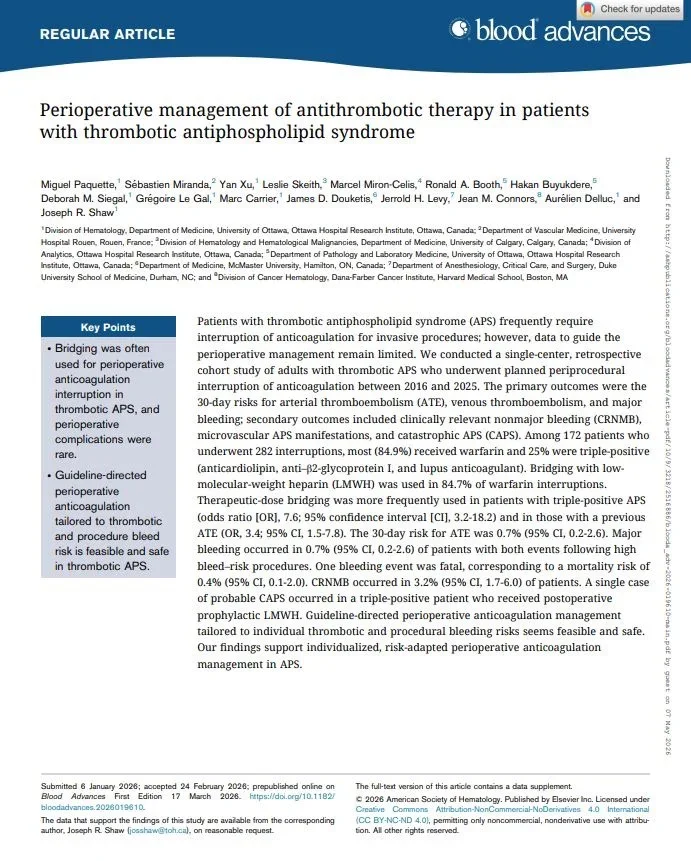
In this study, we evaluated 172 adults with thrombotic APS who underwent 282 planned perioperative anticoagulation interruptions between 2016 and 2025.
To our knowledge, this is the largest single-center cohort focused on perioperative anticoagulation management in thrombotic APS.
A few key findings stood out to me:
- Bridging was commonly used, and clinicians appeared to individualize management based on APS phenotype and prior thrombotic history.
- Patients with triple-positive APS and those with prior arterial thromboembolism were more likely to receive therapeutic-dose LMWH bridging.
Overall, 30-day outcomes were reassuring: the risks of arterial thromboembolism and major bleeding were both 0.7%, while clinically relevant nonmajor bleeding occurred in 3.2% of interruptions.
The take-home message: individualized, risk-adapted perioperative anticoagulation management that considers APS-related thrombotic risk, procedural bleeding risk, and clinical context appears feasible and safe in thrombotic APS.
At the same time, high-risk phenotypes – especially triple-positive APS and prior arterial events – still require careful planning and vigilance.
A special congratulations to Miguel Paquette.
This paper reflects his hard work, persistence, and attention to detail, and I’m very glad to see these important results published in Blood Advances.”
Title: Perioperative management of antithrombotic therapy in patients with thrombotic antiphospholipid syndrome
Authors: Miguel Paquette, Sébastien Miranda, Yan Xu, Leslie Skeith, Marcel Miron-Celis, Ronald A. Booth, Hakan Buyukdere, Deborah M. Siegal, Grégoire Le Gal, Marc Carrier, James D. Douketis, Jerrold H. Levy, Jean M. Connors, Aurélien Delluc, Joseph R. Shaw
Stay updated on all scientific advances with Hemostasis Today.
-
Sep 24, 2026, 16:02Leonardo Roever: Understanding Peripheral Artery Disease in the Modern Era
-
Sep 24, 2026, 15:49Sthanu Subramanian: When HbA1c Does Not Reflect True Glycemia
-
Sep 24, 2026, 15:09Caroline Voltz-Girolt: Accelerating the Development of Innovative Therapies for Rare Blood Disorders
-
Sep 24, 2026, 15:00Gambo Ramatu: Anemia as a Preventable Pregnancy Challenge
-
Sep 24, 2026, 14:56Holly John: Sickle Cell Disease Beyond Pain and Clinical Outcomes
-
Sep 24, 2026, 14:45Bruce Holland: Ex Vivo Assessment of ActiGraft Clot Formation Under Anticoagulation
-
Sep 24, 2026, 14:33Mohamed El Belghiti Alaoui: Thrombin as a Therapeutic Target in Coagulation
-
Sep 24, 2026, 14:22Integrating Thrombosis Risk Into Menopause Care – World Thrombosis Day
-
Sep 24, 2026, 13:41Mahmoud Samir Bayomi: Raise ITP Awareness and Improve Patient Care