


Martin Haluzík Shares A Study on GLP1-1RAs Use in Peripheral Artery Disease and DM
Martin Haluzík, Professor of Medicine at Institute for Clinical and Experimental Medicine, shared on LinkedIn:
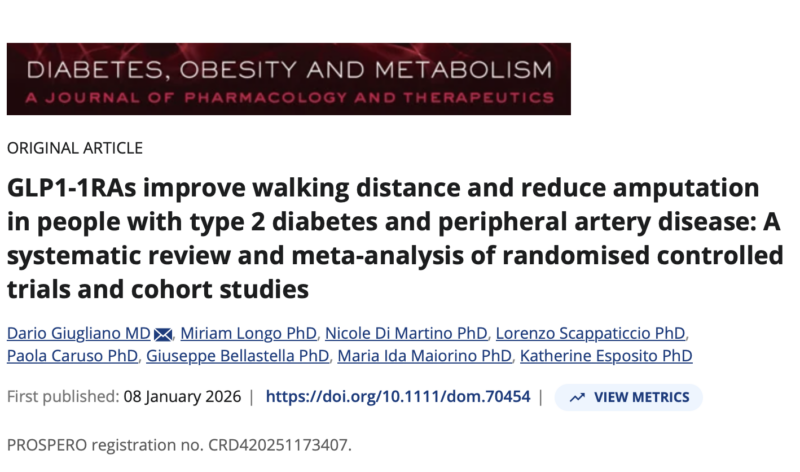
”GLP1-1RAs improve walking distance and reduce amputation in people with type 2 diabetes and peripheral artery disease: A systematic review and meta-analysis of randomised controlled trials and cohort studies
Very interesting paper just published in Diabetes, Obesity and Metabolism by Dario Giugliano and colleagues.
The aim of this systematic review and meta-analysis was to evaluate the effect of GLP-1RAs on functional walking distance and the risk of major adverse limb events (MALE) or lower extremity amputation (LEA) in people with type 2 diabetes and peripheral artery disease (PAD).
The authors searched many electronic databases up to 10 October 2025 for randomised controlled trials (RCTs) and cohort studies.
They included studies enrolling adults with type 2 diabetes and PAD, comparing GLP-1RAs against placebo or other glucose-lowering drugs.
The primary outcomes were walking distance, MALE, or LEA.
Seven studies (3 RCTs, 4 cohorts) enrolling 107 092 participants were included.
The meta-analysis of two RCTs with 847 participants demonstrated a significant improvement in walking distance with liraglutide or semaglutide (HR = 1.10, 95% CI 1.05–1.15, p < 0.001), with no heterogeneity (I2 = 0.0%) and moderate certainty of evidence.
In the additional meta-analysis of two RCTs with 3592 participants, the incidence of MALE or LEA did not differ significantly between patients receiving exenatide or semaglutide and those receiving placebo.
The meta-analysis of four cohort studies with 104 292 participants showed that GLP-1RAs reduced the risk of LEA (RR = 0.53, 95% CI 0.39–0.73, p < 0.001), with high heterogeneity (I2 = 85.96%), totally related to one study, and very low certainty of evidence.
Subgroup analyses showed a significant difference (p < 0.001) between GLP-1RA therapies, with the strongest associations with LEA reduction for tirzepatide and semaglutide (55% and 54% risk reduction, respectively); there was no difference in the LEA outcome excluding from the analysis patients with type 2 diabetes and diabetic foot ulcers at baseline.
This meta-analysis suggests that GLP-1RAs are associated with a significant improvement in functional walking distance and a reduction in the risk of LEA in people with type 2 and PAD.
Further dedicated RCTs are needed to confirm these limb-specific benefits of GLP-1RAs.
- Very interesting data
- This is further evidence adding on to STRIDE trial with injectable semaglutide that showed functional improvement in patients with PAD and the SOUL trial with oral semaglutide where MALE was reduced by 29 %
- A dedicated RCT would be nice but I believe that we have now enough evidence to make GLP-1 RAs (and semaglutide in particular) the preferred treatent optin in patients with T2DM and PAD”
Read the full article here.
Article: GLP1-1RAs improve walking distance and reduce amputation in people with type 2 diabetes and peripheral artery disease: A systematic review and meta-analysis of randomised controlled trials and cohort studies
Authors: Dario Giugliano, Miriam Longo, Nicole Di Martino, Lorenzo Scappaticcio, Paola Caruso, Giuseppe Bellastella, Maria Ida Maiorino, Katherine Esposito
Stay updated on all scientific advances with Hemostasis Today.
-
Oct 20, 2026, 05:02Sanam Loghavi: Test Your Hematology Knowledge at ASH 2026!
-
Oct 20, 2026, 04:13Ifeanyichukwu Ifechidere: DOACs Are Not the Answer to Every Anticoagulation Question
-
Oct 20, 2026, 04:04Sadia Kamal: Honored to Receive the Outstanding Abstract Award at the 20th Midwest Platelet Conference
-
Oct 20, 2026, 04:03Yu-Hsuan Chen: One Antibody, Two Diseases from FcRn Biology to Clinical Translation
-
Oct 20, 2026, 03:49Domenico Simone Castiello: Rethinking Prolonged DAPT in Multivessel PCI – Insights from the DAPT-MVD Trial
-
Oct 20, 2026, 03:37Rucha Patil: Scaling POC Diagnostics for Haemophilia A and VWD Across India
-
Oct 20, 2026, 03:31Zena Vexler: Targeting Neutrophil Elastase and NETosis to Mitigate Infection-Triggered Childhood Stroke
-
Oct 20, 2026, 03:24Chaza Alaji: Diagnosing Protein C and Protein S Deficiency
-
Oct 20, 2026, 03:24Mou Nandi: How Maternal Health During Pregnancy May Shape Infant Development