


Martin Vanden Eede: Can We Safely Reduce Anticoagulation During ECMO?
Martin Vanden Eede, Cardiologist and Intensive Care Physician at ZAS, shared a post on LinkedIn about a recent article by Olivier van Minnen et al. published in The Lancet, adding:
“Can we safely reduce anticoagulation during ECMO?
An interesting Multicentre randomized controlled non-inferiority trial compared:
- Standard-dose UFH (current standard of care)
- Low-dose UFH
- Therapeutic low-molecular-weight heparin (LMWH)
The hypothesis was straight forward: Less anticoagulation may reduce bleeding without increasing thrombosis.
The primary endpoint was a composite of:
- Severe bleeding during ECMO
- Severe thromboembolic complications
- All-cause mortality at 6 months
This endpoint reflects the real clinical balance between preventing thrombosis and avoiding bleeding.
Primary endpoint:
- Standard UFH 81%
- Low-dose UFH 72%
- LMWH 75%
Both low-dose UFH and LMWH met the predefined criterion for non-inferiority, meaning they were not worse than standard-dose UFH regarding the combined endpoint.
Equally important was that:
- Reduced-intensity strategies consistently showed fewer bleeding events.
- Lowering anticoagulation did not increase thrombotic complications.
- Similar transfusion requirements between groups
- Fewer oxygenator exchanges with LMWH
- Low-dose UFH showed the highest probability of being cost-effective.
These findings are likely to influence future ECMO anticoagulation guidelines and support a shift toward lower-intensity anticoagulation in appropriately selected patients.
Three Key Points
- Lower-intensity anticoagulation (low-dose UFH or therapeutic LMWH) was non-inferior to standard-dose UFH during ECMO.
- Reducing anticoagulation did not increase thrombotic complications and showed a consistent trend toward fewer severe bleeding events.
- The study provides strong evidence that routine ECMO anticoagulation targets should be reconsidered, potentially making lower-intensity anticoagulation the future standard of care.”
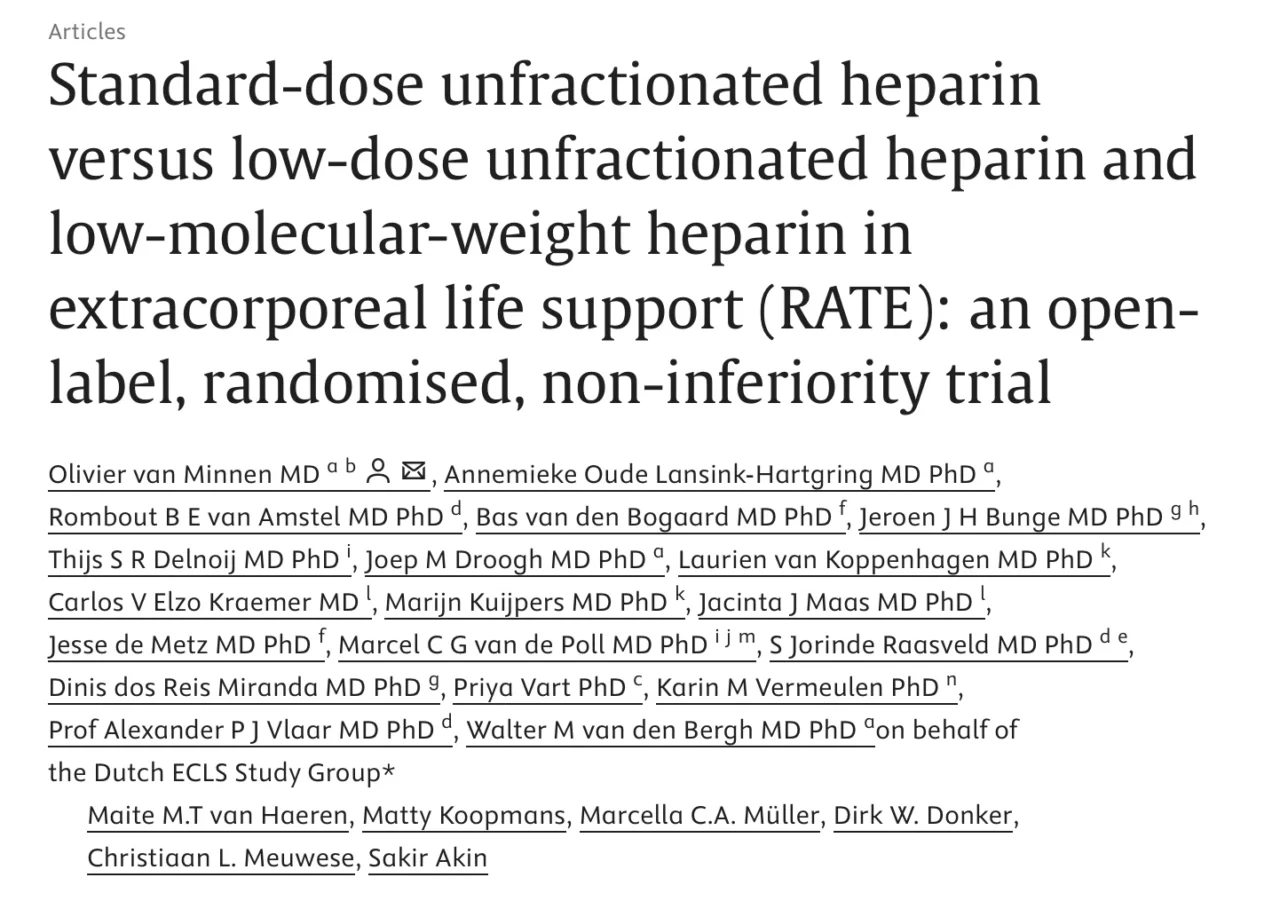
Titile: Standard-dose unfractionated heparin versus low-dose unfractionated heparin and low-molecular-weight heparin in extracorporeal life support (RATE): an open-label, randomised, non-inferiority trial
Authors: Olivier van Minnen, Annemieke Oude Lansink-Hartgring, Rombout B. E. van Amstel, Bas van den Bogaard, Jeroen J. H. Bunge, Thijs S. R. Delnoij, Joep M. Droogh, Laurien van Koppenhagen, Carlos V. Elzo Kraemer, Marijn Kuijpers, Jacinta J. Maas, Jesse de Metz, Marcel C. G. van de Poll, S. Jorinde Raasveld, Dinis dos Reis Miranda, Priya Vart, Karin M. Vermeulen, Alexander P. J. Vlaar, Walter M. van den Bergh, Maite M. T. van Haeren, Matty Koopmans, Marcella C. A. Müller, Dirk W. Donker, Christiaan L. Meuwese, Sakir Akin
Stay updated on all scientific advances with Hemostasis Today.
-
Oct 11, 2026, 16:57Shiny K. Kajal: Japan Advances Artificial Blood via Haemoglobin Vesicles Trials
-
Oct 11, 2026, 16:45Luca Scarcia: Rescue Stenting Superior When Posterior Circulation Thrombectomy Fails
-
Oct 11, 2026, 16:27Giuseppe Bellelli: Reevaluating Anticoagulation Net Benefit in Frail Older Adults
-
Oct 11, 2026, 16:17Johnathan Whetstine: How Does MYC Go From 2 Copies to an Amplified Oncogene?
-
Oct 11, 2026, 16:03Parth Parmar: Practical Guidelines for Managing Venous Thromboembolism
-
Oct 11, 2026, 15:31Muhammad Alvi: CASPR Study Explores Treatment Response Across ESUS Phenotypes
-
Oct 11, 2026, 15:15Thalassaemia International Federation Joins ASCAT 2026 to Advance Sickle Cell and Thalassaemia Care
-
Oct 11, 2026, 15:14Challenges and Perspectives on Gene Therapy in Hemophilia A – Seminars in Thrombosis and Hemostasis
-
Oct 11, 2026, 15:07Neysa Rahardjo: Platelet Estimation Pitfalls and Discrepancy Resolution