


Maymoon Madkhali։ First Report of a Rare D– – Blood Phenotype in Saudi Arabia
Maymoon Madkhali, Head of Immunohematology and Genotyping Department at Ministry of Health Saudi Arabia, shared a post on LinkedIn about a recent article he and his colleagues co-authored, published in Transfusion Medicine, adding։
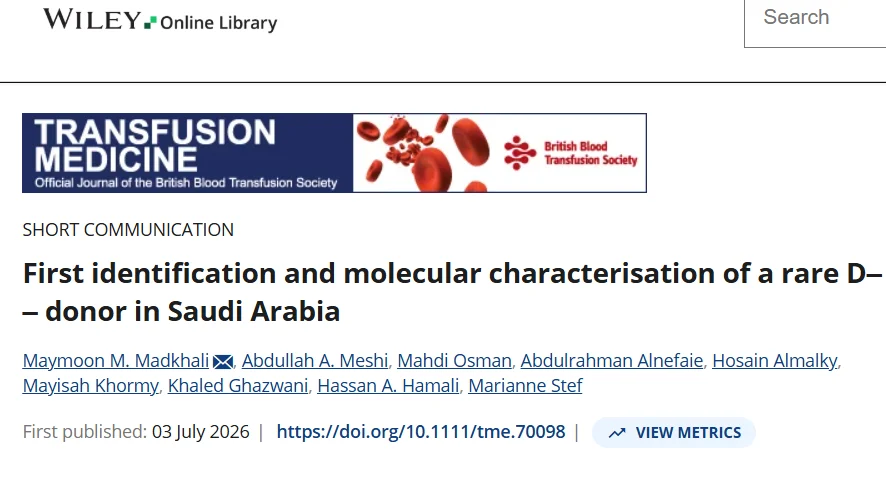
”I am pleased to share our published research, ‘First identification and molecular characterisation of a rare D– – blood phenotype donor in Saudi Arabia,’ in Transfusion Medicine.
This study represents the first documented case of this exceptionally rare blood type in Saudi Arabia and the Middle East, revealing critical insights into rare phenotypes and advancing blood banking and transfusion services across the Kingdom.
Grateful to our exceptional collaborative team whose expertise and dedication made this achievement possible.”
Title: First identification and molecular characterisation of a rare D– – donor in Saudi Arabia
Authors: Maymoon M. Madkhali, Abdullah A. Meshi, Mahdi Osman, Abdulrahman Alnefaie, Hosain Almalky, Mayisah Khormy, Khaled Ghazwani, Hassan A. Hamali, Marianne Stef. (PubMed)
Stay updated on all scientific advances with Hemostasis Today.
-
Sep 21, 2026, 15:56Anita Zaidi: Why Only 2% of Health Research and Development Goes to Women’s Conditions
-
Sep 21, 2026, 15:49Omid Khalafi: Gating Strategy and How Do We Decide Which Cells to Analyze
-
Sep 21, 2026, 15:44Levacetylleucine: A New Therapeutic Approach to Ataxia Telangiectasia
-
Sep 21, 2026, 15:40Andreas Tridimas: The Diagnostic Traps of Lipaemic Blood – Why a Normal Amylase Can Mislead You
-
Sep 21, 2026, 15:33Arsene Mekinian: Exploring Cardiac Involvement in Behçet’s Disease
-
Sep 21, 2026, 15:23Anis Mahjoubi: MRI Findings of Krukenberg Tumors
-
Sep 21, 2026, 15:08Fikreab Tesfaye Tefera: 10 Practical Take-Home Points for Diagnosing Iron Deficiency Anemia
-
Sep 21, 2026, 14:10Aswin K Mohan: Lessons from TRANSCON 2026 – Building Resilient Blood Supply Systems Before Crisis Hits
-
Sep 21, 2026, 14:00Vincent Lu: Beyond PT and aPTT – How Hemostasis Evolves Across a Lifetime