


Renjith Vijayakumar Selvarani: New Nanoparticle Approach Clears Brain Plaque and Restores Memory
Renjith Vijayakumar Selvarani, Founder, Chairman, Chief Scientific and Technology Officer at OLUSIUM, shared a post on LinkedIn about a recent article by et al, published in
“Scientists reversed Alzheimer’s symptoms with nanoparticles that cleared brain plaque and restored memory!
The new treatment cleared toxic proteins in 1 hour and reversed 6 months of cognitive decline.
In a groundbreaking development, Spanish and Chinese researchers have successfully used nanoparticles to clear Alzheimer’s-related brain plaque in mice, offering a promising new strategy in treating the disease.
The study, published in Signal Transduction and Targeted Therapy, demonstrated that just three injections of specially engineered nanoparticles reduced amyloid beta buildup in the brain by up to 60% within an hour. Even more remarkably, mice that had exhibited severe cognitive impairment began behaving normally within six months — a dramatic reversal attributed to restored function of the brain’s blood-brain barrier (BBB), a crucial defense system that becomes compromised in Alzheimer’s patients.
Rather than solely targeting plaque removal, the nanoparticles act as a ‘supramolecular drug’ to revive the BBB’s natural waste-clearing mechanisms, particularly a key protein known as LRP1. This approach tackles one of Alzheimer’s earliest warning signs: vascular damage that precedes memory loss in over 90% of patients.
By repairing the barrier’s function, the treatment improves blood flow, reduces inflammation, and allows the brain to recover its self-regulating processes. Though still in the animal-testing phase, the results open a novel research frontier that may transform how scientists detect and treat neurodegenerative diseases not just by cleaning up damage, but by restoring the body’s natural defenses.”
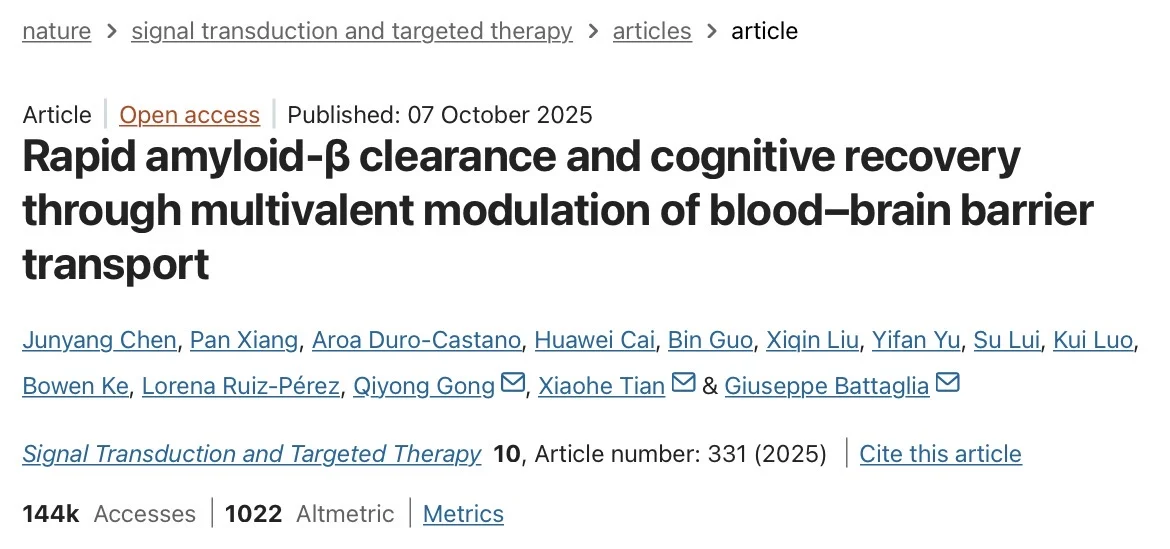
Title: Rapid amyloid-β clearance and cognitive recovery through multivalent modulation of blood–brain barrier transport
Authors: Junyang Chen, Pan Xiang, Aroa Duro-Castaño, Huawei Cai, Bin Guo, Xiqin Liu, Yifan Yu, Su Lui, Kui Luo, Bowen Ke, Lorena Ruiz-Pérez, Qiyong Gong, Xiaohe Tian, Giuseppe Battaglia
Read the Full Article on Signal Transduction and Targeted Therapy
Stay updated on all scientific advances with Hemostasis Today.
-
Sep 17, 2026, 10:08WFH 2027 Comprehensive Care Summit Opens Abstract Submissions – World Federation of Hemophilia
-
Sep 17, 2026, 09:56Marianne Yee: MySCDstory Expands Access to Multilingual Sickle Cell Education
-
Sep 17, 2026, 09:36Enewa Onoja: Platelet Satellitism Phenomenon, Three Misleading Counts
-
Sep 17, 2026, 09:22Emmanuel J Favaloro: Hemostasis and Thrombosis in Exercise and Athletes
-
Sep 17, 2026, 09:18Updated Iron Deficiency Diagnostic Guidelines – American Society of Hematology
-
Sep 17, 2026, 09:14Angela Weyand: ASH 2026 Iron Deficiency Guidelines
-
Sep 17, 2026, 08:18Anirban Sen Gupta: From Flow to Clot Insights Into Hemostasis and Thrombosis
-
Sep 17, 2026, 08:03Aya Sherif: HEMO COP – Building a Collaborative Future for Hemophilia Care
-
Sep 17, 2026, 07:50Applications Are Now Open for the 2026 WFH IHTC Fellowships