


Shrinidhi Nathany: Patients with CHIP May Be Predisposed to Higher Risk of Cytokine Release Syndrome after CAR-T
Shrinidhi Nathany, Consultant Molecular Hematology and Oncology at Fortis Memorial, shared a post on LinkedIn:
“New Research Alert!!!!!!!
CHIP Mutations May Amplify Inflammation in CAR-T Therapy
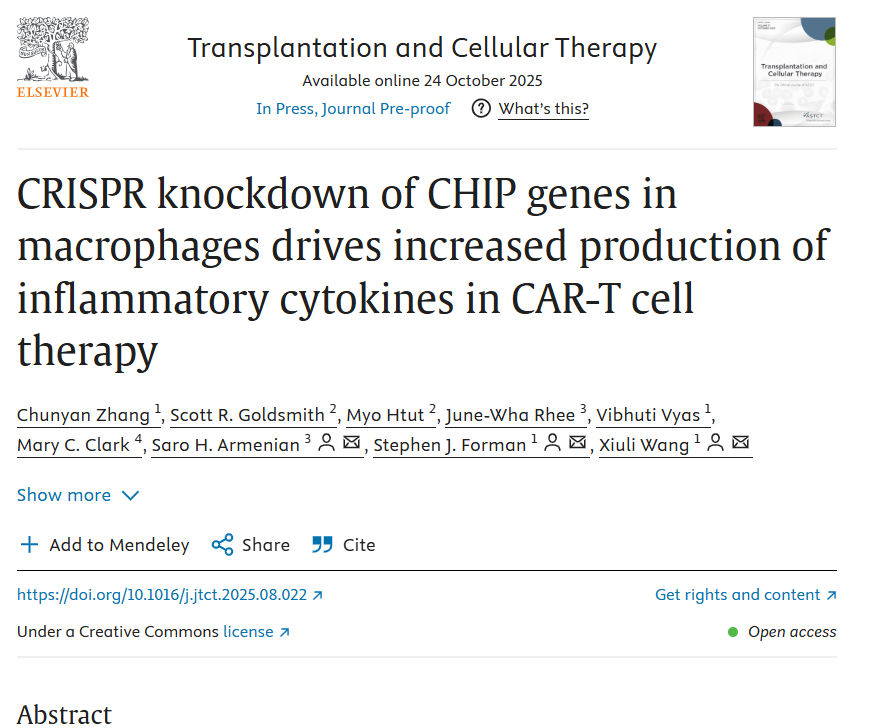
A fascinating new study (Zhang et al., J Transl Clin Transplant 2025) reveals that CRISPR knockdown of CHIP genes (DNMT3A, TET2, ASXL1) in macrophages drives increased production of inflammatory cytokines during CAR-T cell therapy including IL-6, MCP-1, and IL-1β.
Translation?
Patients with Clonal Hematopoiesis of Indeterminate Potential (CHIP) may be predisposed to higher risk of Cytokine Release Syndrome (CRS) after CAR-T.
This could reshape how we risk-stratify, monitor, and personalize CAR-T therapy especially in multiple myeloma and hematologic malignancies.”
Title: CRISPR knockdown of CHIP genes in macrophages drives increased production of inflammatory cytokines in CAR-T cell therapy
Authors: Chunyan Zhang, Scott R. Goldsmith, Myo Htut, June-Wha Rhee, Vibhuti Vyas, Mary C. Clark, Saro H. Armenian, Stephen J. Forman, Xiuli Wang
Read the full article.
Stay updated with Hemostasis Today.
-
Sep 24, 2026, 18:43Hugh Nguyen: Honored to Accept the Friend of Singapore Red Cross Award
-
Sep 24, 2026, 18:42Titilope Fasipe: Proud to Support American Society of Hematology’s SCD Initiative
-
Sep 24, 2026, 18:34Ifeanyichukwu Ifechidere: Why Coagulation Samples Can Be “Too Valuable to Throw Away”?
-
Sep 24, 2026, 18:33Aswin K. Mohan: When a Superpower Hears the Call for Blood
-
Sep 24, 2026, 18:31Mercy Lung’aho: Anemia Is Not Only An Iron Problem
-
Sep 24, 2026, 18:29Nick Hanson: Before a Dementia Diagnosis Check Vitamin B12
-
Sep 24, 2026, 18:28Rachel McBryan: Nearly One in Five Older Canadians Has Low Vitamin B12
-
Sep 24, 2026, 18:27Kemal Karaagac: Early DOAC Initiation After Acute Ischaemic Stroke in Atrial Fibrillation
-
Sep 24, 2026, 18:26Mohammed A. AlOmar: What Characterizes Young Stroke in the UAE?