


Wolfgang Miesbach: Game‑Changing Data on Intensive FVIII Replacement in Haemophilia A with Hypertrophic Synovium
Wolfgang Miesbach, Professor of Medicine at Frankfurt University Hospital, shared a post on LinkedIn about a recent article by Matteo Nicola Dario Di Minno et al, published in Journal of Thrombosis and Haemostasis:
“Targeting Hypertrophic Synovium: Game‑Changing Data from a Randomized Trial.
One of the most practice‑shaping presentations at GTH2026 in Bonn was Matteo Nicola Dario Di Minno’s randomized trial of intensive FVIII replacement in haemophilia A patients with hypertrophic synovium – recently published in Journal of Thrombosis and Haemostasis.
In the RESOLVE study (298 joints), ~60% of PwH on standard FVIII showed persistent or worsening hypertrophic synovium despite prophylaxis, underlining that conventional dosing often fails to control synovial disease activity.
‘Quiet’ joints are not truly quiet: MRI revealed subclinical pathology in many cases—14% with haemosiderin deposits, 16% with subclinical bleeding, and 20% with hypertrophic synovium.
The intervention: 52 adults with severe HA (mean age ~38 years) were randomized to
- Intensive arm: FVIII trough 8–12%
- Standard arm: FVIII trough 3–5%
Most patients received EHL concentrates, and a relevant proportion were already on bypassing agents or COX‑2 inhibitors—clearly a difficult‑to‑treat cohort.
The results:
- HR 4.75 for HS reduction and 10.79 for complete resolution (p=0.014 and 0.023).
- Median time to HS resolution shortened from 16 to 12 months.
- ABR 0 achieved in 59% vs 36% in the standard arm.
- Significant gains in HEAD‑US and HJHS joint scores.
The price to pay: ≈ 40% higher annual FVIII use (≈6580 vs 4720 IU/kg/year).
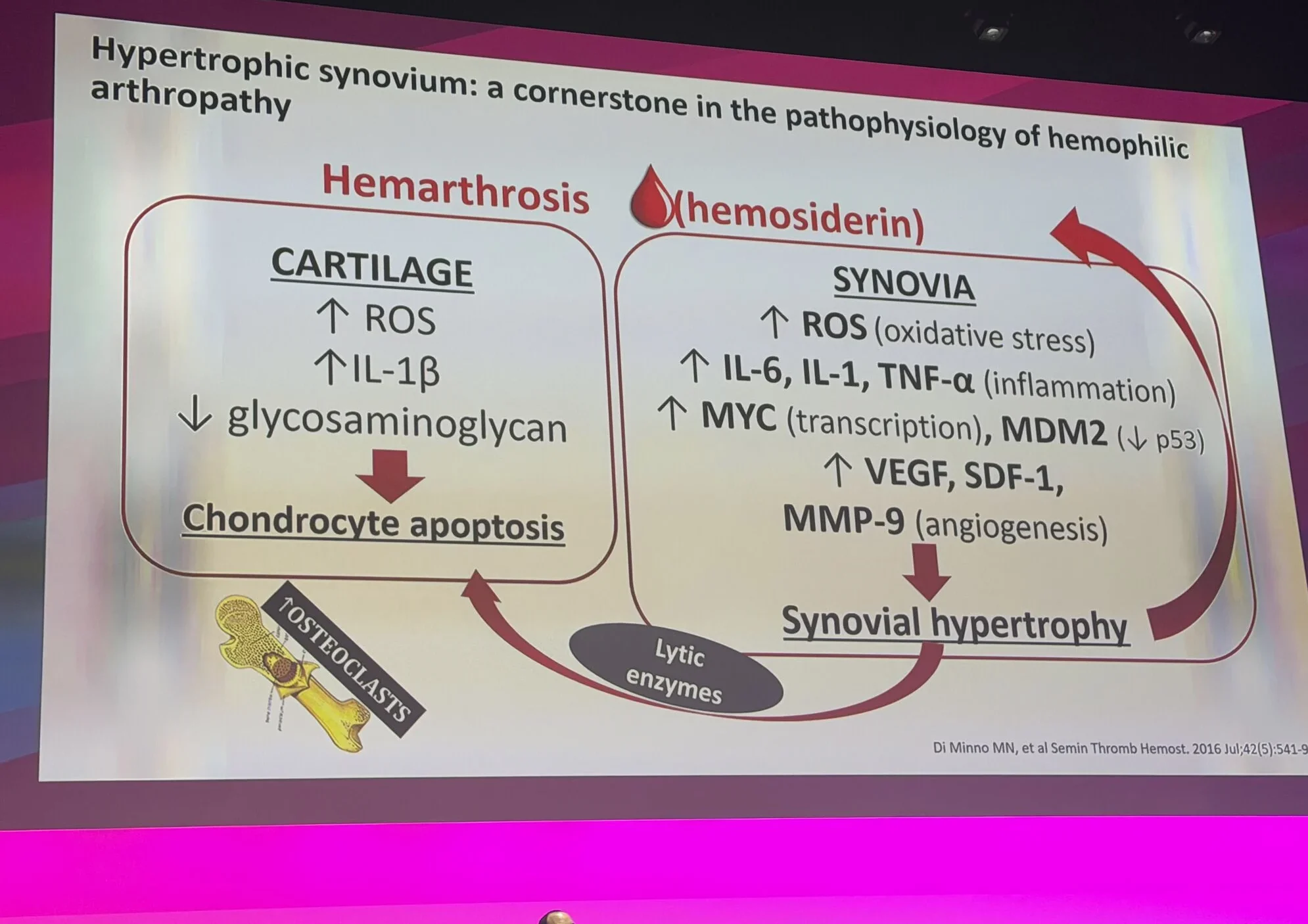
The biology behind it: The pathophysiology slide elegantly walked through the vicious circle: haemarthrosis leads to haemosiderin accumulation, resulting in iron‑driven ROS, IL‑6, IL‑1, TNF‑α, VEGF, MMP‑9, which promote synovial hypertrophy, causing more bleeding and ultimately cartilage apoptosis and osteoclast activation. Once this loop is established, standard troughs are often insufficient to stop it.
Guidelines and practice: These data dovetail with UK, European, Italian and German recommendations that call for treatment tailoring and prophylaxis intensification when synovitis or hypertrophic synovium is detected—shifting us from reactive bleed management to true disease modification.”
Title: Intensive FVIII replacement in hemophilia patients with hypertrophic synovium: a randomized study
Authors: Matteo Nicola Dario Di Minno, Ilenia Lorenza Calcaterra, Erminia Baldacci, Renato Marino, Federica Valeri, Rita Carlotta Santoro, Gianluigi Pasta, Carlo Martinoli
Read the Full Article on Journal of Thrombosis and Haemostasis.

Find more posts featuring Wolfgang Miesbach on Hemostasis Today.
-
Oct 9, 2026, 15:15Maha Othman: Uncovering the Consensus on TXA in TBI – Call for Collaboration on a Landmark Umbrella Review
-
Oct 9, 2026, 15:07Daniel D. Han: How Inhalation Product Exposure Impairs Cardiac and Platelet Recovery After MI
-
Oct 9, 2026, 14:58William Toole: How Ultrasound-Guided PRP Therapy Relieves Joint and Tendon Pain
-
Oct 9, 2026, 14:50Shayan Mohammadmoradi: In Corpus Christi for the 20th Midwest Platelet Conference
-
Oct 9, 2026, 14:37Tariq Tramboo: High Platelet Concentrate for Osteoarthritis Knee – Recent Meta-Analyses
-
Oct 9, 2026, 14:26Yousma Khan: Hematology Series – Beyond RBCs, WBCs and Platelets
-
Oct 9, 2026, 14:13Jesus Ardila Novoa: Why the WHO’s Historic Essential Medicines List Decision Is Just the Beginning
-
Oct 9, 2026, 14:07Chokri Ben Lamine: Pain After Allogeneic Stem Cell Transplantation in Sickle Cell Disease
-
Oct 9, 2026, 13:55Chandler Purser: AABB 2026 Focuses on Transfusion Safety and Audit-Driven Practice Improvement