


Wolfgang Miesbach: How Safe Is AAV Gene Therapy?
Wolfgang Miesbach, Professor of Medicine at Frankfurt University Hospital, shared a post on LinkedIn about a recent article by Lindsey A George et al., published in Molecular Therapy, adding:
“6,000+ people treated. Nine tumors reported.
When a cancer shows up after AAV gene therapy, was the treatment to blame, or just chance?
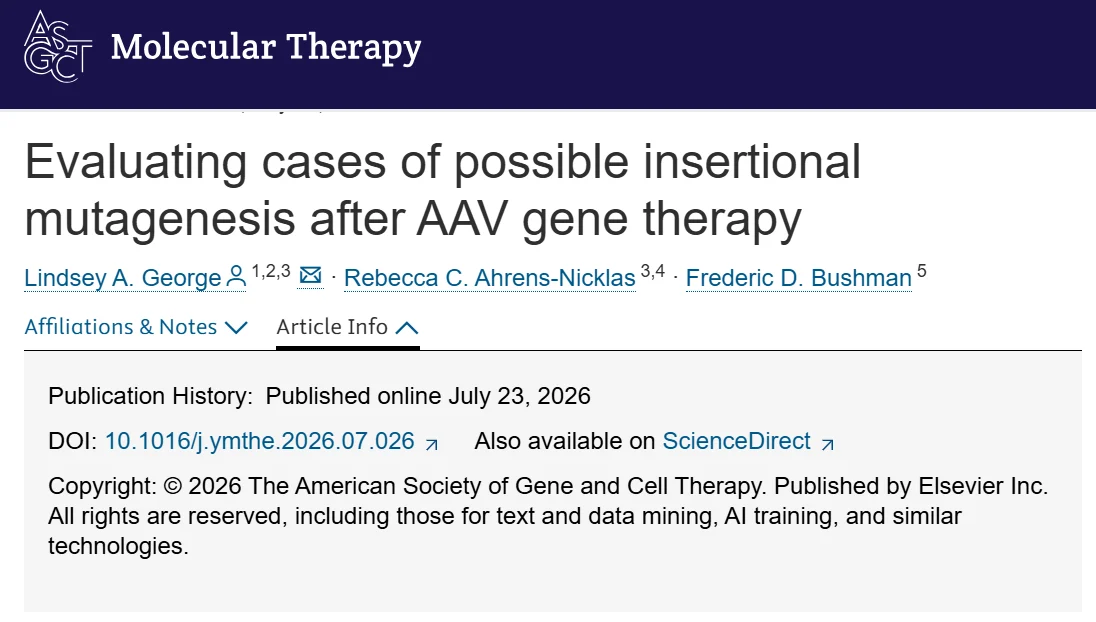
That’s the new Opinion piece in Molecular Therapy by Lindsey George, Rebecca Ahrens-Nicklas and Frederic Bushman.
First, the reassuring part.
AAV gene therapy has a strong safety record. Across an estimated 6,000 plus people treated, only nine tumors have ever been reported afterward – and just one carries clear molecular proof that the vector itself caused the cancer.
That one case is sobering.
A child treated for MPS I at 13 months developed a brain tumor four years later.
The vector had landed inside a gene called PLAG1 and switched it on – using its own built-in regulatory elements to do it.
Encouragingly, the child remains neurologically intact.
The deeper lesson is about proof.
Vector DNA often inserts in a scrambled, rearranged mess, tumor tissue is scarce, and routine clinical labs simply don’t look for it.
In this case the team’s first four methods couldn’t reconstruct what had happened. It took long-read sequencing to finally map it.
Rare doesn’t mean impossible.
The authors make a strong case for rigor, transparency and long-term follow-up as these therapies reach more patients.”
Title: Evaluating cases of possible insertional mutagenesis after AAV gene therapy
Authors: Lindsey A George, Rebecca C Ahrens-Nicklas, Frederic D Bushman
Other posts featuring Wolfgang Miesbach on Hemostasis Today.
-
Sep 8, 2026, 16:14Heghine Khachatryan: Colombo 2026 Insights on Point-of-Care Ultrasound in Hemophilia Joint Care
-
Sep 8, 2026, 15:57Flora Peyvandi: Efficiency Meets Innovation in Hemophilia B Gene Therapy
-
Sep 8, 2026, 15:48Maxime Dely: Guillain-Barré Syndrome – What if the Key Lies in the Plasma?
-
Sep 8, 2026, 15:34Ron DePinho: A Negative Trial Highlights the Need for Precision in Cardiovascular Inflammation
-
Sep 8, 2026, 15:31Adil Yousaf: Thrombolysis Speed Matters, but Eligibility Comes First
-
Sep 8, 2026, 15:28Dhargam Aljebouri: First Molecularly Characterized Para-Bombay Phenotype in the Arab World
-
Sep 8, 2026, 15:27Mohd Ashhad: How Much Does Hemoglobin Increase After 1 Unit of PRBC?
-
Sep 8, 2026, 15:27Sanish Babu: The Hematocrit–Platelet Signal in Severe Dengue
-
Sep 8, 2026, 15:26Mary Kama: Climate-Informed Early Warning Systems for Sickle Cell Anaemia