

Patrick Hsu: A New DNA Editing Technology Reported In Science Magazine
Patrick Hsu, Co-Founder of Arc Institute, posted on LinkedIn:
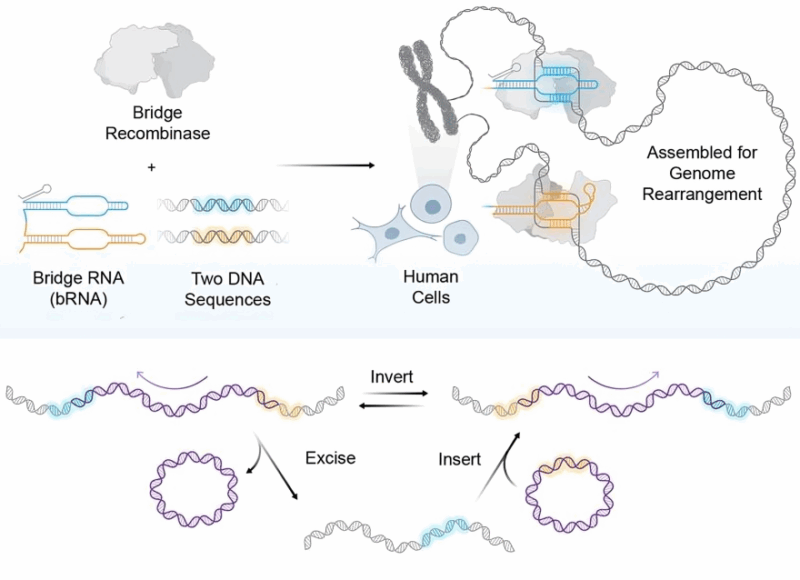
”Today in Science Magazine, we report a new DNA editing technology to seamlessly write massive changes into the right place in the human genome.
The reason gene editing hasn’t transformed human health is that current gene editing technologies like CRISPR are very limited.
The problem with CRISPR is that it cuts up your DNA, and then hopes that unreliable cellular DNA repair will make the wanted edit.
famously called it genome vandalism. More precise versions of CRISPR only edit less than 100 bases – often only a single base. Therefore, it’s not suited to make large changes safely.
However, most diseases are not the result of mutations in one location. Instead, their causes are spread all across the 3 billion base pairs in the genome.
We found bridge RNAs in bacterial “jumping genes” that allow us to make safe and arbitrary changes (insert, cut out, or flip) to every nucleotide within (up to) a 1 million bp sequence in your DNA.
In the paper, we show that we can correct the disease-causing DNA repeats that cause Friedreich’s ataxia (which is a rare neurological disease). The same approach could be applied to Huntington’s and other repeat expansion disorders.
This work was a wonderful collaboration with my Arc Institute cofounder Silvana Konermann and led by the indefatigable Nicholas Perry, alongside our amazing bridge editing team: Liam Bartie, Dhruva Katrekar, Gabriel Gonzalez, Matthew Durrant, James Pai, Alison Fanton, Juliana Martins, Masahiro Hiraizumi, Chiara Ricci-Tam, and Hiroshi Nishimasu”
Read the full article here.
Title: Megabase-scale human genome rearrangement with programmable bridge recombinases
Authors: Nicholas T. Perry, Liam J. Bartie, Dhruva Katrekar, Gabriel A. Gonzalez, Matthew G. Durrant, James J. Pai, Alison Fanton, Juliana Q. Martins, Masahiro Hiraizumi, Chiara Ricci-Tam, Hiroshi Nishimasu, Silvana Konermann, Patrick D. Hsu
Stay updated with Hemostasis Today.
-
Oct 19, 2026, 10:18Flora Peyvandi: Unravelling the Complexity of VWF Through Genetics
-
Oct 19, 2026, 09:55High DOAC Adherence in Patients With Ischemic Stroke and AF – International Journal of Stroke
-
Oct 19, 2026, 08:20Cory Dugan: The IRONWOMAN Trial Individual Responses to IV Iron Therapy in Active Women
-
Oct 19, 2026, 07:36Johannes Kaesmacher: Cerebral No-Reflow After Thrombectomy Toward a Standardized Definition
-
Oct 19, 2026, 07:33Beth Psaila: Highlights from IACH Annual Meeting and MPN Horizons
-
Oct 19, 2026, 07:29Wolfgang Miesbach: Can Losartan Activate Brown Fat? – Nature Study Explores New Therapeutic Link
-
Oct 19, 2026, 07:22Ruben Mesa: Honored to Speak at the Tandem MPN Meetings of IACH
-
Oct 19, 2026, 07:19Saneha Anjum Shaikh: Parul University Partners with Raktasevak Bike Ride 2026 for Blood Donation Drive
-
Oct 19, 2026, 07:09Alejandro González Veliz: No ST Elevation Does Not Guarantee an Open Coronary Artery