


Daniel Victor Ortigoza։ Lipoprotein(a) Levels Predict Long-Term Cardiovascular Risk in Women
Daniel Victor Ortigoza, 2nd Vice President of the Cardio-Oncology Committee at the Argentine Federation of Cardiology and President of the Arrhythmias and Electrophysiology Committee of the Argentine Federation of Cardiology, shared a post on LinkedIn about a recent article by Tybjærg Nordestgaard et al, published in JAMA Cardiology:
”Thirty-Year Risk of Cardiovascular Disease Among Healthy Women According to Clinical Thresholds of Lipoprotein(a). Ask Tybjærg Nordestgaard et al.
Lipoprotein(a) (LP(a) levels are known to be genetically determined, and elevated levels are (for now) an independent and unmodifiable risk factor for cardiovascular disease (CVD).
A 30-year prospective follow-up study was conducted in healthy women, primarily of European descent, comparing baseline LP(a) levels, clinical thresholds, LP(a) percentiles, and a specific genotype to establish the probability of developing CVD.
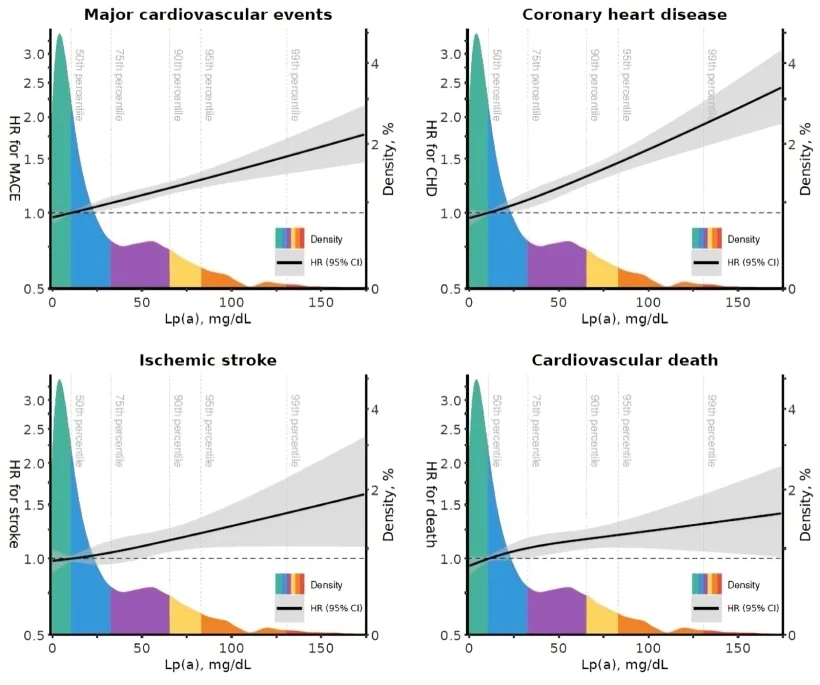
Figure 1. Restricted Cubic Spline Curves of 30-Year Hazard Ratios (HRs) for Major Cardiovascular Events (A), Coronary Heart Disease (B), Ischemic Stroke (C), and Cardiovascular Death (D)
- On the X-axis (baseline levels), analyze LP(a) levels; on the Y-axis, analyze HR (>1 => Risk). On the Y-axis, Graph A: HR for MACE, B: CHD, C: Stroke and D: Death.
- Color zone: Lp(a) levels, green: LP(a) < 10, blue < 30, etc.
- Vertical dotted lines indicating different percentiles.
- The gray band represents the HR width; the narrower the band, the greater the accuracy of the data.
- ight vertical line: Density percentage: referring to the LP (a) with respect to the total population under study.
Interpretation of the graph:
- In CVD the strongest associated risk is obtained with LP ( a) > 150mg/dl ( red) ( HR=2.5)
- In MACE the risk associated with LP ( a) > 100 mg/dl ( HR: 1.8)
- It carries moderate risks in stroke and cardiac death.
- Only women with Lp(a) levels > 30 mg/dl or above the 75th percentile were associated with major cardiovascular disease.”
Title: Thirty-Year Risk of Cardiovascular Disease Among Healthy Women According to Clinical Thresholds of Lipoprotein(a)
Authors: Tybjærg Nordestgaard, Daniel I. Chasman, Vinayaga Moorthy, Jordan M. Kraaijenhof, Nancy R. Cook, I-Min Lee, Julie E. Buring, Paul M. Ridker
Read the Full Article on JAMA Cardiology․
Stay updated on all scientific advances with Hemostasis Today.
-
Oct 19, 2026, 12:46Andrew Choong: Recognizing Thrombosis Before It Becomes Life-Threatening
-
Oct 19, 2026, 11:37Beth Faiman: APSHO Fellows Celebrated for Advancing Hematology and Oncology Practice
-
Oct 19, 2026, 11:26Emanuele Pacini: Myelodysplastic Syndromes Research Featured at JSH Annual Meeting in Kyoto
-
Oct 19, 2026, 10:57Jesmond Dalli: How Erythroblasts Shape Neutrophil Development and Function
-
Oct 19, 2026, 10:41Hisham Fahmi: SCD – Should Gene Editing Begin Before Organ Damage?
-
Oct 19, 2026, 10:33Pallavi Madhiraju: YARTEMLEA Faces Another European Rejection Despite FDA Approval
-
Oct 19, 2026, 10:28Brig Tathagata Chatterjee: Acute Leukemias in AYAs at the Japanese Society of Hematology Conference
-
Oct 19, 2026, 10:27Heather M. Johnson: Join the Discussion on Optimizing the CTEPH Diagnostic Pathway
-
Oct 19, 2026, 10:18Flora Peyvandi: Unravelling the Complexity of VWF Through Genetics