


Arwa Adamjee: Hypertension Emergencies and Hypertension in Pregnancy: A Bedside Teaching Note
Arwa Adamjee, Cardiology Fellow at Jakaya Kikwete Cardiac Institute, shared a post on LinkedIn:
“Hypertension Emergencies & Hypertension in Pregnancy: A Bedside Teaching Note
Hypertension remains the leading reversible cause of preventable cardiovascular mortality worldwide.
Yet, in the emergency unit, the distinction between urgency and emergency is often blurred — a delay in recognition can be fatal.
- Hypertensive Emergencies
Defined as severe BP ≥180/120 mmHg with evidence of acute target organ damage (e.g., encephalopathy, pulmonary edema, ACS, AKI, aortic dissection).
Key principle: Lower BP carefully, not quickly. Rapid drops may precipitate ischemia.
Management pearls:
– Admit to a high-dependency or ICU setting.
– Use IV agents with rapid titratability — labetalol, nicardipine, sodium nitroprusside (depending on setting).
– Aim to reduce MAP by ≤25% within the first hour, then to 160/100 mmHg over the next 2–6 hours (ESC 2024 guidelines).
– Avoid sublingual nifedipine — linked to ischemic complications.
Common causes at the bedside: uncontrolled chronic HTN, medication non-adherence, renal disease, or pregnancy-related hypertensive disorders.
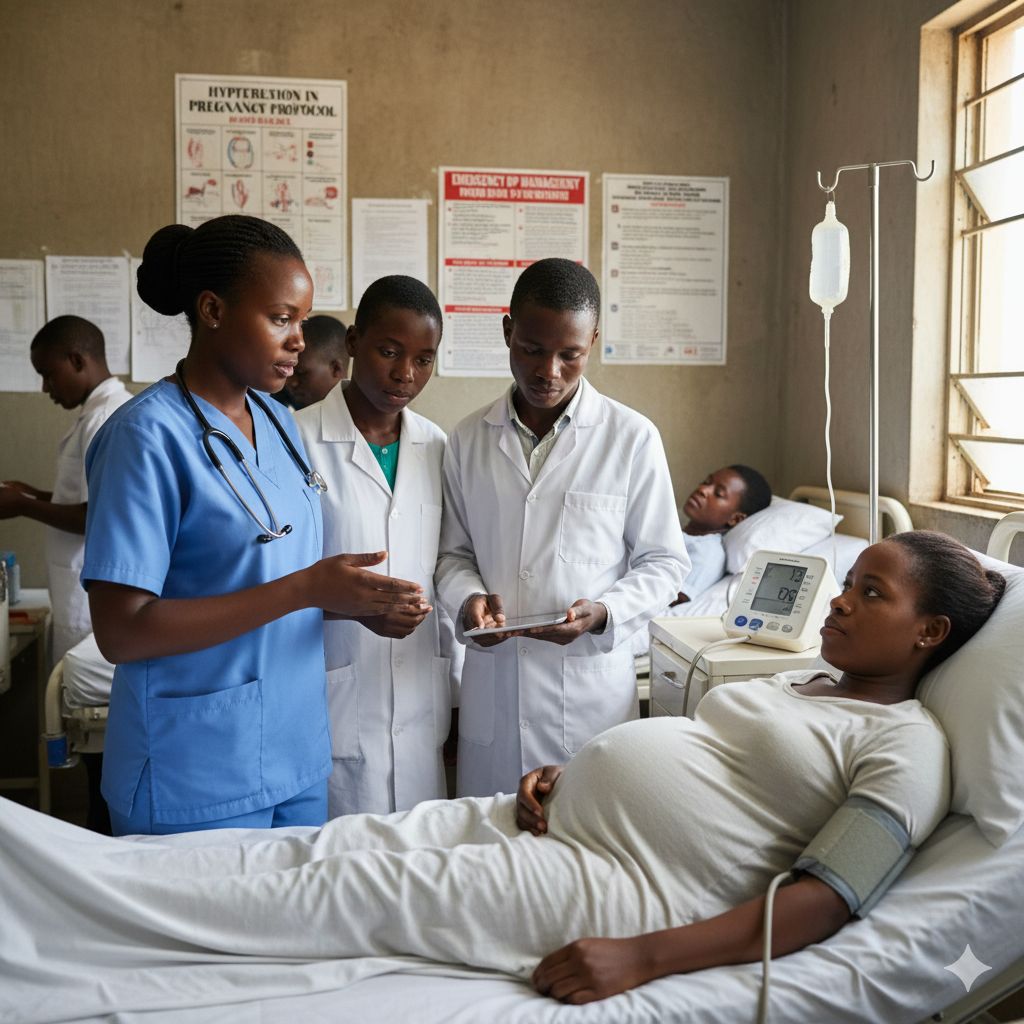
2. Hypertension in Pregnancy
A unique clinical spectrum — from gestational HTN to preeclampsia/eclampsia — where two lives depend on every decision.
Mechanism: Placental dysfunction → endothelial injury → systemic vasoconstriction and capillary leak.
This drives multi-organ risk — HELLP, pulmonary edema, eclampsia, stroke.
Treatment priorities:
– Severe HTN (≥160/110 mmHg) requires immediate but controlled lowering.
– First-line agents: IV labetalol, hydralazine, or oral nifedipine.
– Magnesium sulfate for seizure prophylaxis in preeclampsia/eclampsia.
– Definitive treatment: Delivery — timed to maternal-fetal stability and gestational age.
Bedside Takeaways
- Differentiate hypertensive emergency vs. urgency early — look for organ dysfunction.
- Titrate slowly; never normalize BP abruptly.
- In pregnancy, stabilize the mother first — she is the best incubator for the fetus.
- After crisis control, address adherence, comorbidities, and secondary causes (renal, endocrine).
In Tanzania and across LMICs
Resource constraints amplify risk — delayed presentation, limited ICU access, and underuse of parenteral agents.
Strengthening emergency protocols and clinician training can significantly reduce maternal and cardiovascular mortality.
For clinicians: every elevated BP reading in the ED deserves context, caution, and curiosity.
How does your unit differentiate and manage hypertensive emergencies?”
Stay updated with Hemostasis Today.
-
Oct 9, 2026, 23:57Exploring the Psychosocial Needs of People with Bleeding Disorders in Kyrgyzstan – EAHAD
-
Oct 9, 2026, 23:53Bernard Slater Jr.: Serving on the Advisory Council for the NBDF West Virginia Chapter
-
Oct 9, 2026, 23:53Aurelio Maggio: Thalassemia Reports Real-Time Impact Factor Rises to 1.760
-
Oct 9, 2026, 23:52Stronger Connections, Stronger Organizations – World Federation of Hemophilia
-
Oct 9, 2026, 23:46Samuel Misiani Mbunya: Advancing Sickle Cell Care Through Collaboration at the 21st ASCAT Conference
-
Oct 9, 2026, 23:42Hadeel Swed: My First First-Author Publication in Thrombosis Research
-
Oct 9, 2026, 23:38Micheal Avoseh: Exploring Nanoparticle-Based Therapies for Thrombosis and Vascular Inflammation
-
Oct 9, 2026, 16:23David Boone: Distinguishing Stroke Prevention from Rhythm Control in Atrial Fibrillation
-
Oct 9, 2026, 15:27Mohamed Hegazi: Geostatistical Modelling Maps Global β-Thalassaemia Carrier Prevalence