


Shrinidhi Nathany: Patients with CHIP May Be Predisposed to Higher Risk of Cytokine Release Syndrome after CAR-T
Shrinidhi Nathany, Consultant Molecular Hematology and Oncology at Fortis Memorial, shared a post on LinkedIn:
“New Research Alert!!!!!!!
CHIP Mutations May Amplify Inflammation in CAR-T Therapy
A fascinating new study (Zhang et al., J Transl Clin Transplant 2025) reveals that CRISPR knockdown of CHIP genes (DNMT3A, TET2, ASXL1) in macrophages drives increased production of inflammatory cytokines during CAR-T cell therapy including IL-6, MCP-1, and IL-1β.
Translation?
Patients with Clonal Hematopoiesis of Indeterminate Potential (CHIP) may be predisposed to higher risk of Cytokine Release Syndrome (CRS) after CAR-T.
This could reshape how we risk-stratify, monitor, and personalize CAR-T therapy especially in multiple myeloma and hematologic malignancies.”
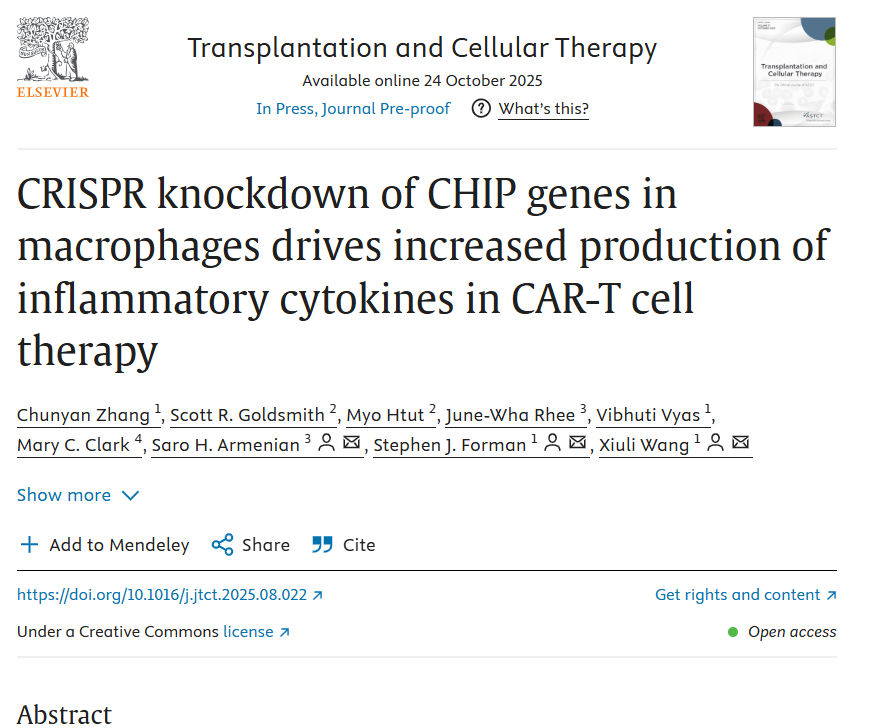
Title: CRISPR knockdown of CHIP genes in macrophages drives increased production of inflammatory cytokines in CAR-T cell therapy
Authors: Chunyan Zhang, Scott R. Goldsmith, Myo Htut, June-Wha Rhee, Vibhuti Vyas, Mary C. Clark, Saro H. Armenian, Stephen J. Forman, Xiuli Wang
Read the full article.
Stay updated with Hemostasis Today.
-
Sep 27, 2026, 15:49Rana Al-Hrout: Iron Deficency – Is Ferritin 15ng/mL or Less Still the Cutoff?
-
Sep 27, 2026, 15:49Ayushi Sharma: What I Thought Transfusion Medicine Would Be vs What It Actually Is
-
Sep 27, 2026, 15:48William Wallace: How Much Human Research Is Behind the Supplements We Take?
-
Sep 27, 2026, 15:46Franck Perraudin: Lp(a) Lowering Alone May Not Be Enough
-
Sep 27, 2026, 15:41Ahmed Hamandi: Sharing Real-World HSCT Experience at the Iraqi Society of Haematology Conference
-
Sep 27, 2026, 15:39Co-creating Digital Support With Young Stroke Survivors – European Stroke Organisation
-
Sep 27, 2026, 15:39Eleri Schiavone: Celebrating 80 Years of the Welsh Blood Service
-
Sep 27, 2026, 15:38Jessica Garcia: Standing Where VWD Was First Recognized 100 Years Later
-
Sep 27, 2026, 15:37Heghine Khachatryan: A Meaningful Step Forward for Inherited Blood Disorders in Africa