


Jan Sloves: Top Takeaways on Modern PTS Recanalization Strategies
Jan Sloves, President and Consultant at Vascular Imaging Professionals LLC, posted on LinkedIn:
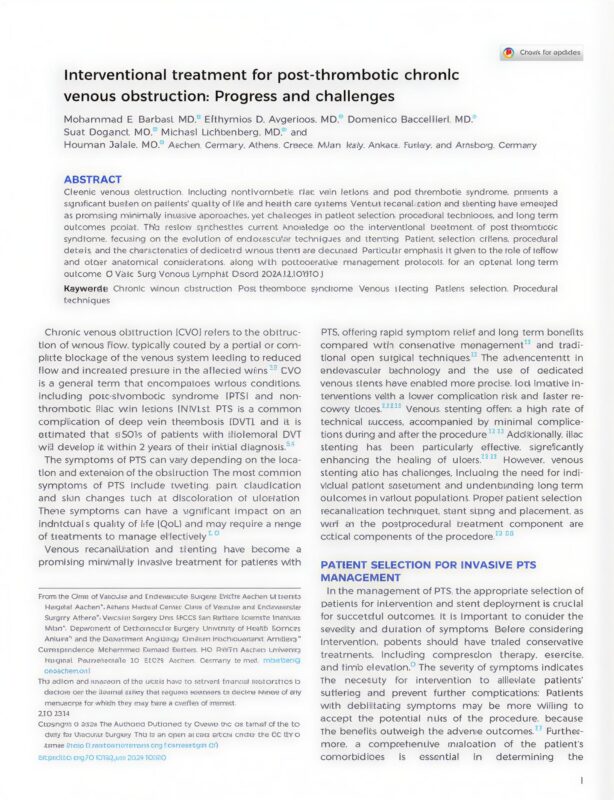
”Key Teaching Points from Mohammad E. Barbati et al.
Interventional Treatment for Post-Thrombotic Chronic Venous Obstruction:
Progress and Challenges
Who Needs Intervention
~50% of iliofemoral DVT patients develop PTS within 2 years; some progress to fixed CVO suitable for recanalization and stenting.
Intervention is for highly symptomatic patients (CEAP C3–C6, ulcers, major functional limits) who truly failed compression, exercise, and elevation.
Patient Selection and Work-Up
Selection must weigh symptom severity, comorbidities, bleeding risk, and ability to stay anticoagulated. Age alone is not a barrier.
Thrombophilia testing should be selective (e.g., unexplained VTE age 40–45, suspected APS); routine testing adds little value.
Inflow Determines Patency
Outcomes depend on inflow from the CFV, FV, and DFV; more infrainguinal disease = worse patency.
CVO classification (Types 1–5) is useful: Types 1–2 have best results; Type 5 (CFV + FV/DFV occlusion) has the poorest and requires careful consideration.
Imaging and IVUS
Duplex + CTV/MRV define anatomy and inflow. Venography and IVUS are intraoperative tools, not standalone diagnostics.
IVUS at the iliocaval confluence and CFV ensures accurate landing zones, avoids unnecessary IVC extension, prevents contralateral jailing, and confirms DFV/FV patency.
Recanalization and Stenting
Crossing strategy: hydrophilic wire + support catheter → escalate to sharp recanalization or dedicated devices if needed.
Stent sizes: 20–24 mm (IVC), 14–16 mm (iliac), 12–14 mm (CFV). Iliac stents ≥100 mm reduce migration. Distal landing typically in the EIV.
Landing Zones and Confluence Techniques
Proximal landing should treat obstruction but minimize IVC extension (contralateral DVT risk 1–2%, higher with aggressive jailing).
Preferred: double-barrel or skip. Inverted-Y and simple apposition have higher restenosis and are reserved for select cases.
Managing Poor Inflow
With single-vein inflow (often DFV), clear synechiae/septa (ballooning, retrograde DFV access, or endophlebectomy) to prevent thrombosis.
Hybrid CFV endophlebectomy + stenting offers similar patency to endovascular-only but with more wound morbidity; approach depends on anatomy and center expertise.
Complications and Prevention
Key issues: thrombosis, migration, fracture, contralateral DVT, back pain. These correlate with inflow quality, stent length, and landing-zone accuracy.
Short 14-mm iliac stents (60 mm) migrate more; longer stents, EIV anchoring, and distal-to-proximal post-dilation reduce risk.
Anticoagulation and Follow-Up
Durable outcomes require structured anticoagulation (warfarin or DOAC 6–12 months; longer for high-risk pts), plus compression.
Duplex at 1, 3, 6, 12 months, then annually, is essential for early detection of restenosis.
Subscribe to the only newsletter built for vascular pros.”
Stay updated with Hemostasis Today.
-
Oct 17, 2026, 04:07Weihao Li: Global HEPATIC Registry Findings on Post-Transplant Arterial Thrombosis
-
Oct 17, 2026, 03:56Ghaith Abu-Zeinah: ASH Publishes 2026 Guidelines for Myelofibrosis Management in Blood Advances
-
Oct 17, 2026, 03:48Tristan Siokos: Why Vascular Occlusion Is More Than Just Clots – Breakdown of the 8 Pathways
-
Oct 17, 2026, 02:36Archil Jaliashvili: Oxygen Transport in Capillaries
-
Oct 17, 2026, 02:35Carly Newton: Understanding Access to Red Blood Cell Exchange for People Living With SCD
-
Oct 17, 2026, 02:34Raising Awareness of Blood Clots During and After Pregnancy – Thrombosis UK
-
Oct 17, 2026, 02:33Alaa Salamat: Our Research Accepted for Publication at ASH 2026
-
Oct 17, 2026, 02:32Mohammed Al Sharif: Discussing Factor XIII Testing and Its Clinical Significance
-
Oct 17, 2026, 02:31Joanna Popiolek-Kalisz: Talking about Novel Pharmacotherapy for Hypertension at CV Prevention and Intervention