


Federica Fogacci on Sex Differences in Inflammatory Markers During Extended Evolocumab Treatment
Federica Fogacci, Young Fellow at European Atherosclerosis Society, shared on LinkedIn:
”Large outcome trials have shown that PCSK9 inhibitors do not significantly reduce hsCRP .
But that does not necessarily mean they have no impact on systemic inflammation.
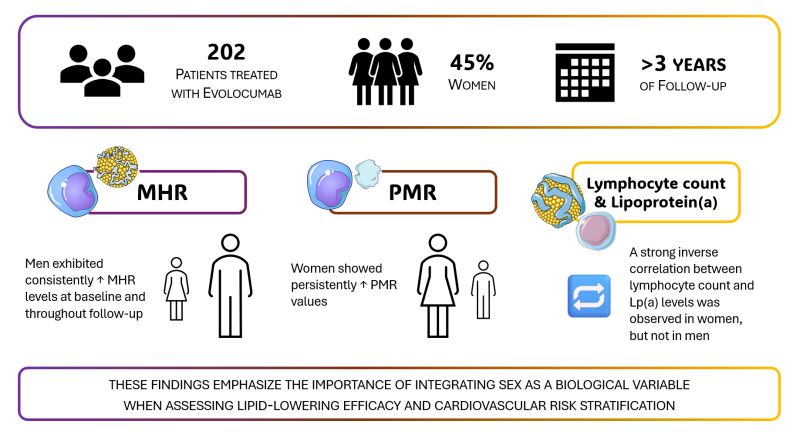
In our new paper, published in the Journal of Clinical Lipidology, we explored sex differences in inflammatory biomarkers during long-term evolocumab therapy in a real-world cohort of 202 patients treated for at least 36 months.
Full article.
What we found
- Men and women showed distinct inflammatory profiles under long-term evolocumab.
- Men had consistently higher monocyte-to-HDL cholesterol ratio (MHR) at baseline and during follow-up.
- Women showed persistently higher platelet-to-monocyte ratio (PMR).
- In women, we observed a strong inverse correlation between lymphocyte count and lipoprotein(a), suggesting sex-specific immunometabolic mechanisms that we would miss if we focused only on traditional lipid parameters.
Why this matters (and a personal thought)
In everyday clinical practice, we have no direct in vivo measure of plaque inflammation.
The neutral effect of PCSK9 inhibitors on hsCRP has sometimes been interpreted as “no inflammatory effect” – but inflammation is much more complex than a single biomarker.
If we could identify simple, robust systemic markers that capture relevant aspects of vascular inflammation under intensive lipid lowering, we would be one step closer to understanding how these therapies modify residual cardiovascular risk.
Leukocyte-based indices such as MHR and PMR:
- come from tests we already perform every day,
- are low-cost and universally available,
- and could, in principle, be easily implemented in routine clinical workflows.
Maybe MHR and PMR are not the whole story – but they might be part of it, and they may help us get closer to the right questions about how to track inflammatory risk in patients on long-term PCSK9 inhibition.
More work is clearly needed – but I think this is a small step in an important direction!”
Read the full article here.
Article: Sex Differences in Inflammatory Biomarkers During Long-Term Evolocumab Therapy
Authors: Federica Fogacci, Serra İlayda Yerlitaş Taştan, Marina Giovannini, Egidio Imbalzano, Dmitri Mitselman, Claudio Borghi, Gökmen Zararsız, Arrigo F.G. Cicero
Stay updated with Hemostasis Today.
-
Sep 30, 2026, 11:16Christina Pohlman: Could aPL Levels Help Predict Stroke Recurrence?
-
Sep 30, 2026, 10:55Rana Al Hrout: Diagnostic Approach to Hypochromic Microcytic Anemia
-
Sep 30, 2026, 01:52Javed Anees: DADA2 – When a Young Stroke Is More Than a Stroke
-
Sep 30, 2026, 01:51How a Venous Thrombus Becomes Revascularized – ISTH
-
Sep 29, 2026, 22:45Victor Agunyego: Paracetamol – The Most Common Drug We Underestimate
-
Sep 29, 2026, 22:42Nova Sinclair: Advancing the Future of Hematology – Meet Our 2027 Organizing Committee
-
Sep 29, 2026, 22:41Lorenz Räber: Intracoronary Imaging in PCI – Why, When, How, and Which Modality?
-
Sep 29, 2026, 22:31Selma Turkovic: Pleased to Deliver the Opening Presentation at Kingston Hospital
-
Sep 29, 2026, 22:31Miguel Teran: Ultrasound and Simulation in Arterial Blood Sampling