


Seyed Mohsen Jahromi Moghadam: Antithrombotic Therapy After Transcatheter Structural Heart Interventions
Seyed Mohsen Jahromi Moghadam, Advanced Interventional Cardiologist at Razavi Hospital, posted on LinkedIn:
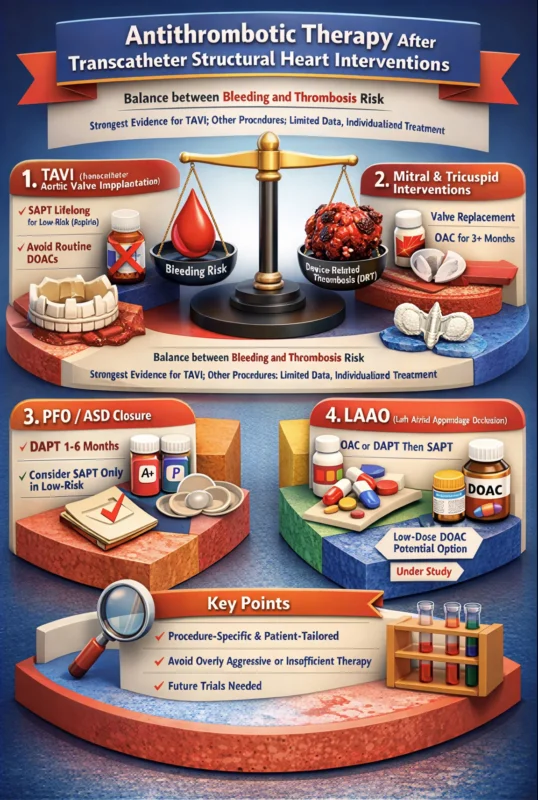
”After transcatheter structural heart interventions, antithrombotic therapy must balance prevention of device-related thrombosis (DRT) against bleeding risk. Evidence is strongest for TAVI; for other procedures, data are limited and treatment should be individualized.
1) Transcatheter Aortic Valve Implantation (TAVI)
Patients without an indication for oral anticoagulation (OAC):
• Lifelong single antiplatelet therapy (SAPT), usually low-dose aspirin, is recommended.
• Dual antiplatelet therapy (DAPT) increases bleeding without ischemic benefit.
• Routine DOAC use is discouraged due to higher mortality and bleeding despite reducing subclinical leaflet thrombosis (SLT).
Subclinical leaflet thrombosis (HALT/RLM):
• More frequent with antiplatelet therapy than with OAC.
• Associated with higher stroke/TIA risk.
• Temporary OAC (VKA or DOAC) for ~3–6 months is recommended when SLT is detected, with CT follow-up.
Patients with an indication for chronic OAC (e.g., atrial fibrillation):
• OAC alone is preferred.
• Adding antiplatelet therapy increases bleeding without benefit.
• DOACs appear reasonable alternatives to VKAs if appropriately dosed and without routine antiplatelet use.
2) Mitral and Tricuspid Interventions
• Valve replacement (TMVI/TTVI): High risk of DRT → OAC for at least 3 months is generally recommended.
• Edge-to-edge repair (TEER): DRT is rare; resume OAC if indicated or use short-term SAPT.
• Evidence comparing DOACs vs VKAs is limited, but DOACs may reduce bleeding.
3) Patent Foramen Ovale (PFO) / Atrial Septal Defect (ASD) Closure
• Traditional approach: DAPT for 1–6 months, then SAPT.
• Recent observational data suggest no clear advantage of DAPT over SAPT.
• In selected low-risk patients, complete discontinuation of antithrombotic therapy after endothelialization may be safe, but evidence is still evolving.
4) Left Atrial Appendage Occlusion (LAAO)
• DRT occurs in <5%, mostly within the first 90 days, but markedly increases stroke risk.
• Regimens vary:
• Short-term OAC or DAPT followed by SAPT is common.
• Emerging evidence suggests low-dose or half-dose DOAC monotherapy may reduce both DRT and bleeding in high-bleeding-risk patients.
• Optimal regimen remains under investigation in ongoing RCTs.
Conclusion
• Antithrombotic strategies after transcatheter structural heart interventions must be procedure-specific and patient-tailored.
• Overly aggressive therapy increases bleeding, while insufficient therapy increases thrombotic risk.
• Future trials (including imaging-guided and factor XIa inhibitor strategies) aim to refine this balance.”
Stay updated with Hemostasis Today.
-
Sep 25, 2026, 07:25Varun Capoor: How Therapeutic Apheresis and Transfusion Medicine Can Complement Clinical Management in SCD
-
Sep 25, 2026, 07:14Manshi Kesharwani: SAK-GQDs Modulate Thrombus Burden and Endothelial Function in Deep Vein Thrombosis
-
Sep 25, 2026, 06:20Farjah Hassan Algahtani: How Can We Better Identify Patients at Risk of Blood Clots after Metabolic and Bariatric Surgery?
-
Sep 25, 2026, 05:59Carla Lewis: Kids Conquering Sickle Disease Joins Nemours Children’s Hospital for 2nd Annual Awareness Event
-
Sep 25, 2026, 05:47Omid Seidizadeh: Evolutionary Constraint and Population Variation Across Coagulation Genes
-
Sep 25, 2026, 05:40Gerald Bertrand: Presenting UMi-NGS Non-Invasive Foetal HPA Genotyping at DGTI 2026
-
Sep 25, 2026, 05:33Urge Congress to support the Sickle Cell Disease Comprehensive Care Act – ASH
-
Sep 25, 2026, 05:24Isabelle Mahé: Reduced-Dose Apixaban in Extended CAT Treatment
-
Sep 25, 2026, 05:15Maria Cherska: High Cholesterol Isn’t Always Diet or Lifestyle – Sometimes It’s Genetic