


Daniel Victor Ortigoza։ Lipoprotein(a) Levels Predict Long-Term Cardiovascular Risk in Women
Daniel Victor Ortigoza, 2nd Vice President of the Cardio-Oncology Committee at the Argentine Federation of Cardiology and President of the Arrhythmias and Electrophysiology Committee of the Argentine Federation of Cardiology, shared a post on LinkedIn about a recent article by Tybjærg Nordestgaard et al, published in JAMA Cardiology:
”Thirty-Year Risk of Cardiovascular Disease Among Healthy Women According to Clinical Thresholds of Lipoprotein(a). Ask Tybjærg Nordestgaard et al.
Lipoprotein(a) (LP(a) levels are known to be genetically determined, and elevated levels are (for now) an independent and unmodifiable risk factor for cardiovascular disease (CVD).
A 30-year prospective follow-up study was conducted in healthy women, primarily of European descent, comparing baseline LP(a) levels, clinical thresholds, LP(a) percentiles, and a specific genotype to establish the probability of developing CVD.
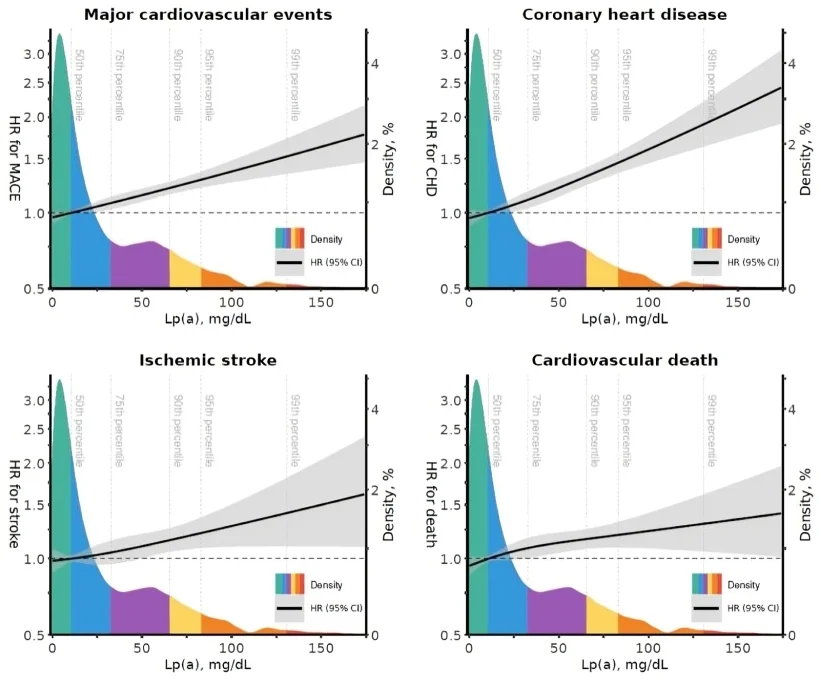
Figure 1. Restricted Cubic Spline Curves of 30-Year Hazard Ratios (HRs) for Major Cardiovascular Events (A), Coronary Heart Disease (B), Ischemic Stroke (C), and Cardiovascular Death (D)
- On the X-axis (baseline levels), analyze LP(a) levels; on the Y-axis, analyze HR (>1 => Risk). On the Y-axis, Graph A: HR for MACE, B: CHD, C: Stroke and D: Death.
- Color zone: Lp(a) levels, green: LP(a) < 10, blue < 30, etc.
- Vertical dotted lines indicating different percentiles.
- The gray band represents the HR width; the narrower the band, the greater the accuracy of the data.
- ight vertical line: Density percentage: referring to the LP (a) with respect to the total population under study.
Interpretation of the graph:
- In CVD the strongest associated risk is obtained with LP ( a) > 150mg/dl ( red) ( HR=2.5)
- In MACE the risk associated with LP ( a) > 100 mg/dl ( HR: 1.8)
- It carries moderate risks in stroke and cardiac death.
- Only women with Lp(a) levels > 30 mg/dl or above the 75th percentile were associated with major cardiovascular disease.”
Title: Thirty-Year Risk of Cardiovascular Disease Among Healthy Women According to Clinical Thresholds of Lipoprotein(a)
Authors: Tybjærg Nordestgaard, Daniel I. Chasman, Vinayaga Moorthy, Jordan M. Kraaijenhof, Nancy R. Cook, I-Min Lee, Julie E. Buring, Paul M. Ridker
Read the Full Article on JAMA Cardiology․
Stay updated on all scientific advances with Hemostasis Today.
-
Oct 19, 2026, 19:44Where You Live Should not Determine Whether You Receive Care – World Federation of Hemophilia
-
Oct 19, 2026, 19:42Belen Bianco: Prevention, Early Suspicion and an Interdisciplinary Approach Save Lives
-
Oct 19, 2026, 19:40Christina Chrysohoou: Catheter-Based LAAC vs OAC for Stroke Prevention in Atrial Fibrillation
-
Oct 19, 2026, 19:38Matthew Flick: A Two-Day Research Meeting on Fibrinogen, Hemostasis and Thrombosis
-
Oct 19, 2026, 19:37Hayat Saeed: Excited to Share Our Publication on the FGL1–Hepcidin Axis in Iron Homeostasis and Disease
-
Oct 19, 2026, 19:08IPAW 2026 Comes to a Close, but the Work Continues – PPTA
-
Oct 19, 2026, 17:44Paul Riley: Moderating a Webinar on Anticoagulation Monitoring
-
Oct 19, 2026, 16:36Christopher Pittman: Blood Clot Prevention Cannot End at Hospital Discharge
-
Oct 19, 2026, 16:13Javier M. Floren: When Immune Cells Move With Their Environment