


Stephen Twumasi: The Impact of Hepatitis B Infection on the Coagulation System During Pregnancy
Stephen Twumasi, Head of Medical Laboratory and Senior Biomedical Scientist at Legacy Hospital, shared a post on LinkedIn about a recent article he and his colleagues co-authored, adding:
“New Publication Alert!
Hepatitis B remains highly prevalent in many parts of the world, particularly in sub-Saharan Africa. But how does Hepatitis B infection affect the coagulation system during pregnancy?
In our newly published study, we investigated the impact of Hepatitis B infection on coagulation parameters and liver biomarkers among pregnant women in Ghana.
Using a case–control design involving 180 pregnant women, we compared HBV-infected participants with HBV-negative controls to better understand the biochemical and hemostatic changes associated with infection.
Key findings from the study:
- HBV-infected pregnant women showed significantly elevated liver enzymes and bilirubin levels, suggesting hepatic injury.
- Important coagulation markers such as fibrinogen, protein C, and protein S were significantly reduced.
- Prothrombin time (PT) and activated partial thromboplastin time (aPTT) were prolonged, indicating disturbances in the coagulation cascade.
- Interestingly, aPTT, fibrinogen, and protein C demonstrated strong diagnostic potential for identifying chronic HBV infection.
Why this matters
Pregnancy naturally alters the coagulation system. When combined with Hepatitis B infection, these changes may further disrupt the delicate hemostatic balance, potentially increasing the risk of complications. Monitoring these biomarkers could therefore play an important role in the clinical management of HBV-positive pregnancies.
Impact
This study adds to the limited evidence on hemostatic alterations in HBV-infected pregnant women in sub-Saharan Africa and highlights potential biomarkers that may aid in monitoring disease-related complications.
I’m grateful to my co-authors and collaborators who contributed to this work.”
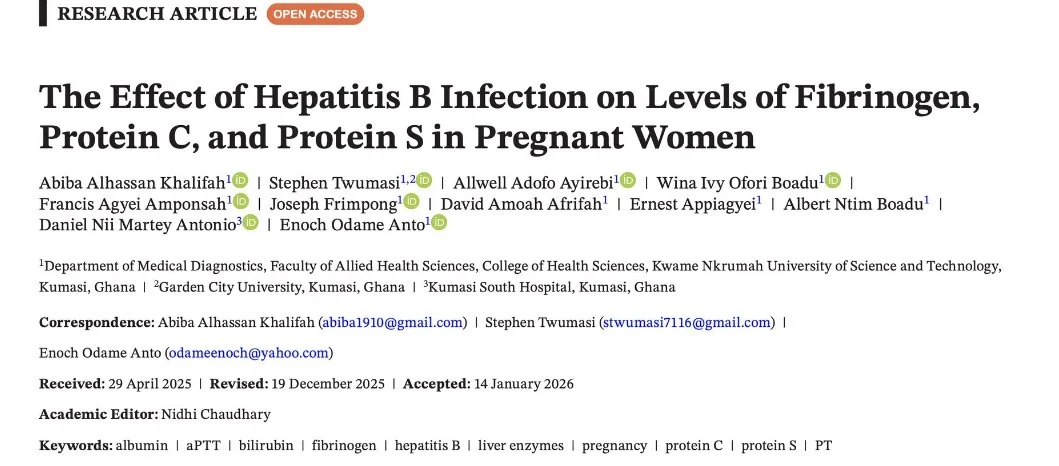
Title: The Effect of Hepatitis B Infection on Levels of Fibrinogen, Protein C, and Protein S in Pregnant Women
Authors: Abiba Alhassan Khalifah, Stephen Twumasi, Allwell Adofo Ayirebi, Wina Ivy Ofori Boadu, Francis Agyei Amponsah, Joseph Frimpong, David Amoah Afrifah, Ernest Appiagyei, Albert Ntim Boadu, Daniel Nii Martey Antonio, Enoch Odame Anto
Read the Full Article on Journal of Pregnancy
Stay updated on all scientific advances with Hemostasis Today.
-
Sep 25, 2026, 07:25Varun Capoor: How Therapeutic Apheresis and Transfusion Medicine Can Complement Clinical Management in SCD
-
Sep 25, 2026, 07:14Manshi Kesharwani: SAK-GQDs Modulate Thrombus Burden and Endothelial Function in Deep Vein Thrombosis
-
Sep 25, 2026, 06:20Farjah Hassan Algahtani: How Can We Better Identify Patients at Risk of Blood Clots after Metabolic and Bariatric Surgery?
-
Sep 25, 2026, 05:59Carla Lewis: Kids Conquering Sickle Disease Joins Nemours Children’s Hospital for 2nd Annual Awareness Event
-
Sep 25, 2026, 05:47Omid Seidizadeh: Evolutionary Constraint and Population Variation Across Coagulation Genes
-
Sep 25, 2026, 05:40Gerald Bertrand: Presenting UMi-NGS Non-Invasive Foetal HPA Genotyping at DGTI 2026
-
Sep 25, 2026, 05:33Urge Congress to support the Sickle Cell Disease Comprehensive Care Act – ASH
-
Sep 25, 2026, 05:24Isabelle Mahé: Reduced-Dose Apixaban in Extended CAT Treatment
-
Sep 25, 2026, 05:15Maria Cherska: High Cholesterol Isn’t Always Diet or Lifestyle – Sometimes It’s Genetic