


Simon Senanu: Key Laboratory Markers of Hemolytic Anemia
Simon Senanu, Medical Laboratory Scientist at Perkins Medical Centre, shared a post on LinkedIn:
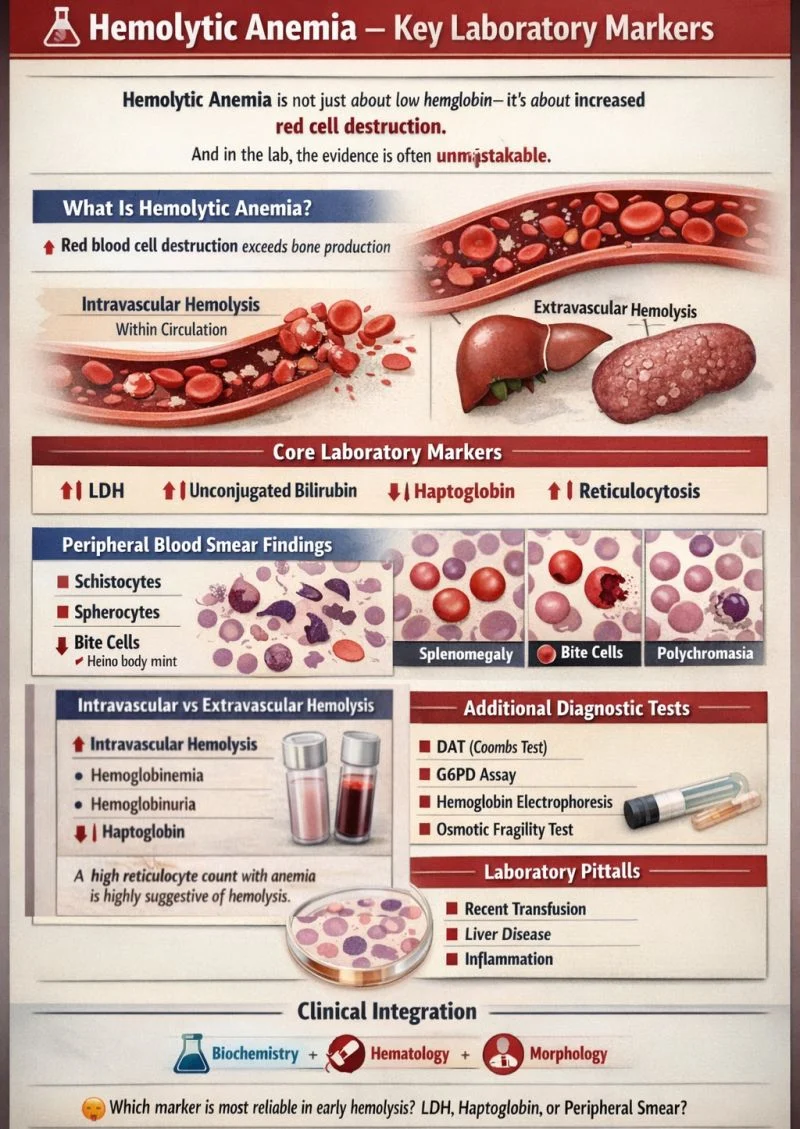
“Hemolytic Anemia – Key Laboratory Markers
Hemolytic anemia is not just about low hemoglobin – it’s about increased red cell destruction.
And in the lab, the evidence is often unmistakable.
What Is Hemolytic Anemia?
Hemolytic anemia occurs when:
- Red blood cell destruction exceeds bone marrow production
It can be broadly classified as:
- Intravascular hemolysis – destruction within the circulation
- Extravascular hemolysis – destruction by macrophages in the spleen and liver
- The distinction is critical, as it directly influences both laboratory findings and clinical presentation.
Core Laboratory Markers
The diagnosis relies on a combination of findings:
- Elevated Lactate Dehydrogenase (LDH) – Reflects cellular breakdown; often markedly increased in intravascular hemolysis
- Increased Unconjugated Bilirubin – Result of heme catabolism; may lead to clinical jaundice
- Reduced Haptoglobin – Binds free hemoglobin; levels drop as it is consumed – Often undetectable in intravascular hemolysis
- Reticulocytosis -Indicates marrow compensation, Reticulocyte count may rise within 3 – 5 days of hemolysis
A high reticulocyte count with anemia strongly suggests a hemolytic process.
Peripheral Blood Smear Findings
The blood film is indispensable in narrowing the cause:
- Schistocytes – Microangiopathic hemolytic anemia (e.g., TTP, DIC)
- Spherocytes – Autoimmune hemolytic anemia or hereditary spherocytosis
- Bite cells / Heinz body remnants – Oxidative damage (e.g., G6PD deficiency)
- Polychromasia – Reflects increased circulating reticulocytes
In many cases, the smear provides the first clue to etiology before confirmatory testing.
Intravascular vs Extravascular Clues
- Intravascular hemolysis
- Hemoglobinemia
- Hemoglobinuria
- Markedly low haptoglobin
Extravascular hemolysis
- Splenomegaly
- Spherocytes on smear
- Mildly reduced haptoglobin
- These patterns help localize where destruction is occurring.
Additional Diagnostic Tests
To further define etiology:
- Direct Antiglobulin Test (DAT / Coombs test) – Autoimmune hemolysis
- G6PD assay – Enzyme deficiency (note: may be falsely normal during acute episodes)
- Hemoglobin electrophoresis – Hemoglobinopathies
- Osmotic fragility test – Hereditary spherocytosis
Laboratory Pitfalls
- Recent transfusion may mask hemolysis markers
- Liver disease can alter bilirubin interpretation
- Inflammation may falsely elevate haptoglobin
Always interpret results in clinical context.
Clinical Significance
Early recognition of hemolysis is critical for:
- Diagnosing autoimmune hemolytic anemia
- Detecting transfusion reactions
- Identifying inherited RBC disorders
Laboratory Takeaway
Hemolytic anemia is a pattern-based diagnosis.
No single test is sufficient – interpretation requires integrating:
- Biochemistry plus Hematology plus Morphology
Which marker do you find most reliable in early hemolysis – LDH, haptoglobin, or the peripheral smear?”
Stay updated with Hemostasis Today.
-
Oct 5, 2026, 22:55Steve Humphreys: A Big Thank You to BSHT for Providing Me With a Recent Skills Exchange Award
-
Oct 5, 2026, 22:52William McKeown: Great to Be in Istanbul for the Opening of the EHC 2026
-
Oct 5, 2026, 22:48Laura Quintas Lorenzo: A New Approach to Healthcare for von Willebrand Disease at EHC 2026
-
Oct 5, 2026, 22:46Anas Zayad: Pleased to Share Our New Review on Thrombosis in SCD and Beta Thalassemia
-
Oct 5, 2026, 22:44Cihan Ay: Honouring Eric Kandel and Eugene Braunwald at the Medical University of Vienna
-
Oct 5, 2026, 22:42Heather L. Gornik: Testing for Aortic and Arterial Thrombosis at VSS 2026
-
Oct 5, 2026, 22:34Hasan Abbas Zaheer: Honoured to Have Co-Authored One of the Four Reviews in The Lancet Thalassemia Series
-
Oct 5, 2026, 22:34Kamyar Shameli: Understanding the Coagulation Cascade – How Anticoagulants Prevent Blood Clots
-
Oct 5, 2026, 22:31Risika Samanta: Pediatric ITP in a 12-year-old – An Atypical Presentation without a Viral Prodrome