


Ifeanyichukwu Ifechidere: When PT and APTT Are Normal but Bleeding Persists
Ifeanyichukwu Ifechidere, Specialist Biomedical Scientist at Sheffield Teaching Hospitals NHS Foundation Trust, shared a post on LinkedIn:
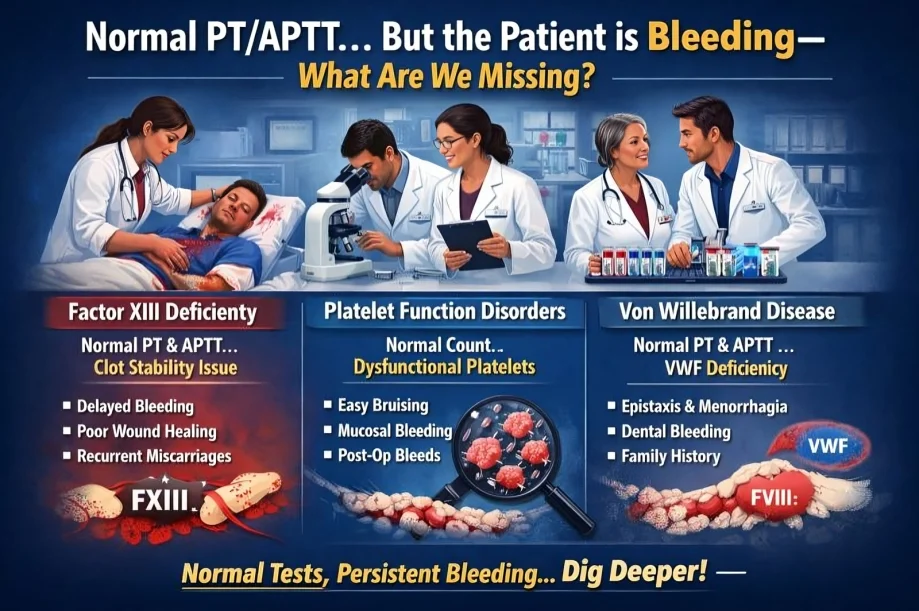
”Normal PT/APTT… but the patient is bleeding — what are we missing?
As biomedical scientists, we’re trained to trust our screening assays. A normal PT and APTT often reassure clinicians that the coagulation cascade is intact.
But here’s the critical reminder: normal screening tests do NOT exclude a bleeding disorder.
When the clinical picture and the lab results don’t align, it’s time to think beyond the basics.
So what could we be missing?
Factor XIII deficiency
PT and APTT assess clot formation — but not clot stability.
Factor XIII acts after fibrin is formed, cross-linking and stabilising the clot.
Deficiency can present with:
- Delayed bleeding (hours to days post-procedure)
- Poor wound healing
- Recurrent miscarriages
Key point: Routine coagulation screens will be completely normal. Specific FXIII assays are required.
Platelet function disorders
Platelet count is not equal platelet function.
Even with a normal platelet count and coagulation screen, dysfunctional platelets can lead to significant bleeding.
Consider in patients with:
- Mucocutaneous bleeding
- Easy bruising
- Post-surgical bleeding with normal labs
Think about:
- Inherited disorders (e.g. Glanzmann, Bernard-Soulier)
- Acquired causes (antiplatelet drugs, uraemia)
Specialist testing (e.g. platelet function analysis, aggregometry) is essential.
von Willebrand Disease (VWD)
The most common inherited bleeding disorder — and frequently underdiagnosed.
VWF plays a dual role:
- Mediates platelet adhesion
- Carries and stabilises Factor VIII
Why PT/APTT may be normal:
- Mild VWD may not significantly reduce FVIII
- APTT may only prolong in more severe cases
Clues:
- Personal or family history of bleeding
- Menorrhagia, epistaxis, dental bleeding
Diagnosis requires a panel: VWF antigen, activity, and FVIII levels.
The takeaway
Normal PT and APTT do not rule out:
- Defects in clot stabilisation
- Platelet dysfunction
- von Willebrand Disease
As laboratory professionals, our value lies not just in reporting numbers — but in recognising when the numbers don’t tell the full story.
- When bleeding is unexplained, expand the investigation.
- When results don’t fit the clinical picture, question them.
Because sometimes, what’s not abnormal is exactly where the answer lies.”
Other posts featuring Ifeanyichukwu Ifechidere on Hemostasis Today.
-
Oct 5, 2026, 15:31Irma Bagdoniene: Multidisciplinary Management of High-Risk Familial Hypercholesterolaemia and CAD
-
Oct 5, 2026, 15:00Serena Williams and Pulmonary Embolism: From Personal Crisis to Lessons in Venous Thromboembolism
-
Oct 5, 2026, 14:55Marco Moscarelli: 3D Reconstruction Enhances Volumetric Assessment of Post-TAVI Thrombosis
-
Oct 5, 2026, 13:24Abdul Muqtadir Abbasi: Diagnostic Pearls for Evaluating Isolated Thrombocytopenia in Residents
-
Oct 5, 2026, 13:16Katerina Pavenski: Rethinking What ‘Normal’ Means for Iron Deficiency
-
Oct 5, 2026, 13:09Rick Matthews: Balancing Established VTE Partnerships with Innovative Interventional Technologies
-
Oct 5, 2026, 13:01Nawsherwan Mohammad: Recognizing TTP Before the ADAMTS13 Result Arrives
-
Oct 5, 2026, 12:51Bruno Pougault: The Hidden Challenges Behind Anti Xa Testing
-
Oct 5, 2026, 12:41Syed Huzaifa Khan: Rethinking CTRP12 as a Biomarker for In Stent Restenosis