


Ifeanyichukwu Ifechidere: The Most Misunderstood Cause of a Prolonged APTT in the Laboratory
Ifeanyichukwu Ifechidere, Specialist Biomedical Scientist at Sheffield Teaching Hospitals NHS Foundation Trust, shared a post on LinkedIn:
” ‘Prolonged APTT: bleeding risk’… right?
This is one of the most misunderstood assumptions in coagulation.
Because one of the commonest causes of prolonged APTT in the lab…
- does NOT cause bleeding at all.
In fact — it’s often associated with the opposite.
Let’s talk about Lupus Anticoagulant (LA)
Despite the name, it is: Not necessarily linked to lupus
Not an anticoagulant in the body
It is a prothrombotic antibody
So why does it prolong APTT?
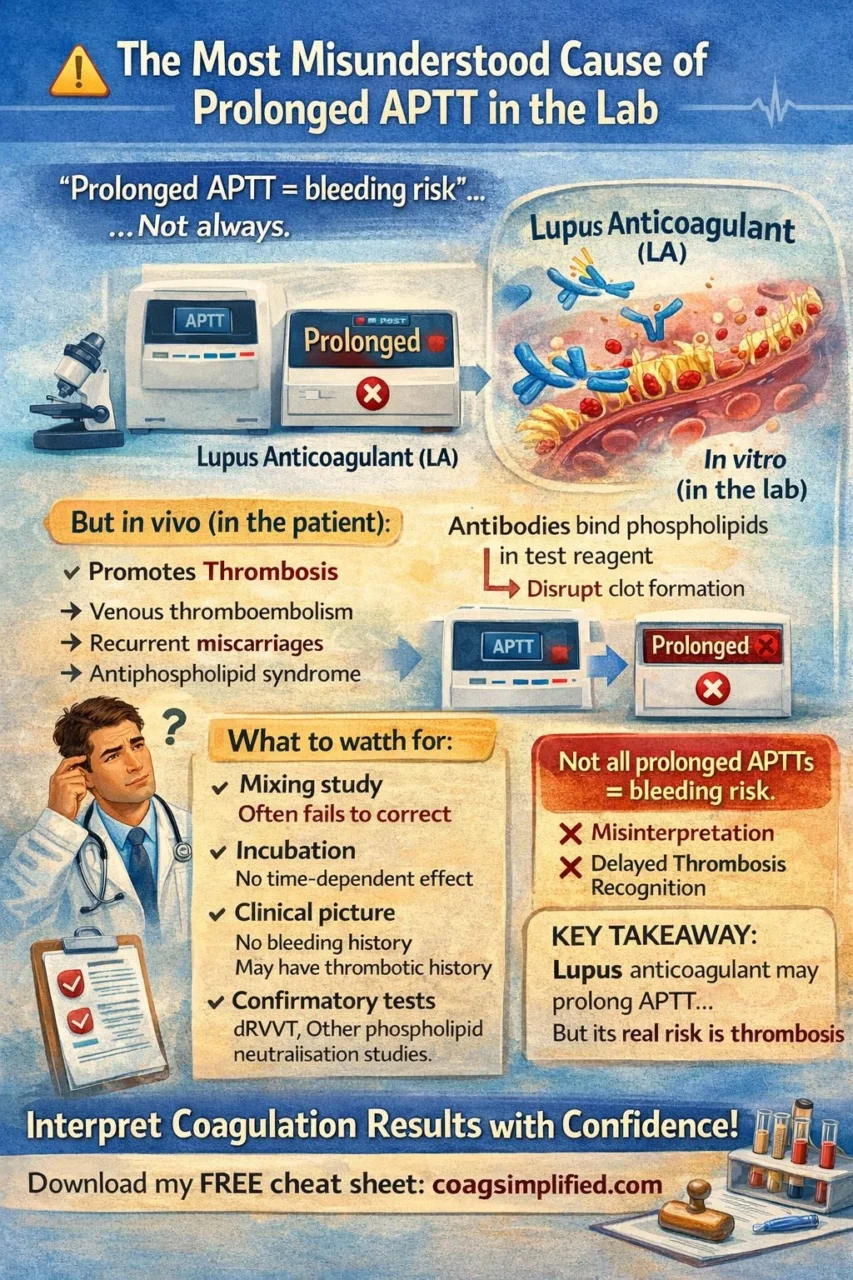
Lupus anticoagulant interferes with: Phospholipid-dependent clotting assays
In vitro (in the lab):
It binds phospholipids in the test reagent
Disrupts clot formation
- Leads to prolonged APTT
But in vivo (in the patient):
It promotes thrombosis, not bleeding
Associated with:
- Venous thromboembolism
- Recurrent miscarriages
- Antiphospholipid syndrome
Why it confuses so many:
Because the pattern looks like a bleeding disorder:
Prolonged APTT
Sometimes no correction in mixing study
Easily mistaken for:
- Factor deficiency
- Factor inhibitor
Key distinguishing features:
- Mixing study
Often fails to correct (inhibitor pattern)
- Incubation
No time-dependent effect (unlike factor VIII inhibitors)
- Clinical picture
No bleeding history
May have thrombotic history
Confirmatory tests
- Dilute Russell Viper Venom Test (dRVVT)
- Phospholipid neutralisation studies
The critical takeaway:
Not all prolonged APTTs indicate bleeding risk.
And missing lupus anticoagulant can lead to:
- Misinterpretation
- Delayed thrombosis risk recognition
- Incorrect clinical decisions
Want a simple way to interpret coagulation results with confidence?
I’ve created a free cheat sheet that breaks down patterns like this — clearly and practically.
Because in coagulation, confidence doesn’t come from memorising — it comes from understanding what the result is really telling you..”
Other posts featuring Ifeanyichukwu Ifechidere on Hemostasis Today.
-
Oct 20, 2026, 03:24Chaza Alaji: Diagnosing Protein C and Protein S Deficiency
-
Oct 20, 2026, 03:24Mou Nandi: How Maternal Health During Pregnancy May Shape Infant Development
-
Oct 20, 2026, 03:13Sumyea Kabir: Pre-Analytical Quality in Phlebotomy – Preventing In Vitro Hemolysis
-
Oct 20, 2026, 02:37M. Sekip Altunkan: Can Anticoagulation Be Safely Stopped After AF Ablation?
-
Oct 20, 2026, 02:26Ahmed Ammar: Managing VT Recurrence Post-Ablation
-
Oct 20, 2026, 01:43Oliver Weingärtner: Deprescribing of Lipid Lowering Drug after MI is Associated with Cardiovascular Events
-
Oct 19, 2026, 19:44Where You Live Should not Determine Whether You Receive Care – World Federation of Hemophilia
-
Oct 19, 2026, 19:42Belen Bianco: Prevention, Early Suspicion and an Interdisciplinary Approach Save Lives
-
Oct 19, 2026, 19:40Christina Chrysohoou: Catheter-Based LAAC vs OAC for Stroke Prevention in Atrial Fibrillation