

Fred Markham: Challenging the Myth of the “Gold Standard” in Stroke Rehab
Fred Markham, Clinical Exercise Physiologist, shared a post on LinkedIn:
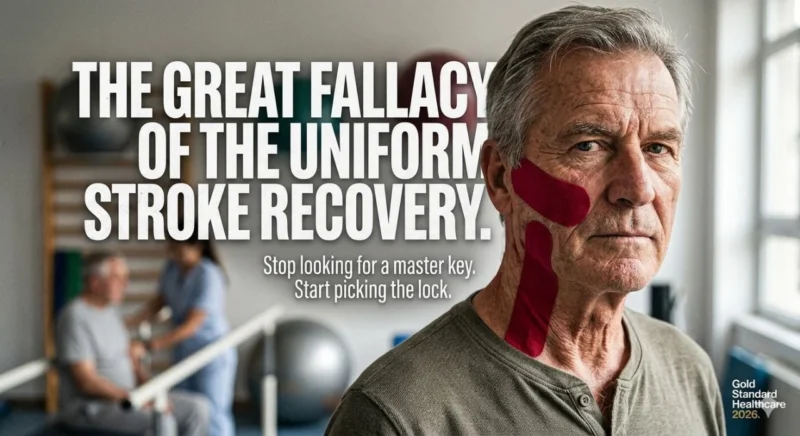
”The Great Fallacy of the Uniform Stroke Recovery
Most medical marketing is a lie.
It promises a single, miraculous path to recovery where none exists.
Your brain is as unique as your thumbprint.
A stroke does not attack a generic organ; it attacks your specific history, your unique neural pathways, and your individual life.
To treat every patient with the same rigid protocol is not just lazy medicine.
It is a disservice to the human spirit.
Real progress happens when we stop looking for a master key and start picking the lock.
To find the way forward, follow these principles:
- Reject the idea of a gold standard method.
- Demand a strategy based on your specific physical deficits.
- Prioritize high-repetition tasks that matter to your daily life.
- Pivot the treatment the moment a plateau is reached.
- Trust clinical intuition over rigid manual instructions.
Stroke rehabilitation is not a science of certainties. It is an art of relentless adaptation.
Stop chasing the perfect method. Start chasing the work that fits your life.”
Stay updated with Hemostasis Today.
-
Sep 30, 2026, 01:52Javed Anees: DADA2 – When a Young Stroke Is More Than a Stroke
-
Sep 30, 2026, 01:51How a Venous Thrombus Becomes Revascularized – ISTH
-
Sep 29, 2026, 22:45Victor Agunyego: Paracetamol – The Most Common Drug We Underestimate
-
Sep 29, 2026, 22:42Nova Sinclair: Advancing the Future of Hematology – Meet Our 2027 Organizing Committee
-
Sep 29, 2026, 22:41Lorenz Räber: Intracoronary Imaging in PCI – Why, When, How, and Which Modality?
-
Sep 29, 2026, 22:31Selma Turkovic: Pleased to Deliver the Opening Presentation at Kingston Hospital
-
Sep 29, 2026, 22:31Miguel Teran: Ultrasound and Simulation in Arterial Blood Sampling
-
Sep 29, 2026, 22:28Mohammad Refaei: Navigating Your Career in Hematology From Training to Practice
-
Sep 29, 2026, 22:27Matteo Foschi: 10 Clinical Pearls for Antithrombotic Therapy in Secondary Stroke Prevention