


Pall T. Onundarson: Fiix-Monitored Warfarin is Actually More Effective than Unmonitored DOACs!
Pall T. Onundarson, Professor Emeritus at Landspitali University Hospital, recently shared an insightful post on LinkedIn:
”Convenient DOAC drugs have been forced to replace conventional PT-INR monitored VKAs to a large degree in patients with AF and VTE while conventional PT-INR monitored VKAs remains used for other conditions where VKAs have been shown to be more effective or safer. Observational data from Germany and the UK suggest lower mortality in VKA treated AF patients.
Would it change the scenario if the effectiveness of VKAs could be enhanced by using a more modern monitoring method than the PT-INR? How would that influence prescriptions?
For patients needing VKAs such as warfarin, isn´t it amazing that most of the world continues to use an old suboptimal test (PT-INR) to monitor and dose them when a better method exists?
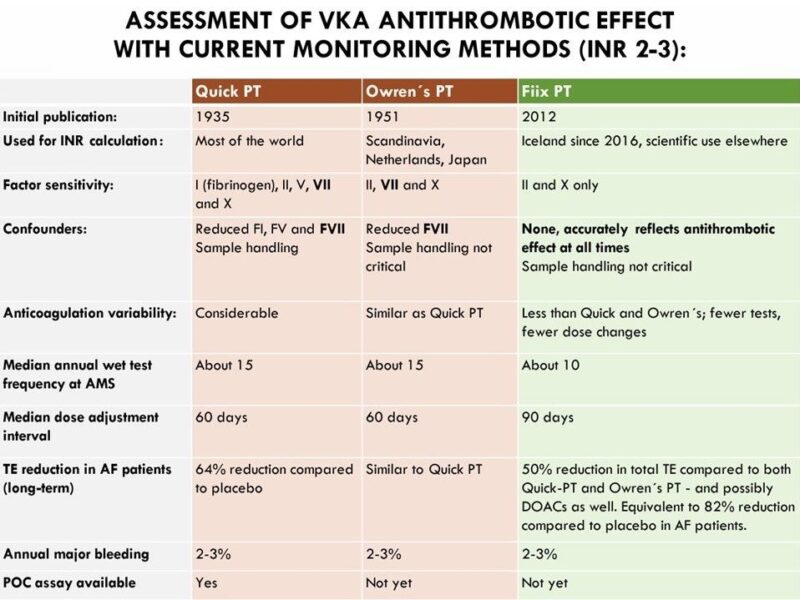
There are only historical reasons for using the old Quick-PT or the Owren´s PT to calculate a normalized ratio; these tests were developed prior to full understanding of coagulation and the antithrombotic effect of VKAs.
Do suboptimal tests cause erroneous tailoring of the dose and consequent suboptimal outcomes? Our 3 clinical studies have found better patient outcomes with Fiix (factor II and X only) monitored warfarin than with conventional PT-monitored warfarin – and suggestive evidence that Fiix-monitored warfarin is actually more effective than unmonitored DOAC drugs in non-valvular atrial fibrillation patients.
These data showing more effective and more convenient warfarin management using Fiix monitoring appears not to interest many. In particular not cardiologists and clinical scientists that have been supported by drug companies. Still the data supporting that factor VII should be ignored during VKA monitoring are there in peer reviewed journals, including in The Lancet Haematology 2015, Blood 2021 and Blood VTH 2025. These results have not been contested but remain ignored.
Is it possible that medical doctors prioritize convenience of prescription over effectiveness? Convenience for patients over less disability and death? How do patients and health authorities feel about that if true?”
Stay informed on the latest scientific developments in coagulation with Hemostasis Today.
-
Sep 24, 2026, 08:55Andres Gudino: Clot Characterization Through Hounsfield Units in Ischemic Stroke
-
Sep 24, 2026, 06:52Gina Sado: Screening-Detected Atrial Fibrillation Carries High Risk of Heart Failure
-
Sep 24, 2026, 06:33Benjamin Vipler: Optimal Oral Anticoagulation Choice in Atrial Fibrillation and Advanced CKD
-
Sep 24, 2026, 06:08Christopher Salerno: AI-Powered At-Home Anemia Screening Advances Telehealth Access
-
Sep 24, 2026, 05:38Aya Qattan: When a Normal CBC Does Not Mean Normal Iron Status
-
Sep 24, 2026, 05:11Mastering Warm Autoimmune Hemolytic Anemia Diagnosis and Practice – ASH Education
-
Sep 23, 2026, 16:04Monia Ezzalfani: Advancing Patient-Centered Care in Hemophilia A and B
-
Sep 23, 2026, 15:49Bilge Başak: How Activated PRP Modulates Osteoarthritic Chondrocyte Function
-
Sep 23, 2026, 14:50Mbonjo Bitsie Dora: Strengthening Sickle Cell Care Through Education, Awareness and Innovation