

William Wallace: Why Vitamin C Is the Only Reason Your Collagen Doesn’t Melt at Body Temperature
William Wallace, Co-Founder and Chief Scientific Officer at Supplement Success Solutions, shared a post on LinkedIn about an article by Matthew D. Shoulders and Ronald T. Raines, adding:
“Your body makes collagen constantly.
But the version it assembles first isn’t finished.
Before collagen can hold its shape, an enzyme has to modify specific amino acids in the chain.
That enzyme needs vitamin C to work.
Here’s what vitamin C actually does:
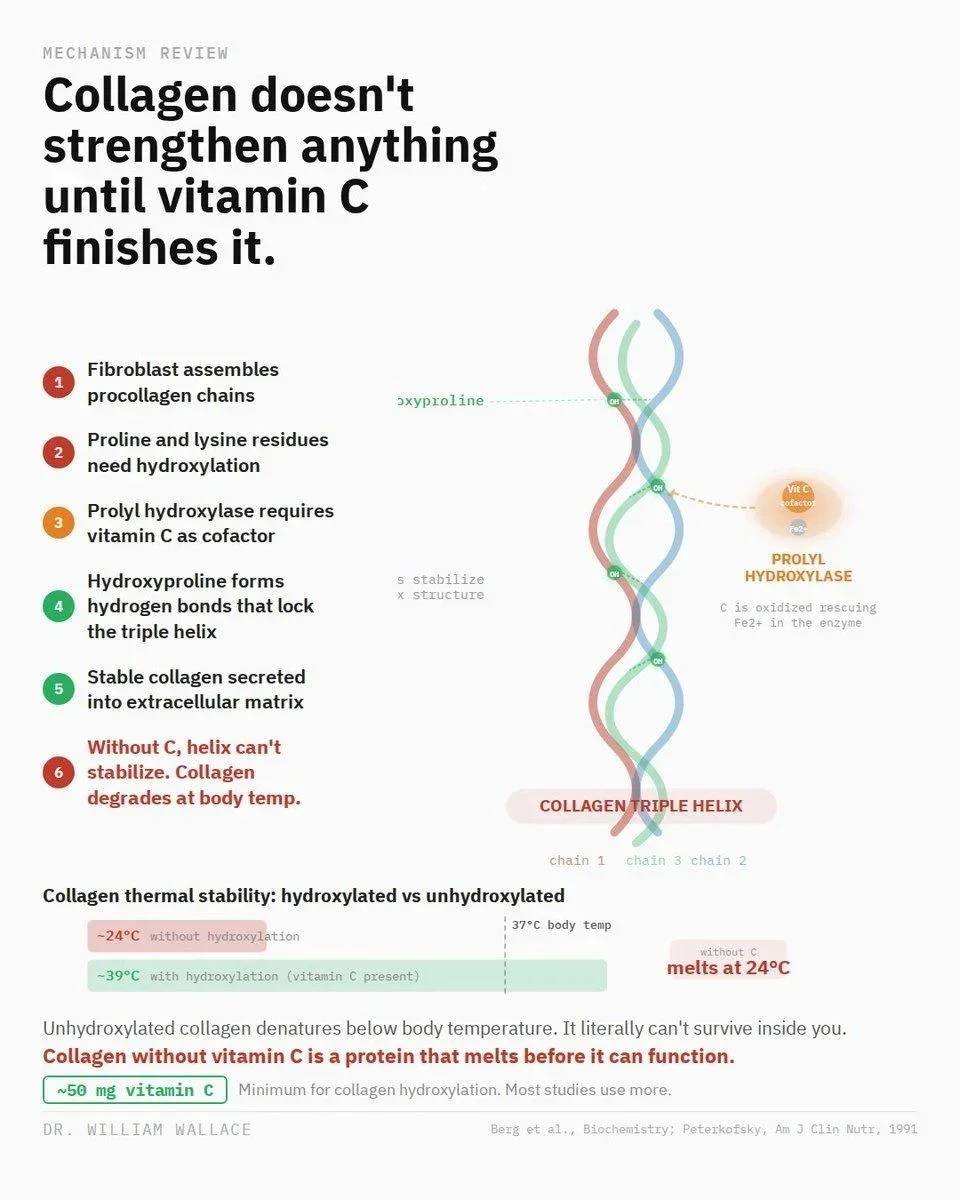
it enables the chemical modification (hydroxylation) that allows three collagen chains to lock together into a stable triple helix.
Without that modification, the collagen structure is so weak it falls apart below body temperature.
Literally.
Unhydroxylated collagen melts at about 24°C.
Your body runs at 37°C.
The only thing keeping your collagen intact at body temperature is the modification that vitamin C makes possible.
This is why scurvy causes bleeding gums, loose teeth, poor wound healing, and joint pain.
Your body is still making collagen.
It just can’t hold together.
Vitamin C isn’t recycled in this process.
It’s consumed each time.
Your supply has to be continuously replenished.
Most collagen supplement studies co-administer vitamin C.
The ones that don’t rarely account for baseline vitamin C status.
If you’re taking collagen without adequate C, you’re supplying the raw material without the tool that finishes it.”
Title: Collagen Structure and Stability
Authors: Matthew D. Shoulders, Ronald T. Raines
Find more posts featuring William Wallace on Hemostasis Today.
-
Sep 30, 2026, 01:52Javed Anees: DADA2 – When a Young Stroke Is More Than a Stroke
-
Sep 30, 2026, 01:51How a Venous Thrombus Becomes Revascularized – ISTH
-
Sep 29, 2026, 22:45Victor Agunyego: Paracetamol – The Most Common Drug We Underestimate
-
Sep 29, 2026, 22:42Nova Sinclair: Advancing the Future of Hematology – Meet Our 2027 Organizing Committee
-
Sep 29, 2026, 22:41Lorenz Räber: Intracoronary Imaging in PCI – Why, When, How, and Which Modality?
-
Sep 29, 2026, 22:31Selma Turkovic: Pleased to Deliver the Opening Presentation at Kingston Hospital
-
Sep 29, 2026, 22:31Miguel Teran: Ultrasound and Simulation in Arterial Blood Sampling
-
Sep 29, 2026, 22:28Mohammad Refaei: Navigating Your Career in Hematology From Training to Practice
-
Sep 29, 2026, 22:27Matteo Foschi: 10 Clinical Pearls for Antithrombotic Therapy in Secondary Stroke Prevention