


Sandeep De: Omicron COVID Infections Linked to Coronary Thrombosis without Detectable Plaque
Sandeep De, Former Senior Manager at OpenText, shared on LinkedIn about a recent article by Ming-Lian Gong and Yi Mao, published in Journal of Medical Case Reports, adding:
“Omicron COVID infections linked to coronary thrombosis without detectable plaque
Three patients infected during China’s Omicron wave developed acute myocardial infarctions caused by major coronary blood clots despite showing no obstructive atherosclerotic plaque on angiography.
Cases without plaque:
A case series published in the Journal of Medical Case Reports examined three Chinese patients treated after China abandoned its ‘dynamic zero-COVID’ policy in late 2022.
One patient, a previously healthy 33-year-old man, developed a massive clot in the left anterior descending artery days after testing positive for COVID-19.
Two elderly patients suffered far more severe complications, including cardiogenic shock, ventricular septal defect, and simultaneous venous thrombosis. All eventually survived following anticoagulant and antiplatelet treatment.
Inflammation and thrombosis:
The authors argue the cases reflect COVID-19’s pro-thrombotic effects rather than conventional plaque rupture associated with most heart attacks. The paper describes endothelial injury, platelet activation, cytokine release, and hypercoagulation as likely mechanisms driving spontaneous clot formation during infection.
One patient developed both coronary thrombosis and deep vein thrombosis simultaneously. SARS-CoV-2 continued treating the circulatory system as a full-service target while public messaging increasingly reduced the pandemic to individual risk management and office attendance policy.
Pandemic-era cardiac care:
The study also documents how pandemic conditions worsened cardiac outcomes. Delayed presentation, reduced access to PCI, prolonged emergency evaluation times, and infection-control procedures contributed to slower intervention during acute myocardial infarction cases.
One patient developed ventricular septal rupture after delayed treatment and required surgical repair with intra-aortic balloon pump support. Healthcare systems spent decades optimizing emergency cardiac response times before colliding with a virus capable of attacking both hospital capacity and vascular tissue simultaneously.
Limits of the study:
The authors acknowledge several limitations.
No IVUS, OCT, or cardiac MRI imaging was performed, meaning subtle plaque disease or myocarditis could not be fully excluded.
The report is also limited to three cases and cannot establish broader incidence rates.
The paper adds to a growing body of evidence showing that even the Omicron period widely described as ‘mild’ continued producing severe cardiovascular complications.
The administrative phase of the pandemic arrived well before the biological phase ended.”
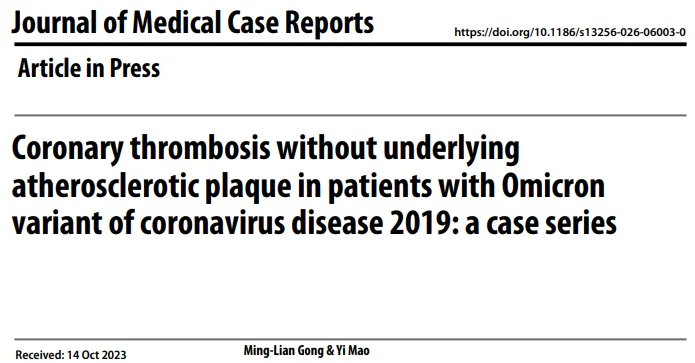
Title: Coronary thrombosis without underlying atherosclerotic plaque in patients with Omicron variant of coronavirus disease 2019: a case series
Authors: Ming-Lian Gong and Yi Mao
Stay updated on all scientific advances with Hemostasis Today.
-
Oct 5, 2026, 15:31Irma Bagdoniene: Multidisciplinary Management of High-Risk Familial Hypercholesterolaemia and CAD
-
Oct 5, 2026, 15:00Serena Williams and Pulmonary Embolism: From Personal Crisis to Lessons in Venous Thromboembolism
-
Oct 5, 2026, 14:55Marco Moscarelli: 3D Reconstruction Enhances Volumetric Assessment of Post-TAVI Thrombosis
-
Oct 5, 2026, 13:24Abdul Muqtadir Abbasi: Diagnostic Pearls for Evaluating Isolated Thrombocytopenia in Residents
-
Oct 5, 2026, 13:16Katerina Pavenski: Rethinking What ‘Normal’ Means for Iron Deficiency
-
Oct 5, 2026, 13:09Rick Matthews: Balancing Established VTE Partnerships with Innovative Interventional Technologies
-
Oct 5, 2026, 13:01Nawsherwan Mohammad: Recognizing TTP Before the ADAMTS13 Result Arrives
-
Oct 5, 2026, 12:51Bruno Pougault: The Hidden Challenges Behind Anti Xa Testing
-
Oct 5, 2026, 12:41Syed Huzaifa Khan: Rethinking CTRP12 as a Biomarker for In Stent Restenosis